
This guide covers how ChatGPT selects products to recommend, what sporting goods retailers must do to appear in those recommendations, and a practical action plan to get started.
Key Takeaways
- ChatGPT recommends products based on structured data quality, third-party presence, and customer reviews — not paid ads
- Retailers need schema markup and accurate product feeds to be machine-readable by AI systems
- Amazon, Google Shopping, and review platforms (such as Google Reviews or Trustpilot) directly shape ChatGPT visibility
- Blocking AI crawlers in robots.txt makes your store invisible to ChatGPT
- Visibility improvements can appear within 30–60 days of implementing structured data and product feeds
Why ChatGPT is Reshaping How Sporting Goods Shoppers Buy
Conversational AI is transforming how buyers research sporting goods purchases. Instead of typing "best fishing rod" into Google and clicking through ten articles, shoppers now ask ChatGPT, "What fishing rod should I buy for bass fishing under $150?" and receive immediate, personalized recommendations. 64% of U.S. teens report having used an AI chatbot, signaling a generational shift in how younger buyers approach product research.
For specialty sporting goods retailers, this shift creates both opportunity and urgency. Unlike big-box chains that compete on price and convenience, independent stores carry deep expertise and niche inventory — exactly what conversational AI excels at matching to specific buyer needs.
When a customer asks, "What tent should I buy for cold weather camping in the Rockies?" ChatGPT can surface a specialty retailer's 4-season mountaineering tent instead of a generic big-box option.
That opportunity is already being seized at scale. Major sporting goods retailers are moving aggressively into this channel. In January 2026, JD Sports announced one-click purchasing capabilities within ChatGPT, Microsoft Copilot, and Google Gemini, enabling seamless in-chat transactions for sports footwear and apparel. Analyst firm eMarketer projects the AI commerce market will reach $144 billion by 2029, while Gartner forecasts a 25% drop in traditional search engine volume by 2026 as users migrate to AI answer engines.

The window is narrow. ChatGPT product rankings are currently based on relevance alone — not paid placement. An independent sporting goods retailer with strong product data and solid reviews can outrank national chains right now, purely on data quality. As more retailers optimize for AI visibility, early movers will build the foundational presence that compounds over time.
How ChatGPT Selects and Recommends Sporting Goods Products
ChatGPT doesn't pull from a single product database. It cross-references multiple sources, weighing data quality and relevance to match products to the user's actual intent. For sporting goods — where most queries are activity-based ("best gear for fly fishing beginners") — that means matching products to specific use cases, not broad categories.
Primary Data Sources ChatGPT Uses
ChatGPT pulls sporting goods product data from six main source types:
- Structured product feeds and APIs — Direct merchant data in Parquet, JSONL, or CSV formats submitted via OpenAI's Agentic Commerce Protocol
- Crawled website content — Product pages indexed by OAI-SearchBot, OpenAI's web crawler
- Marketplace listings — Product data from platforms like Amazon (where accessible based on robots.txt policies)
- Price comparison engines — Google Shopping and Bing Shopping feeds
- Review platforms — Google Business Profile, Trustpilot, and niche sporting goods review sites
- Community discussions — Reddit forums (r/hiking, r/fishing, r/running) and specialty outdoor forums
Presence across multiple sources meaningfully increases recommendation probability. A product listed on your website, in Google Shopping, on Amazon, and mentioned positively in Reddit discussions carries far more weight than one appearing in a single location.
The Role of Customer Reviews
ChatGPT weighs customer ratings and review volume heavily when deciding which products to surface. For sporting goods — where buyer trust around safety, durability, and performance is critical — well-reviewed products on Google, Amazon, and niche platforms carry significant weight. Reviews that include specific use cases ("great boot for winter trail hiking") are especially valuable because they help AI match products to conversational queries about specific activities.
That review quality feeds directly into how ChatGPT ranks results — and those rankings are entirely organic.
Rankings Are Organic, Not Paid
According to official OpenAI documentation, "Product results are organic and unsponsored, ranked purely on relevance to the user." ChatGPT Shopping does not sell placement. This means an independent sporting goods retailer with accurate product data and strong reviews can outrank a national chain that has neglected its listings.
Enabling features like Instant Checkout does not boost general product rankings. However, when multiple merchants sell the exact same product, ChatGPT considers availability, price, and checkout convenience as tie-breaking factors.
Sporting Goods-Specific Considerations
Seasonal relevance matters. Retailers who keep inventory data current and accurate are more likely to receive recommendations during peak buying periods — hunting gear in fall, ski equipment in winter, fishing tackle in spring. Stale pricing or availability data can remove a product from AI consideration entirely.
Activity-based queries dominate sporting goods searches. Shoppers ask, "What running shoes are best for trail running on rocky terrain?" rather than "running shoes." Product descriptions and structured data must answer the implicit question: Who is this for and what does it help them do?
Optimizing Your Product Data for ChatGPT Recommendations
Complete, accurate, and structured product data is the single most important factor for ChatGPT visibility. For sporting goods, every product listing should include:
- Product name
- Full description covering material, dimensions, intended sport/activity, skill level, and use cases
- Current price and availability status
- Brand
- GTIN/SKU
- Aggregate customer rating
Without this structured data, AI systems cannot confidently match your products to user queries — even if the product is perfect for the customer's needs.
Sporting Goods Product Descriptions That AI Can Use
ChatGPT understands intent and use cases, not just keywords. Product descriptions should answer: "Who is this for and what does it help them do?"
Instead of: "30L waterproof backpack"
Write: "30L waterproof hiking backpack ideal for day hikes and light overnight trips, with padded shoulder straps and a rain cover included. Best for intermediate hikers covering 5-10 miles on maintained trails."
Structure descriptions for AI readability:
- Lead with a use-case summary (1-2 sentences defining ideal application and target user)
- Provide bulleted specifications (weight, material, dimensions, waterproof rating)
- Include pros and cons (helps AI generate balanced recommendations)
- Add FAQ content ("Is this suitable for saltwater fishing?" "What skill level is this climbing harness designed for?")
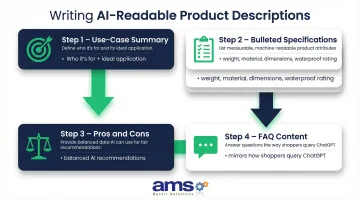
FAQ-style content directly mirrors how shoppers query ChatGPT. When a customer asks, "Can I use this fishing rod in saltwater?" and your product page already answers that question, the AI can confidently recommend your product.
Schema Markup: How to Signal Product Data to AI
Schema.org Product markup (implemented via JSON-LD) is the technical "information package" that communicates structured data directly to AI crawlers. This markup tells ChatGPT what your product is, how much it costs, whether it's in stock, and how customers rate it.
Essential schema fields for sporting goods:
- Product name — Clear, descriptive title
- Description — Full product description including use cases
- Price and priceCurrency — Current price in USD
- Availability — InStock, OutOfStock, PreOrder
- Brand — Manufacturer or brand name
- GTIN — Global Trade Item Number (UPC/EAN barcode)
- aggregateRating — Average rating and review count
Example JSON-LD markup:
{
  "@context": "https://schema.org/",
  "@type": "Product",
  "name": "TrailMaster Pro Hiking Boot",
  "description": "Waterproof hiking boot designed for technical terrain and multi-day backpacking trips. Features Gore-Tex lining, Vibram outsole, and reinforced ankle support.",
  "brand": "TrailMaster",
  "gtin": "012345678901",
  "offers": {
    "@type": "Offer",
    "price": "189.99",
    "priceCurrency": "USD",
    "availability": "https://schema.org/InStock"
  },
  "aggregateRating": {
    "@type": "AggregateRating",
    "ratingValue": "4.7",
    "reviewCount": "143"
  }
}
Verify implementation with Google's Rich Results Test to ensure markup is correctly formatted.
Why Data Consistency Across Channels Matters
Product data must stay synchronized across all channels. Inconsistent pricing or availability between your website, feeds, and marketplace listings reduces AI trust in your data. If your website shows a product in stock at $149 but your Google Shopping feed shows $179 and out of stock, ChatGPT may skip your listing entirely.
For sporting goods retailers using a POS system like NCR Voyix Counterpoint, real-time inventory and pricing synchronization supports the data consistency AI systems require. When a customer buys your last fly fishing rod in-store, your online inventory should update immediately — so AI is never recommending a product you can't deliver.
Building Third-Party Presence That AI Systems Trust
ChatGPT doesn't rely solely on your website. It cross-references third-party platforms to verify product credibility and retailer trustworthiness. The more consistently your products appear across those platforms with accurate information, the more likely ChatGPT is to recommend them.
Highest-Priority Platforms for Sporting Goods Retailers
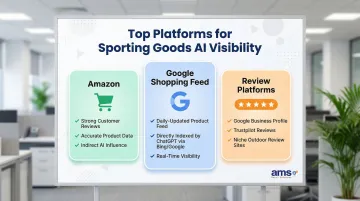
Three platforms carry the most influence for sporting goods retailers:
- Amazon — Despite blocking OpenAI's crawlers directly, products listed with strong reviews and accurate data still influence AI recommendations through indirect pathways and data partnerships.
- Google Shopping feed — Directly indexed by ChatGPT via Bing and Google. Submitting a daily-updated product feed to Google Merchant Center keeps your inventory visible to AI systems.
- Review platforms — Google Business Profile, Trustpilot, and niche sites like specialty outdoor gear review communities provide the trust signals ChatGPT uses to evaluate product quality. Category-specific platforms add credibility that general review sites can't replicate.
The Role of Community Content
ChatGPT pulls from Reddit discussions, outdoor forums, and YouTube review content. When users discuss products in communities like r/hiking, r/fishing, or r/running, those conversations contribute to AI brand recognition.
Genuine participation in these spaces matters more than promotional outreach. Answer questions, share expertise, and make sure product information is accurate wherever it appears. Community-driven discussions where real users recommend your products carry far more weight than brand self-promotion.
Review Generation Strategy
Review signals feed directly into how ChatGPT ranks recommendations — not just traditional SEO. For sporting goods, detailed reviews that mention specific use cases ("great boot for winter trail hiking," "perfect rod for bass fishing in shallow water") are especially valuable. They help AI match your products to highly specific conversational queries. Asking satisfied customers for feedback is one of the most direct ways to build that signal.
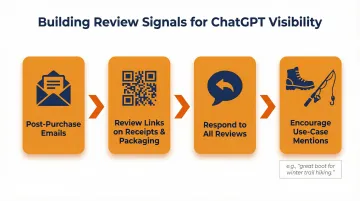
To generate quality reviews consistently:
- Send post-purchase follow-up emails asking for feedback
- Make review links easily accessible on receipts and packaging
- Respond to all reviews — positive and negative — to show engagement
- Encourage customers to mention specific use cases in their reviews
Technical Setup and Tracking for Sporting Goods Retailers
Crawler Access Essentials
ChatGPT uses OAI-SearchBot to crawl websites for product content. Retailers must ensure this bot is not blocked in their robots.txt file.
Check your robots.txt file (yourdomain.com/robots.txt) and ensure it includes:
User-agent: OAI-SearchBot
Disallow:
This allows OpenAI's search crawler to index your content. You can separately block GPTBot if you wish to prevent your content from being used for model training without affecting search visibility.
Additional technical requirements:
- Product content must be visible in standard HTML — pages that load details only through JavaScript may be partially invisible to AI crawlers
- Optimize for Bing Webmaster Tools, as ChatGPT draws heavily from Bing's index
- Ensure product pages load quickly and are mobile-responsive
Product Feed Requirements
Structured product feeds in XML or JSON format allow AI systems to ingest product data directly and accurately. Retailers who already submit feeds to Google Merchant Center should also submit to Bing Shopping.
Feed best practices:
- Update feeds daily (minimum) to ensure pricing and availability accuracy
- Include all required fields: ID, title, description, price, availability, link, image_link, brand, gtin
- Use recommended fields: additional_image_link, product_type, google_product_category
- Compress feeds using .gz format for faster processing
- Host feeds on a stable URL or use SFTP for automated updates
Both Google and Microsoft recommend daily feed updates as a best practice. Feeds expire after 30 days in Microsoft Merchant Center — so a stale feed means your products disappear from AI-driven results until the next submission.
Tracking ChatGPT-Driven Traffic
ChatGPT referral visits appear in Google Analytics as referral traffic from chatgpt.com, often including UTM parameters. According to OpenAI documentation, ChatGPT automatically appends utm_source=chatgpt.com to all referral links.
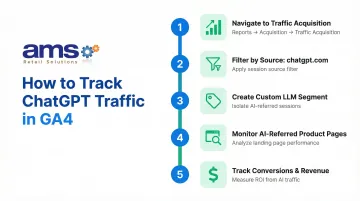
Set up tracking in Google Analytics 4:
- Navigate to Reports → Acquisition → Traffic Acquisition
- Filter by source: chatgpt.com
- Create a custom segment to isolate LLM-driven traffic
- Monitor which product pages receive AI-referred visitors
- Track conversion rates and revenue from ChatGPT traffic
Once you spot which products generate the most AI-referred conversions, prioritize those pages for deeper content optimization and structured data updates.
Frequently Asked Questions
How does ChatGPT decide which sporting goods products to recommend?
ChatGPT evaluates data quality, completeness, customer reviews, and presence across trusted third-party platforms — not paid advertising. Products with accurate structured data, strong review signals, and consistent information across multiple sources rank higher in AI recommendations.
Does my sporting goods store need a website to appear in ChatGPT results?
While a crawlable website with proper product data and schema markup significantly helps, stores can gain visibility through Amazon listings, Google Shopping feeds, and review platforms even without a fully optimized website. That said, hosting your product data on your own site lets you control updates, schema markup, and feed accuracy directly — without depending on third-party platform rules.
How is ChatGPT optimization different from regular SEO for sporting goods retailers?
Traditional SEO targets keyword rankings on Google. ChatGPT optimization focuses on structured product data, multi-platform credibility, and review signals that AI uses to generate conversational recommendations. SEO drives traffic to your site; AI optimization drives direct product mentions.
Should I list my products on Amazon to improve ChatGPT visibility?
Amazon listings carry significant weight in ChatGPT product recommendations, making it a high-priority platform for sporting goods retailers. However, Amazon should complement — not replace — an optimized retailer website and Google Shopping presence. Visibility across all three channels gives ChatGPT more data points to recommend your products.
How long does it take to see results from ChatGPT optimization?
Initial improvements in AI visibility can appear within 30-60 days of implementing structured data and feed submissions. Building review volume and third-party presence takes longer — most retailers see measurable traffic increases within 3-6 months.
Can a small local sporting goods store compete with big brands in ChatGPT recommendations?
Yes — because ChatGPT currently ranks based on data quality and reviews rather than advertising spend, well-optimized small retailers with strong local reviews and accurate product data can appear in AI recommendations alongside national chains. For independent stores, that means a well-maintained product feed and 50 solid reviews can outperform a national brand with poor data hygiene.