Introduction
Specialty retailers face a familiar set of pressures: serve customers faster, keep inventory accurate, and stay competitive without ballooning overhead. Long checkout lines during spring plant sales or holiday rushes drive customers away. Stockouts of popular feed blends or seasonal plants mean lost revenue. Manual inventory counts and spreadsheet reporting leave managers guessing instead of acting.
For garden centers, farm markets, pet supply stores, and similar businesses, these aren't abstract problems — they show up every busy Saturday.
Mobile POS is often positioned as a fix, but the real question is whether it delivers in practice. The answer, for specialty retail, is yes — in five specific, operational ways. Shorter checkout lines, fewer stockouts, stronger customer loyalty, and sharper data are all on the table. Here's what that looks like when product expertise, seasonal demand, and customer relationships are at the center of your business.
Key Takeaways
- A mobile POS (mPOS) system turns a tablet or smartphone into a full-featured point-of-sale terminal, usable anywhere on the sales floor or off-site
- Key benefits include faster checkout, real-time inventory tracking, lower setup costs, improved customer loyalty tools, and actionable sales reporting
- mPOS is especially valuable for specialty retailers managing large floor spaces, seasonal events, or multiple locations
- Retailers without mPOS face slower checkout lines, inventory blind spots, and fewer opportunities to build repeat business
- Solutions like NCR Voyix Counterpoint, offered through AMS Retail Solutions, include offline capability and 24/7 support to keep operations running
What Is a Mobile POS System?
A mobile POS system is a cloud-connected point-of-sale solution that runs on a tablet or smartphone, paired with a card reader, letting retailers process transactions and manage operations from anywhere — in-store or off-site. Unlike traditional fixed registers that anchor checkout to one spot, mPOS frees staff to serve customers wherever they are:
- On the retail floor, walking customers through product options
- At seasonal pop-up events and farm markets
- Across multi-location specialty stores with shared inventory
The global Mobile POS Terminals Market was valued at $40.2 billion in 2023 and is projected to reach $114.59 billion by 2031, growing at a compound annual growth rate of 20.26%. That growth signals something concrete: retailers are rethinking where and how checkout happens.
For specialty retailers, this matters more than most. When your floor space is filled with bulky products — bags of feed, flats of plants, aquariums — completing a sale where the customer stands eliminates friction and speeds throughput during critical seasonal peaks. The payoff is flexibility, speed, and control: outcomes that directly affect both profitability and customer satisfaction.
5 Key Benefits of Mobile POS for Specialty Retailers
The five benefits below are grounded in measurable, operational impact — not abstract capabilities — and are particularly relevant to specialty retail environments where floor space, seasonality, and customer service are critical.
Benefit 1: Faster, More Flexible Checkout
Mobile POS untethers transactions from a fixed register, allowing staff to check out customers anywhere on the floor — reducing queue buildup and eliminating the friction of customers walking to a single checkout point with heavy bags of soil, feed, or pet supplies.
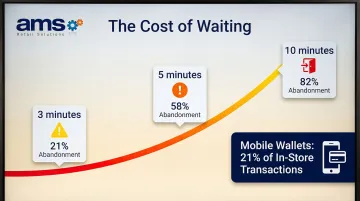
Real-world impact: Associates can complete sales while customers are still browsing, prevent cart abandonment at peak hours, and process contactless payments, chip cards, and mobile wallets without delay. Research shows that customer abandonment risk increases sharply with wait time: after 3 minutes of no progress, 21% of customers are likely to leave; after 5 minutes, this jumps to 58%; and after 10 minutes, 82% will abandon their purchase.
For specialty retailers, this data is critical. During spring plant sales or holiday rushes, every minute a customer waits represents exponential abandonment risk. Mobile POS enables line-busting — staff armed with tablets can process transactions for customers standing in the garden center aisle, eliminating the need to navigate a cart full of mulch bags back through the store to a fixed register.
Mobile wallets now account for approximately 21% of all in-store transactions across 11 countries, an 11% increase since 2022. Contactless payment infrastructure is nearly ubiquitous, with over 96% of global transactions now EMV Chip-based — meaning mPOS systems equipped with contactless readers can process payments as quickly as fixed terminals.
KPIs impacted and when it matters most: Transaction time, queue length, sales per hour. Impact is highest during seasonal peaks — spring plant sales, fall feed stock-ups, holiday pet supply rushes — when staffing and speed are critical for specialty retailers.
Benefit 2: Real-Time Inventory Visibility and Control
Mobile POS systems update inventory counts automatically with every transaction, giving staff and managers a live view of stock levels from anywhere — on the sales floor, in the back room, or remotely. This eliminates the data lag built into batch-update systems and end-of-day manual counts.
Operational benefit: Staff can answer customer questions about stock availability on the spot. A customer asks if you have more 50-pound bags of a specific chicken feed blend — the associate checks the tablet and knows immediately whether to pull from the back or offer an alternative. Managers can catch low-stock alerts before a product runs out, and shrinkage is harder to hide when counts are reconciled in real time.
The financial stakes are enormous. Inventory shrink cost U.S. retailers $112.1 billion in 2022, representing a 1.6% shrink rate. Globally, inventory distortion — a combination of out-of-stocks and overstocks — was estimated to cost retailers $1.77 trillion in 2023, with $1.2 trillion from stockouts alone.
Real-time inventory systems, often enabled by mPOS processes, directly combat this. Technologies like item-level RFID can increase inventory accuracy from an average of 63% to over 95%, leading to a reduction in out-of-stocks by up to 50%. For specialty retailers managing seasonal or perishable products — live plants, feed with expiration dates, seasonal décor — this accuracy means fewer lost sales and less waste from overstocking.
KPIs impacted and when it matters most: Inventory shrink rate, stockout frequency, reorder accuracy. Most critical for seasonal or perishable product categories common to garden centers, farm markets, and feed stores where a missed sales window means both lost revenue and costly markdowns.
Benefit 3: Reduced Setup Costs and Lower Operational Overhead
Mobile POS systems reduce the hardware investment required compared to traditional fixed-terminal setups. A tablet and card reader can replace expensive proprietary terminals, and cloud-based software eliminates the need for on-site servers and complex cabling to fixed checkout counters.
How this creates ongoing savings:
- Consumer-grade tablets cost a fraction of proprietary POS terminals, lowering upfront hardware spend
- Standard devices carry fewer maintenance contracts and are cheaper to service or replace
- Additional terminals can be added during peak seasons without major capital outlay
- Wi-Fi networking costs less to deploy than running dedicated Ethernet to every checkout counter
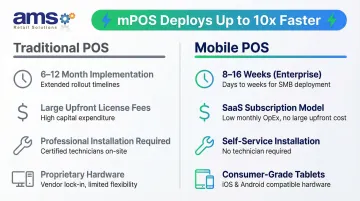
While precise dollar-for-dollar comparisons are often paywalled, the cost drivers reveal clear advantages. Traditional POS systems historically involved large, one-time perpetual license fees with ongoing annual maintenance contracts, plus professional installation for cabling and system integration. Modern mPOS systems operate on predictable SaaS subscription models, shift costs from capital expense to operational expense, and often enable self-service installation.
A 2025 market study by the IHL Group notes that enterprise-level POS implementation timelines have contracted from 6–12 month timelines for traditional systems to 8–16 weeks for modern, cloud-based platforms. For small and medium-sized businesses, mPOS deployment can happen in days to a few weeks — a timeline virtually unachievable with traditional systems.
KPIs impacted and when it matters most: Capital expenditure, IT maintenance costs, cost per transaction terminal. Most valuable for businesses with tight margins or those adding locations or seasonal pop-up sales points like farmers markets or holiday garden sales.
Benefit 4: Stronger Customer Loyalty and Personalized Service
Mobile POS systems can capture and store customer purchase history, preferences, and contact information at the point of sale — enabling staff to deliver personalized service and enroll customers in loyalty programs during checkout rather than after. This transforms the POS from a simple transaction tool into the nerve center of customer relationship management.
How this creates a loyalty loop: Customers earn rewards on transactions, staff can view purchase history to make relevant product recommendations (suggesting a new aquarium filter to a customer who bought a tank three months ago), and managers can segment customers for targeted promotions — all from the same system.
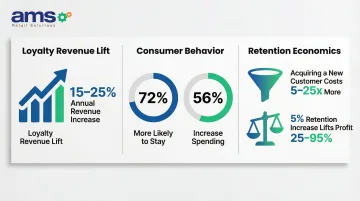
The financial impact is substantial. Top-performing loyalty programs boost revenue by 15% to 25% annually from customers who redeem points.
A 2025 Deloitte survey found that 72% of consumers are more likely to continue spending with a brand because of its loyalty program — and 56% actively increase their spending to maximize program benefits.
For specialty retailers, the value multiplier is even higher. Petco found that an omnichannel loyalty customer — whose journey is unified by modern POS systems — spends five times more than a single-channel customer. This holds true across specialty retail: replenishment cycles and expert recommendations naturally drive return visits.
A pet owner needs food every month. A gardener returns seasonally for plants, soil, and amendments. A farmer restocks feed on a regular schedule. Loyalty tools built into mPOS make it easier to keep each of them coming back.
Retention economics reinforce this strategy. Acquiring a new customer costs five to 25 times more than keeping an existing one. A 5% increase in retention rates can lift profits by 25% to 95%.
KPIs impacted and when it matters most: Customer retention rate, repeat visit frequency, average order value. Especially powerful for specialty retailers where product replenishment cycles and expert recommendations drive return visits.
Benefit 5: Actionable Reporting and Smarter Business Decisions
Mobile POS systems generate detailed sales reports in real time — tracking top-selling products, slow-moving inventory, peak sales hours, and staff performance — accessible from any device, even when the owner is off-site. Owners stop guessing and start making purchasing, staffing, and inventory decisions based on what's actually happening in the store.
How these insights enable proactive decision-making:
- Identify trends before they become problems (a popular plant variety is selling faster than expected — reorder now, not after stockout)
- Optimize purchasing based on actual movement data rather than gut feel
- Align staffing with high-volume windows (schedule more associates on Saturday mornings when sales data shows peak traffic)
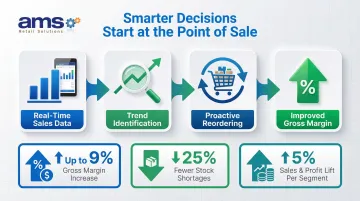
A controlled pilot by McKinsey, Toshiba, and NVIDIA using an AI-powered platform to adjust promotions in real time resulted in an average 5% lift in both sales and profit per targeted segment.
McKinsey also reports that integrating personalization with loyalty and pricing strategies can deliver a 2 to 4 percentage point improvement on gross margin dollars.
On the inventory front, the impact is significant. Real-time inventory systems directly combat the nearly $1 trillion in controllable inventory distortion losses. Retailers implementing advanced planning and real-time inventory systems have achieved up to a 9% increase in gross margins and a 25% reduction in stock shortages.
For specialty retailers managing broad, seasonal product catalogs — where buying too much means costly end-of-season markdowns and buying too little means lost sales — accurate reporting closes the gap between what you ordered and what you should have.
KPIs impacted and when it matters most: Gross margin, inventory turnover, labor efficiency. High-value for multi-location specialty retailers or businesses with broad, seasonal product catalogs where guesswork in buying can directly erode profitability.
What Happens When Mobile POS Is Missing or Ignored
Staying on legacy or fixed-register-only systems carries real operational costs. Staff are tied to one checkout point, lines build during peak hours, and customers who can't get served quickly leave — or don't return. Research shows that customers who are last in a queue are more than three times more likely to abandon the purchase entirely compared to those with even one person behind them.
That bottleneck at the register doesn't stay front-of-house for long — it ripples into inventory and reporting too. Inventory and reporting consequences: Without real-time sync, shrinkage goes undetected, reordering is reactive rather than data-driven, and managers lack the visibility to course-correct before small problems compound. A 2025 report from RSR Research found that 33% of specialty retailers state their current POS system is actively holding them back from offering real-time inventory visibility and personalized checkout experiences.
Seasonal and specialty retailers are disproportionately affected. Seasonal categories experienced a $216.1 billion increase in inventory distortion from 2020 to 2022, accounting for 96% of the total growth in distortion during that period. For garden centers heading into spring rush, farm markets managing harvest season, or feed stores stocking ahead of planting cycles, missing that window means both lost full-price sales and costly overstock once the season passes.
Competitive risk: Specialty retailers still running fixed-only registers give up ground to competitors who can check out customers anywhere on the floor, pull up loyalty accounts instantly, and reorder before a stockout happens — not after.
How to Get the Most Value from Your Mobile POS System
mPOS delivers the most value when it is fully integrated — connected to inventory, customer data, and reporting rather than functioning only as a standalone payment tool. The system should be your operational hub, not just a checkout device.
Best practices for maximizing value:
- Review reports weekly: Sales trends, inventory alerts, and customer data should drive actual business decisions, not collect dust in a dashboard
- Act on inventory alerts promptly: Real-time data only creates value when you respond to it
- Use loyalty data to drive promotions: Segment customers based on purchase history and create targeted campaigns that drive return visits
- Train staff thoroughly: Mobile checkout is only faster if associates are confident and proficient with the system
For specialty retailers looking for a single-source solution, AMS Retail Solutions offers NCR Voyix Counterpoint — a retail management platform built for specialty retail. It supports mobile functionality, offline capability (so sales continue even when connectivity drops), and the scalability to grow from one store to many.
Purpose-built features for specialty verticals include:
- Custom feed blend creation and scale integration for weight-based selling
- Delivery scheduling and customer-specific pricing
- Seasonal inventory management
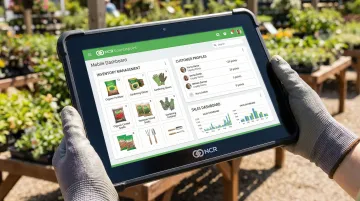
When something goes wrong during a Saturday rush or a seasonal peak, 24/7 support means help is a call away — any time, any day. The team invests time upfront to understand how your business operates, so the guidance you get is specific to your situation, not generic troubleshooting.
Conclusion
A mobile POS system earns its place through compounding operational gains that build on each other over time:
- Faster service keeps customers from walking away mid-purchase
- Real-time inventory prevents stockouts and reduces costly overstock markdowns
- Transaction reporting turns daily sales data into smarter buying, staffing, and promotional decisions
For specialty retailers — where product expertise, seasonal demand, and customer relationships define the business — mobile POS is the operational backbone that keeps the whole business running smoothly.
Frequently Asked Questions
What is a mobile point-of-sale (mPOS) system?
A mobile POS system is a cloud-connected POS solution running on a smartphone or tablet, paired with a card reader, that allows businesses to process payments and manage sales operations from anywhere — on the floor, at events, or across multiple locations.
How do mobile POS (mPOS) systems work?
An mPOS system runs through a downloaded app on a mobile device paired with a card reader. Transactions process over Wi-Fi or cellular data, with inventory and sales data syncing to the cloud in real time. Some systems, like NCR Voyix Counterpoint, also include offline mode for uninterrupted operation.
What are the benefits of using mobile POS (mPOS) in the retail industry?
Key retail benefits include:
- Faster, more flexible checkout anywhere in the store
- Real-time inventory tracking across locations
- Lower hardware costs compared to fixed terminals
- Built-in customer loyalty tools
- Data-driven reporting to improve profitability
What are the advantages of mobile point-of-sale (mPOS) systems over traditional POS?
Compared to traditional POS, mPOS systems give staff the freedom to move rather than staying fixed to one register. They also require lower upfront hardware investment, deploy faster, and scale easily — adding a new device costs far less than purchasing an additional terminal.
Which POS system is best for retail?
It depends on your business type and scale. Specialty retailers — garden centers, farm markets, pet supply stores — often benefit most from a purpose-built solution. NCR Voyix Counterpoint, available through AMS Retail Solutions, is built specifically for this segment with offline capability and single-source support.
Can I use my mobile phone as a POS (point-of-sale) machine?
Yes, most modern mPOS software runs on iOS and Android smartphones. A small card reader attachment or Tap to Pay capability enables in-person payment acceptance, turning a standard phone into a functional POS terminal with minimal additional hardware.