Introduction
Retail competition has intensified dramatically. Consumers have more choices, shorter patience at checkout, and higher expectations for personalization—creating real operational pressure on store owners to do more with less. 41% of consumers have abandoned a purchase due to long lines, and manual processes contribute to checkout error rates exceeding 20% in some inspections, directly impacting profitability.
Many retailers still treat their POS system as just a cash register, missing the compounding value it delivers across inventory, staffing, customer loyalty, and profitability. This article breaks down five practical advantages of a POS system in retail, grounded in what actually changes day-to-day when the right system is in place.
Key Takeaways
- A modern retail POS system handles far more than payments: real-time inventory, sales reporting, and customer loyalty tools in one place
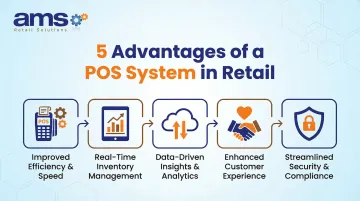
- Five core advantages — faster checkout, inventory accuracy, sales insights, better customer experience, and lower labor costs — each tied to measurable retail outcomes
- Specialty retailers gain the most: seasonal complexity and varied inventory make manual processes especially expensive
- Specialty retailers see outsized returns because their inventory complexity and seasonal demand make manual processes especially costly
What Is a POS System?
A POS (point-of-sale) system is the combined hardware and software that processes customer transactions and, in modern retail, also manages inventory, customer data, sales reporting, and staff activity from a single platform. Modern retail POS platforms connect every customer transaction to inventory counts, purchase histories, and business performance data in real time.
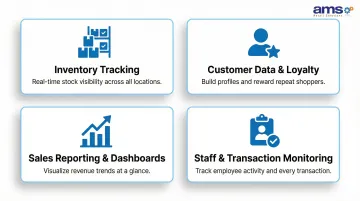
For specialty retailers managing complex SKUs, seasonal demand, and lean teams, that real-time visibility translates directly into better decisions and tighter operations. A well-configured POS handles:
- Inventory tracking across all product categories
- Customer purchase histories and loyalty data
- Sales reporting and business performance dashboards
- Staff activity and transaction monitoring
That combination of functions is what separates a modern POS from the cash registers of an earlier era.
5 Key Advantages of a POS System in Retail
The five advantages below focus on measurable, operational outcomes—not theoretical feature lists—and are especially relevant for specialty retailers managing complex SKUs, seasonal demand, and lean teams.
Advantage 1: Faster, More Accurate Checkout
A POS system replaces manual price lookups, cash drawer math, and handwritten receipts with barcode scanning, automatic tax calculation, and multi-tender payment processing. The result: a faster, cleaner path from scan to sale.
This creates real-world impact:
- Faster lines reduce abandoned purchases — 29% of shoppers abandon purchases due to long checkout lines, representing direct revenue loss
- Fewer pricing errors — Manual systems produce overcharge error rates as high as 16% in government inspections, hurting margin and requiring costly corrections
- Multiple payment options eliminate friction — With over 75% of Mastercard transactions now contactless and 82% of shoppers using digital payments, accepting modern payment methods is no longer optional
KPIs impacted: Average transaction time, checkout error rate, payment acceptance rate, customer satisfaction scores
When this advantage matters most: High-traffic periods like weekends, holidays, or seasonal peaks (spring planting season for garden centers) where even a 30-second reduction per transaction significantly increases throughput.
Advantage 2: Real-Time Inventory Management
A POS system updates inventory counts automatically with every sale, return, or exchange—giving retailers a live view of what is in stock, what is running low, and what is overstocked, without manual counting.
Automated reorder triggers (set at defined stock thresholds) eliminate the reactive scramble of emergency restocking and reduce both stockouts and excess inventory that ties up capital—particularly impactful for specialty retailers managing seasonal or perishable goods.
Why this is an advantage:
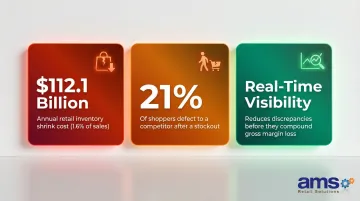
- Inventory shrink is one of the largest controllable cost drivers — Retail inventory shrink costs the industry $112.1 billion annually (1.6% of sales); real-time tracking makes discrepancies visible before they compound
- Stockouts cost both the immediate sale and customer loyalty — 21% of shoppers defect to a competitor after encountering a stockout
- Inventory visibility directly impacts gross margin — Over-ordering reduces profitability, while stockouts cost sales
KPIs impacted: Inventory shrink rate, carrying cost, stockout frequency, gross margin, days-on-hand by SKU
When this advantage matters most: Retailers with high SKU counts, seasonal assortments, or perishable items (garden centers, farm markets, feed and seed stores) where manual tracking fails under volume and complexity. Solutions like NCR Voyix Counterpoint, used by specialty retailers through providers like AMS Retail Solutions, are purpose-built for exactly this environment.
Advantage 3: Data-Driven Sales Reporting and Analytics
A retail POS captures every transaction and surfaces it as structured data—sales by item, category, time of day, staff member, or promotion—giving owners the reporting they need to make decisions based on what is actually happening, not guesswork.
This shifts retailer behavior from reactive (noticing an empty shelf) to proactive (identifying slow-moving SKUs before they become write-offs, or spotting peak hours to optimize staffing in advance).
Why this is an advantage:
- Data-driven decisions improve margins — McKinsey research shows analytics can increase retail margins by 1.2 to 1.9 percentage points
- Sales analytics inform labor planning — Understanding peak transaction windows allows owners to schedule staff more efficiently, reducing overtime and idle labor costs simultaneously
- Pricing and promotion decisions become strategic — Discounting slow movers before they expire or doubling inventory on top sellers before peak season improves cash flow
KPIs impacted: Sell-through rate, average transaction value, promotional ROI, labor cost as a percentage of sales, gross margin by category
When this advantage matters most: Retailers experiencing seasonal demand swings, expanding their product assortment, or trying to improve margin without growing headcount—exactly the situation most specialty retailers face year-round.
Advantage 4: Improved Customer Experience and Loyalty
A POS system improves the customer experience at every touchpoint: faster checkout reduces frustration, multiple payment options (card, contactless, digital wallets) eliminate friction, and stored purchase history enables personalized service and targeted promotions.
Integrated loyalty programs—where points are tracked and rewards applied automatically at checkout—do this without requiring separate systems or manual record-keeping, converting one-time buyers into regulars.
The loyalty advantage is measurable:
- A 5% increase in customer retention can boost profits by up to 95%, according to Bain & Company
- Consumers enrolled in loyalty programs are 72% more likely to spend and increase their spending by 56% over time
KPIs impacted: Customer retention rate, repeat purchase frequency, loyalty program enrollment, average order value, net promoter score
When this advantage matters most: Specialty retailers where relationship and expertise drive repeat visits—pet supply stores, garden centers, and outdoor sporting goods shops—where personalized recommendations and remembered preferences are a genuine competitive differentiator.
Advantage 5: Leaner Operations and Lower Labor Costs
A POS system reduces the manual administrative burden on staff—automating end-of-day reconciliation, inventory counts, purchase order generation, and reporting tasks that otherwise require dedicated labor hours.
This frees employees to focus on floor service and customer interaction rather than back-office tasks, and user-friendly POS interfaces reduce the time needed to train new hires—a significant benefit for retailers with seasonal staffing needs.
The operational impact is significant:
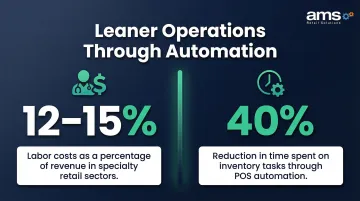
- Labor costs constitute 12-15% of revenue in specialty retail sectors like nursery and garden centers
- Automation can reduce time spent on inventory tasks by up to 40%, directly addressing rising unit labor costs
KPIs impacted: Labor cost as a percentage of sales, hours spent on administrative tasks, training time for new staff, transaction-per-employee rate
When this advantage matters most: Small and mid-sized specialty retailers operating with lean teams where each staff hour has high opportunity cost, and during seasonal hiring surges when rapid onboarding is critical.
What Happens When You Operate Without a POS System
Running a specialty retail store without a POS system means small problems quietly become expensive ones. Here's where the damage shows up:
Inventory errors go undetected — Shrink accumulates, stockouts hit without warning, and over-purchasing drains cash before you see it coming. Manual counts are often 60% inaccurate, and correcting that data alone can unlock a 4–11% sales uplift.
Promotions and pricing become guesswork — Without sales data, responding to demand shifts or competitive pressure takes too long to matter. Slow movers sit until expiration; top sellers run out before peak season.
Manual processes cap your growth — A second location, more SKUs, or a busy season can push a manual operation past its limit. Without a centralized system, scaling isn't just difficult — it often isn't possible.
How to Get the Most Value from Your Retail POS System
A POS system delivers compounding value only when configured correctly for the specific retail environment—meaning item data, reorder points, customer fields, and reporting dashboards are set up to reflect how that business actually operates, not just installed with default settings.
Consistent use across all transactions — returns, exchanges, and vendor receipts — keeps your data clean enough to act on. A POS is only as useful as the accuracy of the information flowing through it.
This is where working with an implementation partner matters. AMS Retail Solutions offers 24/7 support and hands-on setup guidance so retailers aren't left configuring the system alone or troubleshooting problems mid-season.
Review POS reports at least weekly and act on what you find:
- Adjust reorder points as seasons shift
- Update pricing based on margin data
- Use customer purchase history to time promotions around actual buying patterns rather than the calendar alone
Frequently Asked Questions
What are the benefits of a POS system for retail businesses?
A modern POS system delivers faster checkout, real-time inventory tracking, sales analytics, improved customer loyalty, and reduced labor costs. Together, these capabilities improve both efficiency and profitability across day-to-day operations.
Is a retail POS system worth the investment?
Reduced inventory shrink, lower labor costs, fewer pricing errors, and improved customer retention typically offset the system cost within the first year. The right system also scales as the business grows, protecting the initial investment over time.
What is the best POS system for retail stores?
The best POS depends on the specific retail type. Specialty retailers — garden centers, feed stores, pet supply shops — benefit most from purpose-built solutions like NCR Voyix Counterpoint, which offer strong inventory management, offline capability, and industry-specific reporting that generic platforms often lack.
Are there retail POS systems with no monthly fees?
Some POS systems offer one-time licensing models or free base tiers, but evaluate total cost of ownership including hardware, support, and feature access. Lower upfront costs sometimes mean limited inventory or reporting capabilities that matter most to specialty retailers.
How does a POS system help reduce inventory shrink?
Real-time tracking surfaces inventory discrepancies as soon as they occur. Automated reorder points reduce human error in restocking, and transaction-level data helps identify theft patterns or vendor shortfalls before losses compound.
Can a POS system work without an internet connection?
Modern retail POS systems—including solutions built on platforms like NCR Voyix Counterpoint—offer offline functionality that keeps transactions processing during connectivity outages, with automatic data syncing once the connection is restored. This is essential for retailers in areas with unreliable connectivity.