Introduction
Specialty retailers face a unique challenge: customers now expect to shop in-store, online, and across multiple locations—and they demand a seamless experience every time. Yet many businesses struggle with the wrong POS software, creating data silos that prevent inventory visibility, pricing errors that confuse customers, and fulfillment mistakes that cost sales. According to industry research, inventory distortion from stockouts and overstocks costs the global retail industry $1.77 trillion annually, with much of this loss stemming from disconnected systems that can't track stock across channels in real time.
For garden centers managing seasonal plant inventory, pet supply stores juggling products and grooming appointments, or sporting goods retailers tracking serialized equipment, a generic POS won't handle the complexity. Specialty retail demands purpose-built tools.
This article covers the essential POS software features that make true multi-channel retail management possible: unified inventory, flexible checkout, customer loyalty, and real-time reporting. Understanding these capabilities will help you choose a system that grows with your business.
Key Takeaways
- Multi-channel POS software unifies in-store, online, and multi-location operations into one centralized system
- Look for real-time inventory sync, flexible fulfillment, integrated CRM and loyalty programs, and secure payment processing across every channel
- Offline capability keeps sales running at outdoor markets, farm stands, and remote locations without network connectivity
- The right system scales from one register to multiple stores without requiring separate platforms or vendor relationships
- Specialty retailers benefit most from industry-specific solutions built around complex inventory, seasonal demand, and the workflows unique to their business
What Is Multi-Channel POS Software?
Multi-channel POS software lets retailers sell across multiple channels—a physical storefront, an eCommerce site, additional locations—from one centralized platform. Unlike single-channel systems that treat each location as its own silo, a multi-channel POS synchronizes inventory, customer data, pricing, and sales information in real time across every touchpoint.
That integration is what separates it from a basic POS. A standard system records transactions at one register. A multi-channel POS connects every register, location, and online storefront—so when a customer buys online, in-store inventory adjusts instantly. Staff at any location can check stock across all other locations in real time.
Multi-Channel vs. Omnichannel: Understanding the Distinction
These terms get used interchangeably, but the distinction matters. Multi-channel means selling across several channels—you have a physical store, a website, and perhaps a seasonal pop-up. Omnichannel means those channels are fully integrated so the customer journey is seamless regardless of where or how they shop.
An omnichannel POS provides a single, shared, real-time view of customer and inventory data across all touchpoints. This enables experiences like buy-online-pick-up-in-store (BOPIS), which one-third of U.S. online adults now use regularly, and ship-from-store fulfillment that turns your retail locations into mini distribution centers. For specialty retailers—garden centers, farm markets, pet supply stores—this means a customer can check availability online, reserve an item, and pick it up in-store without any friction on your end or theirs.
Unified Inventory Management Across All Channels
Centralized inventory management is the backbone of any effective multi-channel POS. When inventory data is separated by channel or location, overselling, stockouts, and fulfillment errors follow quickly. Research shows that 75% of shoppers consider online visibility into in-store product availability important, yet many retailers still operate with disconnected systems that can't deliver this transparency.
A unified system updates stock levels in real time across every channel the moment a transaction occurs. When a customer purchases an item online, your in-store inventory adjusts immediately. When staff sells the last unit at Location A, your eCommerce site stops showing it as available—instantly.
That synchronization prevents overselling, where customers order products you don't actually have in stock. Left unchecked, it leads to cancellation rates of 34% and an average cost of $67 per cancelled order.
Inter-Store and Inter-Channel Inventory Visibility
True multi-channel inventory management provides complete visibility into what's available at each location or warehouse. Staff can locate items for customers, fulfill online orders from store stock, or initiate store-to-store transfers without manual reconciliation or phone calls between locations.
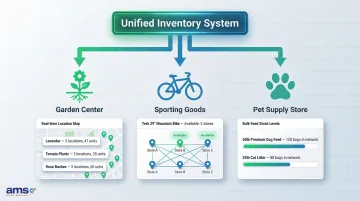
This capability is particularly valuable for specialty retailers with seasonal inventory or high SKU counts. Consider a few practical examples:
- A garden center can pinpoint which location has specific plant varieties during peak spring season
- A sporting goods shop can track a particular bike model and size across its entire network
- A pet supply store can check bulk feed availability across multiple locations to fulfill a large order
Purchase Order and Replenishment Automation
A well-integrated POS tracks reorder points, generates purchase orders, and helps buyers stay ahead of demand—particularly valuable for seasonal specialty retailers like garden centers or farm markets with fluctuating inventory cycles. The system can identify when products approach minimum stock levels and automatically alert purchasing staff or generate suggested orders based on historical sales patterns and lead times.
For specialty retailers managing seasonal demand spikes, this automation prevents both stockouts during peak periods and overstock at season's end. Garden centers can configure season-aware reorder points that adjust for spring rushes, while feed stores can manage bulk purchasing cycles aligned with agricultural seasons.
Tracking by Product Variant, SKU, and Category
Specialty retailers need sophisticated tracking capabilities beyond basic SKU management. The right POS tracks items by:
- Size, color, and style variants for apparel and accessories
- Weight and unit of measure for bulk products sold by the pound or container
- Serialized tracking for high-value equipment — bikes, skis, boats
- Product attributes like plant size, pot type, or feed formulation
This granular tracking prevents SKU explosion—where every minor variant requires a separate SKU—while maintaining the detail needed for accurate inventory management and customer service.
Offline Inventory Capability for Specialty Retailers
When a POS can continue recording transactions and tracking inventory without a live network connection, operations continue uninterrupted at outdoor events, seasonal pop-ups, or farm markets. Once connectivity is restored, data syncs automatically to the central system.
This offline capability is a unique differentiator worth prioritizing for specialty retailers who sell in environments where reliable internet isn't guaranteed. Solutions like NCR Voyix Counterpoint, offered by AMS Retail Solutions, support offline POS capability specifically to keep operations running without interruption—whether you're selling plants at an outdoor nursery yard, feed at a rural farm market, or sporting goods at a trade show.
Omnichannel Selling and Checkout Features
Unified Pricing and Promotions Management
A multi-channel POS ensures the same prices, discounts, and promotions are reflected across all channels simultaneously. When you create a promotion, it pushes to your physical stores, online storefront, and mobile selling locations at once, preventing customer confusion and revenue leakage when in-store and online prices don't match.
Shoppers who see one price online and a different price at the register lose trust fast — and that trust is hard to rebuild.
Flexible Fulfillment Options
Omnichannel POS enables the fulfillment flexibility customers now expect:
- Buy online, pick up in-store (BOPIS) reduces shipping costs and drives foot traffic
- Ship from store turns retail locations into fulfillment centers, reducing delivery times
- Buy in-store, deliver to home accommodates large purchases customers can't transport themselves
- Reserve online, try in-store lets customers secure inventory before visiting
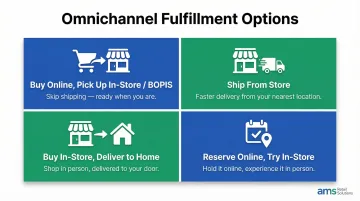
These options require real-time inventory visibility and order management to execute reliably. Without synchronized data, you risk promising products you can't deliver or missing sales opportunities because customers can't see what's actually available.
Fast and Flexible Checkout Tools
Modern checkout features speed up transactions and keep lines moving:
- Touch-screen terminals with intuitive interfaces that minimize training time
- Barcode scanning for rapid product lookup and accurate pricing
- Mobile POS for floor selling, line-busting during peak periods, and outdoor market operations
- Multiple payment methods including credit/debit cards, contactless payments, digital wallets (Apple Pay, Google Pay), and gift cards
Digital wallet adoption has grown significantly, with 58% of consumers now using mobile payment options, making support for these payment types essential rather than optional.
eCommerce Integration
A POS that connects natively with eCommerce platforms automatically synchronizes online and in-store sales, inventory, and customer data, eliminating manual updates and duplicate data entry. When a product sells online, your in-store inventory adjusts. When you update pricing in your POS, your website reflects the change.
This integration keeps all your business data in one reliable system, reducing errors and giving customers accurate inventory information when they need it. Managing two disconnected systems means they will eventually fall out of sync — and your customers will be the ones who notice first.
Mobile POS Capabilities
The ability to process transactions from a tablet or handheld device extends your point of sale beyond the fixed checkout counter. Mobile POS enables:
- Sales floor transactions that improve customer service
- Line-busting during peak periods to reduce wait times
- Outdoor selling at garden centers, nurseries, and farm markets
- Trade show and event sales without traditional register infrastructure
For specialty retailers with large outdoor sales areas or seasonal selling environments, mobile POS isn't just convenient. It's essential for capturing sales that would otherwise be lost to long checkout lines or customers who give up rather than haul heavy items to a distant register.
Customer Management, Loyalty, and CRM
Why CRM Integration Matters for Multi-Channel Retail
A POS with built-in CRM capabilities creates a unified customer profile that captures purchase history, preferences, and contact information across every channel. Staff get the context to deliver personalized service whether the customer walks in, calls, or shops online.
When a customer who buys premium dog food online walks into your pet supply store, staff can see that history and make relevant recommendations on the spot. That kind of contextual service builds the relationships that drive repeat business—and retaining customers is 5 to 25 times cheaper than acquiring new ones.
Loyalty and Rewards Program Features
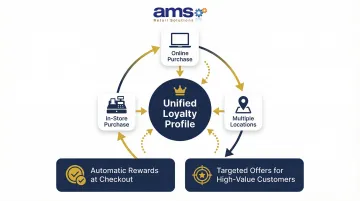
A POS-integrated loyalty system automatically tracks points, applies rewards at checkout, and identifies high-value customers for targeted offers. In specialty retail—where repeat customers and seasonal buyers drive a significant share of revenue—that automation compounds quickly.
Rather than requiring customers to remember to mention their loyalty membership or staff to manually look up accounts, the system recognizes customers automatically through their phone number, email, or payment card. Points accumulate across all channels—whether they shop in-store, online, or at multiple locations—driving repeat purchases across every touchpoint.
Customer Segmentation and Targeted Marketing
The ability to group customers by purchase history, buying frequency, or product preferences enables targeted campaigns with measurable impact. You can:
- Alert garden center customers when new plant stock arrives
- Notify pet owners when their preferred food brand is on sale
- Remind sporting goods customers about seasonal equipment maintenance
- Target high-value customers with exclusive early access to new products
These segments trigger email campaigns automatically, putting your customer data to work well beyond the point of sale.
Gift Card and Store Credit Management
A multi-channel POS enables the issuance and redemption of gift cards and store credits across all channels and locations. Customers can purchase a gift card online and redeem it in-store, or receive store credit at one location and use it at another.
Managing gift cards within the POS eliminates the data sync problems that arise when those balances live in a separate system. Research shows that 61% of consumers spend more than the gift card value, averaging $31.75 in additional purchases—making gift cards not just a convenience feature but a reliable revenue driver.
Reporting, Analytics, and Payment Processing
Real-Time Reporting and Analytics
A strong POS reporting suite gives owners visibility into sales performance by channel, location, product category, and time period—enabling data-driven decisions on staffing, promotions, and purchasing. Data-driven retailers outperform competitors by 5 percentage points in revenue growth and 7 percentage points in profitability, which means analytics belongs in your core software evaluation criteria, not an afterthought.
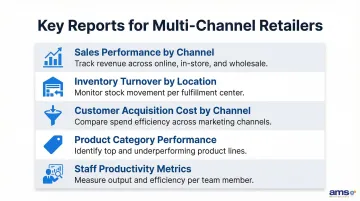
Key reports for multi-channel retailers include:
- Sales performance by channel to understand where revenue comes from
- Inventory turnover by location to optimize stock allocation
- Customer acquisition cost by channel to focus marketing investment
- Product category performance to guide purchasing decisions
- Staff productivity metrics to identify training opportunities
That reporting foundation matters even more when paired with how your system handles payments.
Integrated Payment Processing
Integrated payment processing—where the payment terminal connects directly to your POS rather than operating as a standalone device—speeds up checkout, reduces errors, and simplifies reconciliation. Modern payment standards including EMV chip cards (used in 96% of transactions) and contactless payments are table stakes for contemporary retail.
The difference between standalone terminals and integrated processing is significant. With standalone terminals, staff enter transaction amounts twice (once in the POS, once on the payment device), which opens the door to keying errors and slower lines. Integrated processing captures payment data automatically, ties it to the transaction record, and eliminates the manual batch matching that slows end-of-day reconciliation.
Integration also enhances security through tokenization, which removes sensitive cardholder data from your POS system, reducing PCI compliance scope and risk.
Employee Management and Access Controls
Time tracking, role-based permissions, and performance reporting within the POS help multi-channel retailers manage staff across locations, reduce shrink from unauthorized discounts, and measure productivity by team member or register.
Role-based access controls keep each user within appropriate boundaries:
- Cashiers can process transactions but cannot modify pricing
- Managers can approve discounts but cannot delete transaction history
- Owners retain full system access
These controls directly address employee theft, which accounts for 29% of retail shrink losses.
Performance reporting by employee helps identify top performers, recognize training opportunities, and ensure accountability across your retail operation.
What Specialty Retailers Should Look for in a Multi-Channel POS
Purpose-Built for Your Industry
Not all POS platforms are built for specialty retail. General-purpose systems may lack the inventory depth, category flexibility, or channel integrations that garden centers, pet supply stores, farm markets, or sporting goods retailers require.
Garden centers need systems that handle perishable inventory, variable units of measure (by plant, container, or weight), and extreme seasonal demand. Pet supply stores need integrated appointment scheduling for grooming services alongside product sales. Sporting goods retailers need serialized tracking for high-value equipment and integrated repair order management.
Prioritize a system purpose-built or deeply configured for your specific business type rather than attempting to force-fit a generic platform to your unique requirements.
Scalability and Single-Source Management
The ability to run one store today and expand to multiple locations or add an online channel tomorrow—without replacing your POS or managing disconnected tools—is critical for growing retailers.
A single-source POS solution reduces vendor complexity, cuts IT overhead, and ensures data consistency from day one. Rather than coordinating between separate vendors for hardware, software, payment processing, and support, you work with one partner who understands your business and owns the entire system.
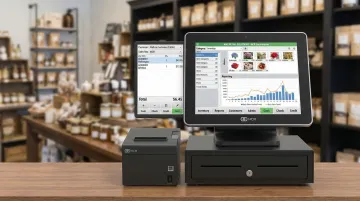
AMS Retail Solutions takes this approach as a single-source POS partner for specialty retailers, powered by NCR Voyix Counterpoint. Customizable tools built for garden centers, farm markets, pet supply stores, feed stores, and sporting goods retailers — backed by 24/7 support — mean your system can scale from one register to multiple locations and online channels without switching vendors or rebuilding from scratch.
Key Evaluation Criteria
When evaluating multi-channel POS systems, consider:
- Reliability: Offline capability keeps your registers running even with inconsistent connectivity
- Integrations: Native connections to eCommerce platforms, accounting software, and marketing tools
- Implementation: Training, data migration, and go-live support — not just software delivery
- Support: 24/7 availability with industry expertise, especially during peak seasons
- Total cost: Factor in implementation, hardware, integrations, and support — not just licensing fees
The lowest-priced system is rarely the best value when you factor in integration complexity, support quality, and the operational costs of working with multiple vendors.
Frequently Asked Questions
What are the key features of a POS system?
Essential POS features include inventory management, payment processing, checkout tools, sales reporting, customer management, and employee management. Multi-channel retailers need these capabilities to work across all locations and channels simultaneously with real-time data synchronization.
What is multichannel POS?
A multichannel POS is a point-of-sale system that lets retailers sell and manage operations across multiple channels—such as physical stores, online storefronts, and multiple locations—from one centralized platform with synchronized data.
What are the 4 types of POS systems?
The four common types are legacy/on-premise, cloud-based, mobile (tablet or smartphone), and self-service kiosk POS systems. Cloud-based systems with mobile capabilities are generally the best fit for modern multi-channel retailers.
Can a multi-channel POS system work offline?
Select POS systems include offline capability, allowing transactions to be recorded and inventory tracked without an active internet connection. Data syncs automatically once connectivity is restored—critical for farm markets, seasonal pop-ups, and outdoor events where reliable internet isn't guaranteed.
How does a multi-channel POS help specialty retailers manage inventory?
A multi-channel POS gives specialty retailers real-time visibility into stock across all locations and channels, automates reorder alerts, and enables inter-store transfers—reducing both overstock and stockouts for seasonal or high-SKU-count product categories.
What's the difference between multi-channel and omnichannel POS?
Multi-channel means selling across several channels; omnichannel means those channels are fully integrated—with consistent inventory, pricing, and customer data everywhere. A true omnichannel POS supports experiences like buy-online-pick-up-in-store through a single, real-time view of your business.