 Use POS to Manage Complex Inventory](https://file-host.link/website/amsretail-s09mhm/assets/blog-images/a3dddaa9-1031-4aee-a556-87d9bf6f54b1/1776808849102993_daea4f700373421496f21a2ddc489f48/360.webp)
Introduction
Health food and natural grocery stores rank among the most inventory-intensive retail environments in operation — managing thousands of SKUs across perishables, supplements, bulk goods, and specialty items, each with varying shelf lives and regulatory requirements. Natural and organic products now represent 10.31% of the $1.073 trillion US food retailing industry, with sales reaching $110.75 billion in 2024 — growing at 6.89%, outpacing conventional grocery growth of 4.95%.
Competition is intensifying. Independent natural grocers face consolidation pressure — store counts declined 0.6% in 2024 despite strong sales growth — making efficient operations a survival requirement, not a competitive advantage.
Yet while POS systems are widespread in retail, most store owners don't understand how they handle natural grocery complexity. That gap leads directly to preventable spoilage, stock errors, and margin losses — in an environment where products expire, weights vary, and every percentage point of shrink matters. This guide breaks down exactly how POS inventory management works in practice, so you can close that gap before it costs you.
Key Takeaways
- Health food store POS systems are operational infrastructure—actively managing perishables, bulk bins, supplements, and specialty products in real time
- Complexity comes from expiration tracking, weight-based pricing, 250,000+ SKU catalogs (UNFI), and variable replenishment cycles across categories
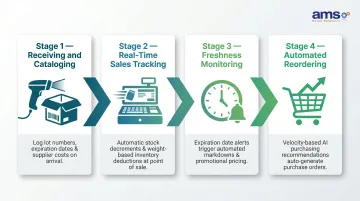
- POS handles four stages: stock receiving with lot/expiration data, real-time sales tracking, freshness alerts, and data-driven reordering
- Results include reduced spoilage (grocery perishables average 4.62% shrink), better margin control, and purchasing backed by sales velocity data rather than guesswork
- Success depends on choosing systems built for specialty retail complexity—like AMS Retail Solutions' NCR Voyix Counterpoint platform—not generic cash registers
What Is POS Inventory Management for Health Food Stores?
POS inventory management is the system that connects every product in your store—from the moment it arrives at receiving to the moment it's sold or removed—through a centralized, real-time data layer that operates through and alongside the point of sale. It's not a standalone tracking tool or a separate app added on top of a register. In a well-implemented system, the POS and inventory layer are unified: every scan at checkout automatically updates stock counts, cost tracking, and reorder status simultaneously.
This matters because health food retail is genuinely more complex than general merchandise. Natural grocery stores handle inventory that spoils, expires, sells by weight, or requires regulatory tracking. Manual systems cannot manage this responsibly at any meaningful scale.
Consider what a single store might handle simultaneously:
- Fresh produce with 3-day shelf windows requiring daily rotation decisions
- Supplement batches with 2-year expiration tracking and lot number requirements
- Bulk bins with no individual barcodes, priced and sold by weight
- Products carrying allergen, certification, or country-of-origin disclosures
Paper systems and spreadsheets break down fast across this kind of variety.
A well-configured POS inventory system bridges that gap — keeping what's on the shelf, what's in the system, and what needs reordering in sync at all times.
Why Health Food Store Inventory Is More Complex Than Standard Retail
Multi-Category Complexity
Unlike a clothing or hardware store — where most products share similar handling characteristics — natural grocers simultaneously manage fundamentally different inventory types:
- Perishables (produce, prepared foods) requiring rotation every few days
- Shelf-stable supplements with expiration batch variance — multiple lots of the same SKU carrying different dates
- Bulk bin goods sold by unit weight with no individual barcodes and scale-dependent pricing
- Packaged specialty items with extreme SKU density (UNFI alone offers more than 250,000 SKUs to independent natural grocers)
Natural and organic products occupy only 5.14% of total US food retail square footage but account for 10.31% of total sales, indicating significantly higher SKU density per square foot than conventional retail. This compression means stores must track more products in less space with greater precision.
Pricing Complexity Layer
Health food stores frequently deal with:
- Variable-weight pricing for produce and bulk goods requiring integrated scale calculations
- Multi-tiered customer pricing including co-op member discounts, wholesale accounts, and loyalty program tiers
- Promotional windows on near-expiry products requiring rapid price adjustments
- Supplier price fluctuations on organic products—the organic-conventional price premium fluctuates frequently, and private-label competition from chains like Kroger's Simple Truth ($2.3 billion brand) puts constant pressure on independent retailer margins
When any of these variables fall out of alignment, the margin impact is immediate — and often invisible until it shows up in end-of-period shrink reports.
Compounding Risk
Every complexity layer described above multiplies shrink exposure. A product that expires, is mis-weighed, or rings at the wrong price simultaneously erodes margin, customer trust, and compliance standing.
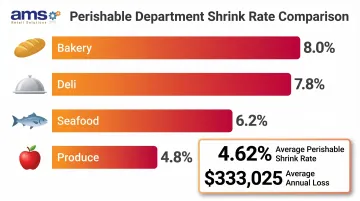
Perishable departments account for 65% of all store shrink but only 38% of total store sales, with average perishable shrink rates reaching 4.62% — an average profit loss of $333,025 per store annually. Department-level rates tell the full story:
- Bakery: 8.0%
- Deli: 7.8%
- Seafood: 6.2%
- Produce: 4.8%
64% of shrink stems from operational inefficiencies — improper markdowns, inventory control errors, and overstock — not theft. That means most of it is preventable with tighter inventory systems.
How POS Systems Manage Complex Health Food Inventory: Step by Step
A POS-driven inventory system operates through a defined sequence of stages—each building on the last—so inventory data remains current, usable, and actionable.
Receiving and Cataloging Stock
Inventory enters the system at the point of receiving. Items are scanned or imported (often via supplier integration or wholesale data feeds), and the POS records purchase cost, quantity, lot number, and expiration date—establishing the baseline for all downstream tracking. For health food retailers, this initial data capture is essential: FDA 21 CFR Part 111 mandates that dietary supplements carry batch or lot numbers enabling complete traceability from supplier to distribution, with records linking lot numbers to receipt dates, suppliers, and approval status.
Errors introduced during receiving—wrong cost entry, missed expiration dates, incorrect unit counts—compound throughout the entire inventory cycle and cannot be corrected at the register. When a supplement batch with a March 2026 expiration date is entered incorrectly as March 2027, the system won't flag it for removal until a year too late.
Real-Time Stock Tracking During Sales
At the moment of sale, every transaction automatically decrements inventory counts, updates on-hand quantities, and logs which items are moving fastest—giving the store a live, accurate picture of what's on the shelf without physical counts. In manual systems, stock levels are only accurate immediately after a count; every transaction after that erodes reliability.
For health food stores, there's an additional weight-based selling layer. Integrated scale connections allow the POS to capture exact weights for bulk items and produce, then adjust inventory by actual quantity sold. When a customer purchases 1.3 pounds of organic quinoa from a bulk bin, the system deducts exactly 1.3 pounds—not an estimated "unit" that creates cumulative variance over time.
Expiration and Freshness Monitoring
A health food POS monitors product freshness by flagging items approaching expiration thresholds—enabling staff to pull, discount, or promote products before they become waste rather than after. This proactive intervention recovers value that would otherwise represent total loss.
The margin protection impact is measurable. Key benchmarks show what's at stake:
- Nearly 50% of retail food waste traces back to date label concerns
- Store shrinkage averages 2.70% of retail sales—roughly $512,922 per store annually
- Frontline interventions targeting food waste achieved average reduction rates of 66% in pilot programs
Automated promotions and timely discounting move near-expiry inventory before it expires unsold—recovering revenue that a reactive system would write off entirely.
Automated Reordering and Purchase Decisions
The POS translates inventory data into purchasing recommendations by analyzing sales velocity, seasonal demand patterns, lead times, and current stock levels. The system can generate suggested orders or trigger automatic purchase orders—removing guesswork from replenishment and reducing the likelihood of both stockouts and over-ordering perishables.
NCR Voyix Counterpoint, deployed through AMS Retail Solutions, includes this automated purchasing capability configured specifically for specialty retail. For natural grocers, that means maintaining optimal stock levels without the cash flow strain of over-ordering perishables—keeping shelves full without accumulating product that won't sell before it expires.
Where POS Inventory Management Makes the Biggest Difference in Health Food Retail
Bulk Bin and Weight-Based Selling
POS handles bulk inventory where there are no individual barcodes through scale-integrated systems that calculate price by weight at checkout, deduct the correct quantity from bulk bin stock, and trigger replenishment when bin levels drop below threshold. Over 60% of natural foods shoppers would stop patronizing their store if the bulk section were removed, making this functionality critical to customer retention.
Without POS integration, bulk inventory is nearly impossible to track accurately. Manual methods rely on staff recording tare weights, customers selecting correct PLU codes, and periodic physical bin checks — all prone to error. POS automation adds visibility into which bulk items turn fastest, so buyers can act on that data before a stockout or a slow-mover becomes a loss.
Supplement and Vitamin Management
POS tracks supplement inventory at the batch or lot level, monitors expiration dates across multiple SKUs with multiple active batches, and can flag compliance issues. This is particularly important as CBD, certain botanicals, and specialty supplements carry regulatory weight. US dietary supplement sales reached $72.88 billion in 2025, representing a significant revenue category that demands precision.
FDA regulations require dietary supplement records to be retained for 1 year past shelf life date — or 2 years from distribution of the last batch. Distribution records must also track lot numbers through the supply chain for recall capability. POS systems built for health food retail manage these requirements automatically, keeping stores audit-ready without manual recordkeeping.
Perishable and Prepared Food Rotation
POS enforces FIFO (first in, first out) logic through receiving date tracking, alerts staff when product rotation is needed, and generates data on which prepared or fresh items are underperforming before the loss is already realized. Produce accounts for more than one-third of total food waste nationally, making effective rotation systems essential.
Fresh department complexity is growing fast. Retailers plan to expand:
- Fresh produce space: 63% increasing allocation
- Deli: 45% increasing allocation
- Seafood: 41% increasing allocation
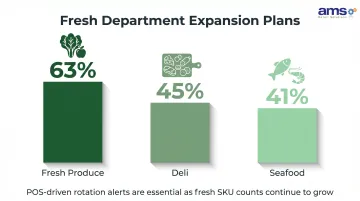
Without POS-driven rotation alerts, stores fall back on manual visual inspection — an approach that breaks down quickly as SKU counts grow.
Vendor and Multi-Supplier Management
Natural grocery stores typically source from multiple local farms, distributors like UNFI and KeHE, and specialty wholesalers. A POS system consolidates all supplier relationships, tracks pricing changes by vendor, and compares cost-per-unit across sources — so buyers can see at a glance which supplier is cheapest for a given item today.
When organic produce prices fluctuate (food-at-home prices increased 1.2% in 2024), stores need real-time visibility into which suppliers offer the best current pricing for comparable products. POS systems with vendor management capabilities automate this comparison, enabling buyers to make informed decisions quickly.
Customer-Linked Inventory Insights
Loyalty and co-op membership data feeds back into inventory planning — stores can see which members buy which products regularly, anticipate demand around membership cycles, and stock accordingly to reduce both overstock and out-of-stock situations. When 60 regular customers purchase a specific probiotic brand every month, the system can flag unusual demand drops or recommend increased orders before seasonal peaks.
This insight matters most for specialty and emerging products where general market data is thin or nonexistent. Customer purchase history gives natural grocers a signal weeks earlier than conventional sales reporting — enough lead time to reorder a breakout item before it's gone or cut a slow mover before it expires on the shelf.
Conclusion
For health food and natural grocery stores, POS inventory management is the operational infrastructure behind every successful receiving decision, reorder trigger, and margin call. Stores where products expire, weights vary, and supplier relationships are fragile need systems that handle that complexity automatically—so operators can focus on the floor, not the spreadsheet.
As the natural grocery sector continues growing—organic sales projected to reach $76.6 billion in 2025 with 5.1% CAGR through 2029—independent natural grocers face real pressure: consolidation from larger chains and conventional retailers expanding organic offerings. Inventory accuracy, shrink reduction, and tighter purchasing cycles are where margins get protected or lost.
Health food and natural grocery operators should evaluate POS solutions built or configured specifically for specialty retail environments. AMS Retail Solutions, powered by NCR Voyix Counterpoint, provides a single-source POS platform built for specialty retail depth: offline capability, automated purchasing tools, and configurable features that adapt as your store grows. For more information, contact AMS Retail at 757.495.4995 or schedule a consultation to discuss your specific operational needs.
Frequently Asked Questions
What is POS inventory management?
POS inventory management is the system that tracks every product from receiving through sale in real time, automatically updating stock levels, costs, and reorder status with each transaction. It eliminates the need for continuous manual counts by maintaining a live data layer that reflects actual inventory positions.
How do grocery stores keep track of inventory?
Health food and natural grocery stores use POS-integrated inventory systems that record each sale automatically, pull in receiving data as shipments arrive, and conduct periodic physical counts to verify accuracy. Together, these inputs keep shelf counts current without relying on manual tracking alone.
What is the difference between POS and inventory?
POS (point of sale) handles the transaction itself—scanning, pricing, payment processing—while inventory management handles stock tracking, ordering, and reporting. In a well-integrated system, these two functions operate as one unified platform where each sale automatically updates inventory records.
What POS systems have inventory management features?
Many retail POS platforms include inventory features, but health food and natural grocery stores benefit most from systems built or deeply configured for specialty retail—ones that handle expiration tracking, scale integration, and bulk bin management as core capabilities, not add-ons.
What are the basic features of a POS system?
Basic features include transaction processing, barcode scanning, receipt printing, and sales reporting. Modern systems go further with real-time inventory tracking, customer loyalty programs, vendor management, and analytics dashboards that surface purchasing trends and stock performance.
How does a POS system help reduce food waste in a health food store?
POS systems flag products nearing expiration, trigger targeted promotions on slow-moving perishables, and sharpen ordering accuracy using sales velocity data. Catching near-expiry items early lets stores discount proactively and recover value instead of writing off spoiled stock.