Introduction
A customer walks in asking for their dog's prescription diet food—the one their veterinarian specifically recommended for kidney health. You check the shelf. Empty. You check the stockroom. Nothing. That customer doesn't just leave without buying; they leave wondering if they can count on you next time.
Meanwhile, three shelves over, $800 worth of seasonal Halloween costumes from last year sits gathering dust, tying up cash you desperately need for spring flea and tick inventory.
That tension defines pet store inventory management: a constant balancing act between stockouts that send customers to competitors and overstock that suffocates cash flow. According to AlixPartners research, 66% of consumers will leave a store and shop elsewhere when an item is out of stock—and in pet retail, where customers depend on specific formulas for their pets' health, that lost sale often becomes a lost customer permanently.
This guide covers the complete inventory management toolkit for independent pet store owners: the four core inventory methods, essential daily practices, product mix strategy, POS automation, and supplier planning that together turn inventory from a daily headache into a manageable, profitable system.
TLDR:
- Perishables, health-critical products, and seasonal spikes make pet store inventory uniquely demanding
- FIFO, ABC analysis, and perpetual POS tracking are the three methods that cover most inventory problems
- Modern POS systems automate reorder alerts and can deliver an 8.9% sales uplift through tighter stock control
- Cutting shrink (industry average: 1.6% of sales) and offloading slow movers directly improves cash flow
Why Pet Store Inventory Is Uniquely Challenging
Pet stores carry one of the widest product ranges in specialty retail. Each category on your shelves demands different reorder timing, storage conditions, and turnover management:
- Perishable food and treats with strict expiration dates
- Temperature-sensitive supplements and medications
- Seasonal flea, tick, and parasite prevention products
- Durable accessories and equipment
- Specialty health and prescription diet items
- Impulse toys and seasonal novelties
The stockout problem hits pet retailers especially hard. When a pet parent relies on a specific prescription diet or limited-ingredient formula for their dog's allergies or digestive issues, an empty shelf isn't just an inconvenience—it's a health concern. These customers don't wait; they immediately turn to a competitor or order online. The data confirms this behavior: 66% of consumers will leave and shop elsewhere when they encounter a stockout, representing a direct path to lost customers—and many won't come back in a $152 billion U.S. pet industry.
These challenges are made worse by the fact that many independent pet store owners still operate with manual or spreadsheet-based inventory tracking. A Capterra study found that 58% of small businesses rely on manual methods (34%) or spreadsheets (24%) for inventory management. These systems create blind spots—you don't know what's actually on the shelf versus what your records say, leading to surprise stockouts, unnoticed shrink, and cash tied up in products you didn't realize were sitting unsold for months.
The financial stakes are significant. Inventory shrink alone—from theft, supplier errors, spoilage, and administrative mistakes—averages 1.6% of sales across retail, totaling $112.1 billion in annual losses. For perishable categories like pet food, spoilage and expiration can cost an additional 1-2% of gross sales. Every percentage point of improvement directly increases your gross margin.
The 4 Types of Inventory Management Pet Store Owners Should Know
Most pet stores don't use just one inventory method—they combine two or more to address different operational challenges. Understanding these four core approaches helps you build a system that prevents waste, prioritizes your best sellers, and maintains accurate stock counts without overwhelming your staff.
FIFO — First-In, First-Out
FIFO is non-negotiable for any pet store carrying food, treats, supplements, or products with sell-by dates. Products received first must always be the first placed on the sales floor and sold. This prevents older stock from sitting behind fresh inventory, aging out, and ending up as waste or—worse—sold to a customer after expiration.
Implementing FIFO doesn't require complex technology. Effective systems include:
- Color-coded receiving labels showing the date received
- Shelf rotation protocols where staff always pull from the front and stock from the back
- Manager spot-checks during daily walkthroughs to verify rotation compliance
- Stockroom organization with oldest inventory positioned for easiest access
When any employee—including part-time weekend help—can instantly see which products to stock first, FIFO runs on autopilot instead of becoming an ongoing training headache. That consistency matters most during busy receiving days when shortcuts are tempting.
ABC Analysis
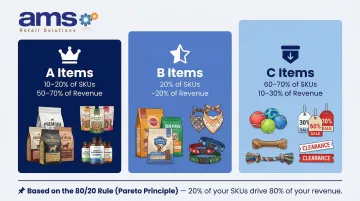
ABC segmentation ranks your inventory into three priority tiers based on sales velocity and revenue contribution:
- A items (10-20% of SKUs): High-value or fast-moving products generating 50-70% of revenue — premium dog food brands, top-selling treats, essential health supplements
- B items (20% of SKUs): Mid-priority products contributing roughly 20% of revenue — secondary food brands, seasonal accessories with moderate turnover
- C items (60-70% of SKUs): Slow movers or low-value products accounting for 10-30% of revenue — niche toys, specialty items, clearance products
This directly connects to the 80/20 rule: roughly 20% of your SKUs typically generate 80% of revenue. Identifying your A items ensures reorder priority, tightest stock control, and premium shelf placement go to products that actually drive your business. Meanwhile, C items get less frequent counts, lower par levels, and potential discontinuation if they're not earning their shelf space.
Periodic vs. Perpetual Inventory
These two methods represent opposite ends of the inventory tracking spectrum. Here's how they compare:
| Periodic Inventory | Perpetual Inventory | |
|---|---|---|
| How it works | Physical counts at set intervals (weekly, monthly, quarterly) | Stock levels update automatically with every POS transaction |
| Visibility | Gaps between counts — you may miss theft or spoilage until it's too late | Continuous real-time view of what's on hand |
| Best for | Very small operations with limited SKU counts | Growing stores with 500–1,000+ SKUs |
| Reorder alerts | Manual, based on count results | Automated when stock hits minimum levels |
Growing pet stores typically make the switch to perpetual inventory as their SKU count climbs beyond what manual counting can reasonably handle — around 500–1,000 products.
The advantage is immediate: you know exactly what's on hand right now, can set automated reorder alerts when stock hits minimum levels, and catch discrepancies (shrink) as they happen rather than discovering them months later during a physical count.
Essential Inventory Management Practices for Pet Stores
Establish Par Levels for Every Product Category
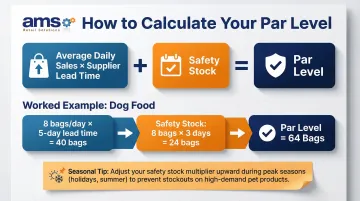
Par levels are the minimum stock quantity that triggers a reorder. Calculate them using this formula:
Par Level = (Average Daily Sales × Supplier Lead Time) + Safety Stock
Example: Your premium grain-free dog food sells 8 bags per day on average. Your supplier delivers in 5 business days. You want 3 days of safety stock for unexpected demand spikes.
- Par Level = (8 bags × 5 days) + (8 bags × 3 days) = 40 + 24 = 64 bags
When your inventory drops to 64 bags, you reorder. Adjust par levels seasonally—flea and tick products need higher par levels in spring and summer, holiday toys need increases in Q4.
Apply the 10% Rule for Slow Movers
Regularly identify the bottom 10% of performers across product categories and make hard decisions:
- Discontinue products with no strategic value
- Reduce order quantities to minimum viable levels
- Shift to seasonal-only stocking for items with predictable demand windows
Cutting these products frees up cash and shelf space for higher-margin items. Run this analysis quarterly using your POS sales reports to identify candidates.
Implement Regular Inventory Audits
Distinguish between two audit types:
Full physical counts: Every item counted and reconciled, typically once or twice per year. Time-intensive but necessary for financial reporting and catching systemic issues.
Cycle counts: One category audited at a time on a rotating schedule. Use ABC analysis to determine frequency:
- "A" items: Weekly or biweekly counts
- "B" items: Monthly counts
- "C" items: Quarterly counts
Cycle counts are more practical for busy stores because you're counting 50-100 items at a time rather than shutting down to count 2,000 SKUs in one marathon session.
Reduce Shrink Through Process Controls
Shrink—from theft, supplier errors, spoilage, and admin mistakes—directly erodes gross margin. Reduce it through:
Receiving procedures:
- Count and verify every delivery against the packing slip before signing
- Check expiration dates on all perishables and flag items approaching sell-by dates
- Immediately enter received inventory into your POS system
Expiration flagging:
- Set system alerts for products within 30-60 days of expiration
- Implement markdown protocols to move aging stock before it expires
- Pull expired products immediately and document waste
Discrepancy protocols:
- Investigate any variance between physical counts and system records
- Document patterns (specific products, specific times) to identify root causes
Designate an Inventory Manager
Even as a part-time duty, one person should own inventory oversight. Clear accountability reduces errors, waste, and reorder delays. In small stores, this is typically the owner or a senior manager putting in 5-10 hours per week. Core responsibilities include:
- Monitoring par levels and triggering reorders on schedule
- Conducting cycle counts and reconciling discrepancies
- Reviewing shrink patterns and flagging root causes
Train All Staff on Inventory Protocols
Inventory software only works when staff use it correctly. Even part-time and seasonal employees need training on the protocols that keep data accurate:
- FIFO placement so older stock sells first
- Correct receiving entry into the POS system at time of delivery
- Proper return handling to keep stock counts reconciled
Human error at the shelf and stockroom level can quietly undermine an otherwise solid inventory system.
Building the Right Product Mix for Your Pet Store
The Four Pillars of Pet Store Product Mix
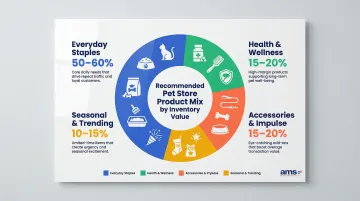
Balance your inventory across these categories:
Everyday staples (50-60% of inventory value):
- Dog and cat food (dry, wet, raw)
- Treats and chews
- Litter and waste management
Health and wellness essentials (15-20%):
- Supplements and vitamins
- Grooming supplies
- Flea, tick, and parasite prevention
Accessories and impulse items (15-20%):
- Leashes, collars, harnesses
- Toys and enrichment products
- Bowls and feeding accessories
Seasonal and trending products (10-15%):
- Holiday-themed items
- Seasonal health products (flea/tick in summer)
- Limited-time specialty foods
This balance maintains steady cash flow from staples while leaving room for unplanned add-ons and seasonal opportunities.
Diversify Your Supplier Base
Over-reliance on a single supplier creates risk. If that supplier faces a disruption, your shelves go empty and customers go elsewhere. Diversifying vendors for core categories:
- Reduces supply chain vulnerability
- Provides access to unique products larger competitors don't carry
- Creates negotiating leverage through competitive bidding
Aim for at least two suppliers per major product category (food, treats, health products).
Use Merchandising to Accelerate Sell-Through
Thoughtful product placement reduces how long slow-moving stock sits:
- Eye-level placement for high-margin items customers might otherwise overlook
- Complementary groupings that encourage add-on purchases (leash + waste bags + training treats)
- Impulse items near checkout where customers make quick decisions while waiting
- Endcap promotions for seasonal items or products you're actively trying to move
Merchandising done well serves a practical purpose: the right placement moves product faster and keeps slow-moving stock from tying up shelf space and cash.
Using POS Technology to Automate Pet Store Inventory
Real-Time Stock Tracking Eliminates Manual Errors
A modern retail POS system updates inventory automatically with every sale, return, and receiving entry. This perpetual tracking eliminates the manual counting and spreadsheet errors that lead to stockouts and overbuying. When your system shows 47 bags of premium dog food on hand, you know that's accurate as of the last transaction—not a guess based on last week's count.
Automated Reorder Alerts Prevent Stockouts
Set par levels in your POS system for every product. When stock drops below that threshold, the system triggers an alert—via dashboard notification, email, or automated purchase order. No more guesswork, and no more awkward moments when a customer asks for something you sold out of three days ago.
Demand Forecasting Drives Smarter Purchasing
POS systems with sales history analysis identify patterns over time:
- Which SKUs consistently sell fastest
- Seasonal trends (flea prevention spikes in April-August)
- Underperformers sitting on shelves for months
Objective sales data replaces gut-feel purchasing decisions, helping you stock more of what sells and less of what doesn't.
AMS Retail Solutions: Specialty Retail POS Built for Pet Stores
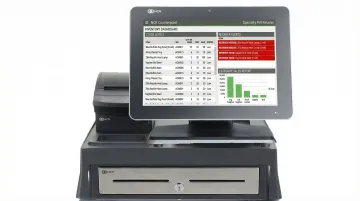
AMS Retail Solutions offers NCR Voyix Counterpoint, a specialty retail POS built for specialty retailers, including pet supply stores. It handles inventory across single or multiple locations, flags expiring products, automates reorder triggers, and gives you category-level sales reporting out of the box.
AMS specialists work with you directly before implementation—learning your store's workflows so the setup fits how you actually operate, not a generic retail template. Support runs 24/7, and offline POS capability keeps your checkout running even during internet outages.
What to Look for in a Pet Store Inventory System
When evaluating POS platforms, prioritize these capabilities:
- Updates inventory automatically on every transaction (no manual entry)
- Supports multiple locations if you operate or plan to expand
- Flags products approaching their sell-by date before they become a loss
- Reports sales by category so you can spot fast movers and slow movers
- Triggers reorder alerts based on par levels you set per product
- Integrates with supplier orders to cut purchase order creation time
- Operates offline so sales continue during internet outages
These features together eliminate guesswork and create a system that works for you rather than requiring constant manual intervention.
Supplier Relationships, Seasonal Demand, and Perishable Stock
Managing supplier relationships, anticipating seasonal swings, and handling perishables are three areas where proactive systems pay off most. Here's how to approach each one.
Share Sales Data to Strengthen Supplier Partnerships
Providing suppliers with sales data specific to their product lines creates a valuable feedback loop. Suppliers can flag new product launches, alert you to quality issues, or offer promotional opportunities based on real sell-through performance. In return, you gain:
- Better lead times and priority allocation during shortages
- Early access to new products before they hit the open market
- Promotional pricing tied to your actual sell-through performance
The more visibility your suppliers have into your sales, the more invested they become in helping you stay stocked.
Plan for Seasonal Demand Spikes in Advance
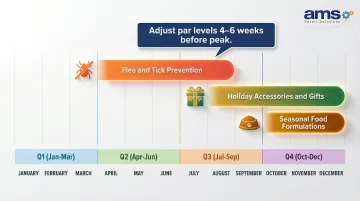
Certain product categories see predictable seasonal lifts:
Flea and tick prevention (March-August): Demand peaks in warmer months. A Merck Animal Health survey found 44% of pet owners identify summer as primary flea and tick season. Increase par levels in late winter to ensure stock availability when customers need it.
Holiday accessories and gifts (Q4): November and December drive significant spending on holiday-themed items. The American Pet Products Association reports over 40% of cat owners purchase Christmas gifts, averaging $30.70 per gift.
Seasonal food formulations: Limited-time flavors and holiday treat assortments see concentrated demand in specific windows.
Adjust par levels and reorder timing 4-6 weeks before seasonal peaks rather than reacting once shelves are already running low.
Manage Perishable Stock Proactively
Prevent waste and protect customers through systematic perishable management:
Receiving workflow:
- Check expiration dates on every delivery
- Flag items with fewer than 90 days until expiration
- Enter expiration dates into your POS system if it supports date tracking
System alerts:
- Set automated alerts for products within 30-60 days of expiration
- Review these alerts weekly to plan markdowns or promotions
Markdown protocol:
- Discount items 30-45 days before expiration to accelerate sell-through
- Pull and document expired products immediately
- Never sell expired products—the liability and reputation damage far exceed the lost sale
Done consistently, this approach keeps spoilage costs—typically 1-2% of gross sales for perishables—in check while ensuring customers always receive fresh, safe products.
Frequently Asked Questions
What is the 80/20 rule in inventory?
The 80/20 rule (Pareto Principle) means roughly 20% of your products typically account for 80% of sales revenue. For pet stores, this means identifying your top-performing SKUs and prioritizing their stock levels, reorder frequency, and premium shelf placement over slower-moving items.
What are the 4 types of inventory management?
The four main approaches are FIFO (First-In, First-Out), Just-In-Time, ABC Analysis, and periodic vs. perpetual inventory systems. Most pet stores use a combination—FIFO is especially critical given the prevalence of perishable food and treats with expiration dates.
How often should a pet store conduct a physical inventory count?
Monthly cycle counts by product category are more manageable than annual full counts. Use ABC analysis to prioritize: count high-value "A" items weekly or biweekly, "B" items monthly, and "C" items quarterly. Conduct at least one full physical count per year to reconcile records and identify shrink.
What is a par level and how do I set one for my pet store?
A par level is the minimum stock quantity that triggers a reorder. Calculate it by multiplying average daily sales by supplier lead time, then add safety stock for demand variability—and adjust seasonally for predictable spikes like flea prevention or holiday items.
How should a pet store handle expired products or recalls?
Flag expiration dates at receiving, set alerts for approaching sell-by dates, and pull expired items immediately. For recalls, subscribe to FDA notifications via GovDelivery, pull affected products promptly, notify customers who purchased them, and document your response.
What features should I look for in a pet store inventory management system?
Essential features include real-time stock tracking, automated reorder alerts based on par levels, expiration date flagging, sales and category reporting, multi-location support, and supplier order integration.