Introduction
Customers expect the same experience whether they shop online, walk into your store, or call ahead for curbside pickup. When your online inventory doesn't sync with your in-store stock, loyalty programs only work at the register, or web orders can't be filled from in-store stock, you lose sales to competitors who can deliver that seamless experience.
A disconnected POS system is usually the root cause. Pet supply retailers need software that keeps every channel in sync — not just a register that handles transactions.
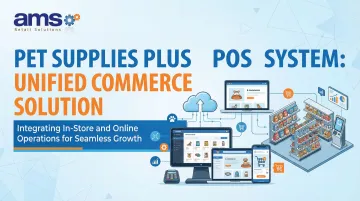
This blog covers the key features a POS system must have for pet supply retailers, how unified commerce works in practice, and what to look for when choosing or upgrading your solution. The right POS unifies your entire operation under one platform built specifically for specialty retail.
Key Takeaways
- Pet retailers get a single dashboard for in-store and online sales — inventory, customers, and transactions all in one place
- Real-time inventory sync, BOPIS, built-in loyalty, and offline mode are non-negotiable for modern pet retail
- Multi-location and franchise operators require centralized reporting alongside per-store pricing control
- NCR Voyix Counterpoint consolidates IT overhead so pet retailers can scale without swapping systems
Why Pet Supply Stores Need a Specialized POS System
Pet supply retail has operational demands that generic checkout tools can't handle. You're managing perishable items with expiration dates, breed-specific products with hundreds of SKU variations, and grooming or pharmacy services alongside high-frequency repeat purchases.
A POS built for general retail — or repurposed from hospitality or food service — lacks the specialty features your store actually needs.
The numbers make the gap hard to ignore. E-commerce in the pet industry grew 9% in 2024, while brick-and-mortar sales grew less than 1%. Consumers are omnichannel: 79% of all pet care spending now comes from shoppers who buy across both online and in-store channels. Within a three-month period, 33% of U.S. online adults used Buy Online, Pick Up In-Store (BOPIS) and 21% used curbside pickup. If your POS can't support these behaviors, you're losing a majority of pet owners before they reach the register.
That gap has a direct price tag. When your POS can't keep up, the losses compound quickly:
- Stockouts cost U.S. retailers over $82 billion in missed sales in 2021, with pet food among the most impacted categories
- Retail shrink reached 1.6% of sales in FY2022 — $112.1 billion lost to theft, spoilage, and process errors
- Siloed customer data means you can't reward repeat buyers or personalize offers at scale
- Manual data aggregation across locations slows decisions and hides problems until they're expensive to fix
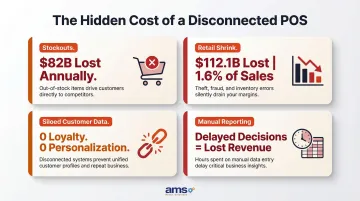
A POS built for pet specialty retail closes each of these gaps — connecting online orders, in-store pickup, inventory, and customer history in one system so you can act on the right data at the right time.
Core Features of a Unified Commerce POS for Pet Supply Stores
Real-Time Inventory Management
Per-store inventory visibility is critical for pet supply retailers. You face seasonal demand spikes (flea and tick products in spring, holiday toys in December), product variety by location (urban stores carry different brands than suburban locations), and the constant risk of overstock or stockouts on fast-moving items like prescription foods.
A unified POS keeps inventory synced across all channels automatically. When a customer buys a bag of dog food online, your in-store count updates instantly. When staff receive a shipment, the system reflects new stock levels across your website and all locations in real time. This eliminates the manual reconciliation that causes errors and prevents overselling.
BOPIS and Curbside Pickup Support
Your POS must connect online orders to in-store fulfillment in real time. When a customer clicks "buy" on your website, the system should:
- Route the order to the correct store location based on inventory availability
- Notify staff immediately with order details
- Update inventory instantly to prevent double-selling
- Confirm pickup with automated customer notifications
Pet Supplies Plus's "You-Click-We-Fetch" curbside program demonstrates what customers now expect: orders ready in as little as one hour at no extra cost. Independent pet retailers need that same speed and simplicity to stay competitive.
Customer Loyalty Program Integration
Built-in loyalty tools within your POS increase repeat visits and average transaction value. Pet supply customers buy on a recurring schedule—food every month, treats every few weeks, seasonal products throughout the year. When your POS tracks points, purchase history, and personalized offers automatically, you can:
- Reward customers for repeat purchases without manual tracking
- Send targeted promotions based on buying patterns (e.g., "It's been 30 days since you bought dog food—here's 10% off your next bag")
- Increase purchase frequency by 10% and average order value by 12%, according to Forrester research on loyalty programs
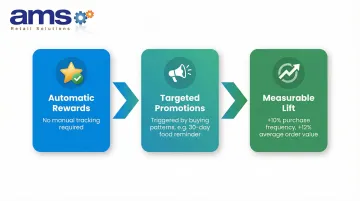
A loyalty program only works when it's embedded directly in the POS. Separate apps or manual point entry create friction—staff skip it, customers disengage, and the program delivers no measurable lift.
Offline POS Capability
Pet supply stores in strip malls or areas with unreliable connectivity need a POS that continues processing transactions without a network connection. When your internet goes down, an offline-capable POS:
- Processes sales, returns, and exchanges at full speed
- Stores transaction data locally
- Syncs automatically when connectivity is restored
An outage from your internet provider becomes a minor inconvenience—not a sales disruption.
Fast, Intuitive Checkout Experience
A POS designed specifically for retail speeds up transactions and reduces cashier errors. Features like customizable touchscreens, suggested add-ons at checkout, and secure payment processing improve the experience during high-volume periods. Faster, more intuitive checkout means more customers served per hour and shorter onboarding time for new staff.
Unifying In-Store and Online Sales for Pet Supply Retailers
Unified commerce means one platform connects your POS, e-commerce store, inventory, and customer data — so pricing, stock levels, and purchase history stay consistent whether a customer shops online or walks through your door. Disconnected systems are the root cause of the "online says one price, in-store it's different" problem that quietly erodes customer trust.
Synchronized Pricing and Promotions
Run the same sale or discount across online and physical locations simultaneously. When you mark down seasonal items, the price updates everywhere at once — no manual syncing, no staff confusion, no customer complaints at checkout.
Ship-from-Store Fulfillment
A unified POS lets you fulfill online orders directly from local inventory. You pick and ship from the store nearest the customer — cutting delivery time and reducing freight costs compared to routing everything through a central warehouse. For independent pet retailers, this closes the fulfillment gap against national chains without requiring a distribution network to match.
Unified Customer Profiles
When your POS captures purchase history across channels, staff actually know who they're talking to. If a customer regularly buys a specific brand of cat food in-store, that data is available when they call, email, or visit. Staff can flag that it's time to reorder, suggest a food topper the customer hasn't tried, or note an allergy concern — the kind of service that turns a one-time buyer into a regular.
This channel-level data becomes even more critical — and more complex — when you're managing multiple locations.
Multi-Location and Franchise Considerations
Franchise networks need a POS that shares data across corporate and franchised locations without stripping each store of local control. Corporate needs chain-wide visibility into sales and inventory; franchise owners need the flexibility to adjust pricing and manage stock based on their local market. The right system draws a clear line between shared data and store-level autonomy.
Managing Inventory and Franchises with the Right POS
Centralized vs. Per-Store Inventory Control
A well-designed POS for multi-location pet supply retailers gives corporate chain-wide inventory visibility while letting individual store owners manage their own stock levels, reorder points, and supplier relationships.
Corporate can identify trends across all locations — which products are moving, which are stagnating — while store managers stay focused on day-to-day ordering and merchandising decisions.
Automated Purchasing and Replenishment
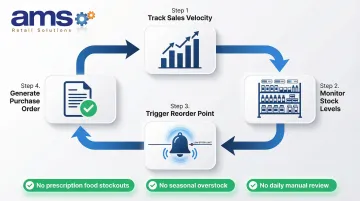
Automated purchasing tools within a POS reduce manual ordering errors and prevent stockouts of high-demand items. The system tracks sales velocity, monitors inventory levels, and generates purchase orders when stock hits predefined reorder points. For pet supply stores, this means:
- Never running out of prescription pet foods customers depend on
- Avoiding over-purchasing seasonal products that tie up cash
- Maintaining optimal stock levels without daily manual review
Franchise Reporting and Oversight
A unified POS pulls consolidated sales and inventory reports across all franchise locations automatically — no manual data aggregation required. Corporate gains the visibility to:
- Compare performance across stores
- Identify best practices worth scaling
- Spot problems before they compound
This speeds up decision-making and reduces the administrative load on franchise owners.
Inventory Shrink Reduction
A POS with built-in shrink controls helps pet supply stores reduce losses from theft, spoilage, or receiving errors. Features like variance tracking, receiving verification, and employee access levels create accountability at every step. Given that retail shrink costs the industry $112.1 billion annually, with 36% from external theft, 29% from internal theft, and 27% from process failures, even small improvements in shrink control deliver significant margin gains.
How to Choose the Right POS System for Your Pet Supply Store
Before selecting a POS, ask these key questions:
- Does it support your retail model? Single-location, multi-store, and franchise operations have different needs. Confirm the system scales without a full replacement as you grow.
- Does it integrate with your e-commerce platform? Can the POS sync inventory, orders, and customer data in real time — or will you be manually reconciling two systems?
- Is it built for specialty retail? Generic solutions miss features pet supply stores rely on: tracking perishable items, managing breed-specific SKUs, and supporting service add-ons like grooming or pharmacy.
Stitching together separate vendors for checkout, inventory, loyalty, and reporting creates gaps — in data, support, and accountability. AMS Retail Solutions, powered by NCR Voyix Counterpoint, delivers all of these in one platform built for specialty retailers like pet supply stores. That means:
- 24/7 support from a single point of contact
- Retail-hardened hardware designed for commercial environments
- One vendor responsible for your entire system
Scalability is worth evaluating early. The right POS adds new locations without a full system replacement, maintains centralized reporting across stores, and avoids costly re-implementation as your business expands.
Frequently Asked Questions
What POS system does Pet Supplies Plus use?
Pet Supplies Plus (the national chain) has used integrated systems including Microsoft Dynamics 365 Commerce for POS and ERP operations, and Sitecore for its e-commerce platform. Independent and franchise pet supply stores often need a more accessible, single-source specialty retail POS solution like NCR Voyix Counterpoint.
What is the best POS system for retail stores?
The best POS depends on your retail category. Specialty retailers like pet supply stores benefit most from a POS built specifically for their industry: one with real-time inventory, loyalty programs, multi-location support, and omnichannel capabilities built in—not bolted onto generic checkout software.
What is POS in pet care?
POS (point of sale) in pet care is the system used at checkout and throughout store operations to process transactions, track inventory, manage customer loyalty, and connect in-store activity with online sales.
What features should a pet supply store POS system have?
The most important features are real-time inventory management, customer loyalty integration, BOPIS/online order fulfillment, offline transaction capability, and multi-location or franchise reporting tools. These features enable pet retailers to compete effectively in an omnichannel market.
Can a POS system help manage loyalty programs for pet stores?
Yes. Modern POS systems built for specialty retail include built-in loyalty program tools that track customer purchases, issue rewards automatically, and allow targeted promotions—no separate third-party app required.