Introduction
On any given morning, a ranch supply store owner might ring up a walk-in customer buying a single bag of layer feed, then pivot to process a 2,000-pound bulk order for a commercial poultry operation — all before lunch. These aren't just different transaction sizes; they're fundamentally different business models running through the same front counter.
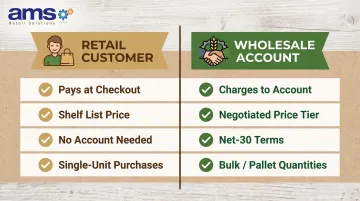
The retail customer pays cash and leaves. The wholesale buyer charges to a net-30 account at a negotiated price tier that's 15% below shelf retail.
Running both models through one counter, without the right system, creates chaos. Staff manually override prices, scribble account numbers on receipts, and reconcile spreadsheets at month-end. Pricing errors leak profit. Wholesale customers get billed incorrectly and dispute charges. Inventory counts drift out of sync because bulk sales aren't deducted properly.
IHL Group reports that global retail loses $1.73 trillion annually to inventory distortion — out-of-stocks and overstocks that stem largely from systems that can't track what's actually on hand. Farm supply stores are especially vulnerable: high-volume bulk SKUs, seasonal demand swings, and perishable feed stock all compound the risk when inventory data lags reality.
This article breaks down the retail-versus-wholesale challenge, the POS features that solve it, and what to look for when choosing a system designed around the specific demands of ranch and farm supply retail.
Key Takeaways
- Ranch and farm supply stores serve retail walk-ins and wholesale accounts simultaneously — standard POS systems break under this dual load
- A purpose-built POS auto-applies tiered pricing, manages wholesale credit accounts, and tracks bulk/multi-unit inventory automatically
- The right system cuts pricing errors, speeds checkout during spring rushes, and improves cash flow through integrated A/R tools
- Offline capability is essential — 22.3% of rural Americans lack reliable broadband, making connectivity a real operational risk
- The right vendor brings specialty retail experience, 24/7 support, and the flexibility to scale as your business grows
Why Ranch and Farm Supply Stores Need a Specialized POS System
Ranch and farm supply stores don't fit the grocery store template. A typical operation carries 17,000 to 27,000 SKUs spanning wildly different categories: livestock feed, equine tack, welding supplies, pet food, fencing wire, work boots, and riding mowers.
The range isn't incidental — it's the business model. Tractor Supply Company's annual report illustrates this: their stores generate sales across five major categories — Livestock/Equine/Agriculture (26%), Companion Animal (25%), Seasonal/Recreation (23%), Truck/Tool/Hardware (16%), and Clothing/Gift/Decor (10%).
Each category operates on different economics. Feed turns 12-25 times per year at 4-8% margin. Tires turn 4-7 times at 10-20% margin. Bulk fertilizer crawls at 1-3 turns annually. Generic retail POS software assumes uniform inventory logic — it can't optimize buying decisions or flag slow movers when performance benchmarks vary this dramatically across departments.
Farm stores also serve two distinct customer types simultaneously: everyday retail shoppers paying at checkout, and commercial wholesale accounts — ranchers, farmers, co-ops — buying in bulk on negotiated pricing with net-30 terms. These aren't edge cases. Atradius reports that 40% of U.S. agri-food B2B invoices are overdue, with 5% eventually written off as bad debt. Managing wholesale credit outside the POS — in spreadsheets or disconnected accounting software — turns billing into a recurring reconciliation problem every month.
Basic POS systems fail here because they force workarounds:
- Staff manually look up wholesale prices and override shelf tags
- Account charges get written on paper and entered into QuickBooks later
- Bulk sales (selling by the ton instead of the bag) require calculator math to deduct inventory correctly
- Credit limits exist in someone's head, not in the system
Oklahoma State University research found that inventory represents over 50% of current assets for farm supply co-ops, with total carrying costs reaching 30% of inventory value. Shrinkage from paperwork errors, measurement mistakes on bulk products, and theft drain profitability when systems can't track transactions accurately.
Those tracking failures are compounded by one more reality: rural connectivity. Many farm stores operate where internet service is intermittent at best. USDA data shows 22.3% of rural Americans lack fixed 25/3 Mbps broadband, compared to just 1.5% in urban areas. Cloud-only POS systems that assume always-on connectivity aren't viable for these locations. Offline capability isn't a nice-to-have — it's an operational necessity.
The Retail vs. Wholesale Management Challenge
Managing retail and wholesale in one system means the POS must recognize who is at the register and automatically apply the correct pricing tier — no manual overrides, no staff intervention. When a wholesale customer account is looked up at checkout, their negotiated rate should populate instantly across every item in the cart.
How wholesale accounts work inside a POS:
Wholesale buyers maintain a store account with several attributes the system must track:
- Assigned price tier — contractor rate, volume discount, co-op pricing, or custom negotiated margin
- Credit limit — maximum outstanding balance before additional charges are blocked
- Payment terms — net 30, net 60, or other agreed schedule
- Account balance and aging — current charges, overdue invoices, and payment history
When this data lives in spreadsheets or disconnected accounting software, staff can't see credit limits at checkout — orders get approved that shouldn't, invoices go out with wrong pricing, and customers dispute charges. Research shows 40% of U.S. agri-food invoices are overdue, and 5% become bad debt — losses that integrated A/R tools directly reduce.
Tiered Pricing at Checkout
A POS built for dual-channel retail lets owners set up multiple price levels — retail list, contractor discount, commercial rate, co-op member pricing — and assign each customer to a tier. At checkout, the system automatically applies the correct price across all items. This removes the most common source of pricing errors: staff forgetting to discount wholesale orders or applying the wrong percentage.
Accounts Receivable Built Into the Register
Wholesale customers rarely pay at point of sale — they charge purchases to their account and settle via monthly statement. A POS with built-in A/R tracking allows staff to:
- Post charges directly to customer accounts during checkout
- Generate itemized monthly statements automatically
- Track outstanding balances with 30/60/90-day aging visibility
- Flag customers who've exceeded credit limits before approving new orders
- Apply finance charges to overdue balances per agreed terms
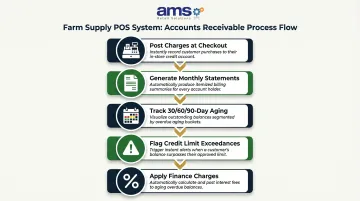
Without this integration, every wholesale transaction requires duplicate manual entry: once at the register, again in QuickBooks. That's exactly where billing errors compound and invoices get disputed.
Purchase History as a Retention Tool
For retail customers, purchase history powers loyalty programs — points per purchase, birthday discounts, targeted promotions. For wholesale accounts, it enables volume rebate tracking, automated reorder reminders for regular supplies, and sales rep follow-up triggers.
Bain research shows that increasing retention by just 5% increases profits by 25–95%, and acquiring new customers costs 5–25 times more than retaining existing ones. A POS that tracks who buys what — across both customer segments — converts transaction history into a practical tool for follow-up, reordering, and account growth.
Essential POS Features for Ranch and Farm Supply Stores
Inventory Management Across Thousands of SKUs
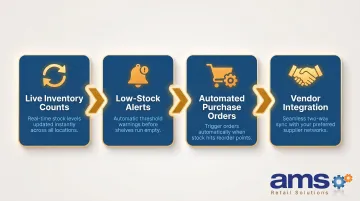
With 17,000–27,000 products spanning feed, hardware, tack, apparel, and seasonal goods, real-time inventory visibility isn't optional. A well-configured POS tracks stock across all departments with:
- Live inventory counts updated at every sale
- Low-stock alerts triggered when quantities hit reorder points
- Automated purchase order generation based on velocity and lead times
- Vendor integration to simplify reordering with major distributors
IHL Group found that 2025 profit-winning retailers prioritize inventory visibility 208% higher than laggards and invest 740% more in IT growth. Retailers using RFID and advanced inventory tools average 56% higher sales growth as a result.
Multi-Unit-of-Measure and Bulk Sales
Selling chicken feed by the bag at retail and by the pallet at wholesale requires a POS that handles multiple units of measure for the same SKU. The system must:
- Support each, case, pallet, pound, ton, and custom units
- Calculate pricing and deduct inventory correctly based on unit sold
- Integrate with scales for fractional quantities and weight-based pricing
HandiFox reports that 9 out of 10 small businesses arriving for inventory automation don't track units of measure — leading to procurement errors, incorrect pricing, and fulfillment delays. For farm stores, multi-UoM isn't an add-on; it's baseline functionality.
Barcode Scanning and Custom Label Printing
With thousands of SKUs — many with multiple names (brand name, common name, generic equivalent) — fast, accurate scanning is critical. Fast, accurate scanning reduces manual errors and speeds shelf management during seasonal changeovers. The POS should support:
- Barcode scanning across all product types
- Custom shelf labels and price tags printed from within the system
- Unique barcodes for each unit type (bottle, case, pallet) to ensure accurate inventory deduction
Actionable Reporting for Buying Decisions
Generic sales reports don't cut it. Farm supply owners need reporting that surfaces:
- Top movers by department — which feed, hardware, and apparel items actually sell
- Slow-moving seasonal inventory flagged beyond 90 days, so it clears before next season
- Revenue split between retail and wholesale customers
- Gross margin by category, from feed (4–8%) to tires (10–20%)
Oklahoma State Extension recommends tracking the Inventory Management Index (IMI = Turns × Earns) alongside ABC analysis. "A" items — less than 15% of inventory — generate over 80% of sales, while "B" and "C" items make up the bulk of stock with far lower returns. Reports that surface these patterns help owners buy smarter and carry less dead stock.
Offline POS Capability
Rural connectivity isn't reliable. USDA data confirms 22.3% of rural Americans lack broadband coverage, and Pew Research found only 71% of rural households subscribe to home broadband vs. 84% in suburban areas. A POS that requires constant internet connectivity fails the moment the connection drops.
Offline-capable systems process transactions locally and sync data when connectivity returns. For stores in agricultural regions, this isn't optional — a dropped connection means lost sales.
How a Unified POS Simplifies Daily Operations
Faster Checkout for Both Customer Types
A unified system eliminates mode-switching. Staff look up the customer, the system auto-applies their price tier, items scan at the correct rate, and payment processes — cash, card, or charge-to-account — without switching screens. During spring buying season when lines are deep, this speed keeps customers moving.
Employee Access Controls Reduce Shrink
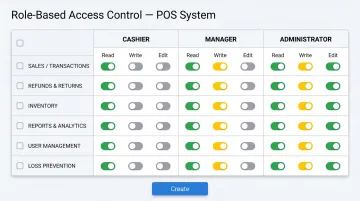
Role-based permissions let managers assign access by job function. A new cashier can process retail sales but can't edit wholesale pricing tiers or approve account credits. NRF's 2023 security survey found that internal theft accounts for 29% of total shrink, and exception-based reporting software — enabled by POS access controls — is the #1 mitigation tool for internal fraud.
Loyalty and Incentives for Both Segments
The same system handles retail and wholesale programs side by side — no separate platforms, no manual tracking. That includes:
- Retail loyalty: points per purchase, seasonal promotions
- Wholesale incentives: volume rebates, early-payment discounts, tiered pricing unlocks
What to Look for When Choosing a Ranch and Farm Supply Store POS
Confirm True Wholesale Account Management
Not all POS systems support tiered pricing, credit limits, and net terms out of the box. Ask vendors specifically:
- Can customers be assigned to price tiers that auto-apply at checkout?
- Does the system enforce credit limits before approving charges?
- Can it generate monthly statements and track 30/60/90-day aging?
- Does it handle net-30, net-60, and custom payment terms?
If the answer requires "workarounds" or third-party integrations, keep looking.
Prioritize Specialty Retail Experience
Generic small-business POS works for cafes and boutiques. Ranch supply stores need vendors who understand feed turns, bulk sales, and seasonal inventory cycles. Ask if they have existing customers in the farm, feed, or ag supply space — and request references from similar operations.
AMS Retail Solutions, for example, focuses exclusively on specialty retailers. Their NCR Voyix Counterpoint implementation supports tiered pricing, multi-unit-of-measure inventory, wholesale account management, and offline operation — with 24/7 support from staff who know agricultural retail. As a single-source provider, AMS covers software, implementation, training, and ongoing support, so you're not coordinating between three vendors when something breaks.
Evaluate Scalability and Future-Proofing
Whether you operate one location today or plan to expand, the POS should handle:
- Additional registers without system replacement
- New store locations with centralized reporting
- Evolving customer account structures as your wholesale business grows
Systems that require a rip-and-replace when you add a second location waste time and money.
Frequently Asked Questions
What does a ranch supply or feed store do?
Ranch and farm supply stores sell products that support livestock, equine, poultry, and farm operations — including feed, tack, farm hardware, fencing, pet supplies, and clothing. They serve both individual retail customers and commercial agricultural businesses.
How do wholesale accounts work?
Wholesale accounts allow commercial buyers (farmers, ranchers, resellers) to purchase at negotiated lower price tiers, often on open terms like net 30. Charges post to a store account and are settled via monthly statement rather than at point of sale.
What is dual pricing in a POS system?
Dual pricing (or tiered pricing) means the system stores multiple price levels for each product and automatically applies the correct price based on the customer's assigned account type — retail list price vs. wholesale or commercial rate — at checkout.
How does a POS system handle inventory for a ranch or farm supply store?
Core steps include receiving and tagging inventory, real-time tracking of stock levels, setting reorder points, generating purchase orders, and conducting periodic counts. A POS system automates most of these steps to reduce manual effort and inventory shrink.
What is the best POS system for a ranch or farm supply store serving retail and wholesale customers?
The best POS for this use case is one built for specialty retail — not a generic small-business system. Ranch and farm supply stores need dual pricing, wholesale account management, and deep inventory tools. NCR Voyix Counterpoint, offered through AMS Retail Solutions, is purpose-built for exactly this combination.
Are there any free POS software options for small retail businesses?
Free or entry-level POS options exist but typically lack wholesale account management, tiered pricing, and deep inventory features that ranch and farm supply stores require. Investing in a purpose-built system proves more cost-effective long-term by preventing pricing errors, billing disputes, and inventory shrink.