Introduction
Picture this: It's mid-April, your spring rush is in full swing, and a loyal customer walks in asking for the flat of petunias she saw last week. You check the greenhouse, scan the lot, and realize—they're gone. Sold out three days ago. Meanwhile, a pallet of ornamental grasses nobody's buying occupies prime retail space near the entrance. Every stockout during peak season sends customers to competitors, and every unsold perishable plant ties up cash that could have stocked faster-moving inventory. The cost adds up faster than most owners realize.
Garden centers face challenges that generic retail systems weren't designed to handle: living, perishable stock that loses value daily; extreme seasonal demand swings; outdoor registers with spotty connectivity; and variable pricing by size, bundle, or bloom stage.
This article breaks down the features that genuinely matter for garden center operations, and which ones you can skip.
TLDR:
- Up to 78% of garden center shrink comes from spoilage, not theft — perishable tracking is non-negotiable
- Barcode scanning cuts inventory data errors by 10,000x compared to manual entry
- Integrated POS-inventory systems eliminate lag and manual reconciliation during spring rush
- Prior-year sales data replaces gut-feel ordering and reduces both stockouts and overstock
- Offline POS capability protects outdoor registers when network connectivity fails
Why Garden Centers Need Inventory Software Built for Their World
Garden center inventory is uniquely difficult to manage. Unlike apparel or hardware retailers, you're working with living, perishable stock that changes value as it grows, blooms, or wilts. A vibrant flat of impatiens in early May commands full price; two weeks later, if leggy and stressed, it's markdown material.
Add seasonal demand spikes—where 50-80% of annual revenue concentrates into a few spring months—plus inventory spread across greenhouse bays, outdoor lots, hardgoods aisles, and seasonal décor sections, and most generic retail systems simply can't keep up.
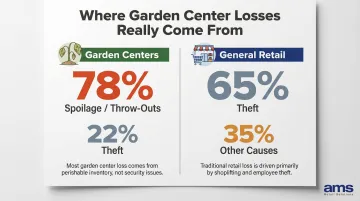
The cost of mismanagement is steep. According to Garden Center Magazine, up to 78% of garden center shrinkage comes from spoilage and throw-outs, not theft. This fundamentally differentiates garden centers from general retail, where theft accounts for roughly 65% of losses. Overstocking perishables ties up cash and creates shrink; understocking during peak season drives customers elsewhere—and unlike other retail categories, you can't recover lost spring demand in July.
The shift from pen-and-paper or disconnected spreadsheets to purpose-built software has transformed garden centers' ability to act on data. Two examples show what that looks like in practice:
- Lichtenfelt Nurseries (South Carolina) moved from analog cash registers to a cloud-based POS in 2018, gaining real-time inventory visibility across their yard—enabling website-synced stock and buy-online-pick-up-in-store.
- Landscape Garden Centers (South Dakota) replaced bulk upfront ordering with weekly POS-driven reordering tied to prior-year sales history. The result: fresher stock, better sell-through, and as President Erik Helland put it, "We have really taken the gut check out of it and rely on our numbers."
The Margin Pressure Reality
The 2025-2026 State of the Industry Report found that 2025 produced "one of the least profitable springs in the last decade" for independent garden centers. When margins tighten, inventory efficiency shifts from a nice-to-have to a survival issue. IHL Group research shows that retailers classified as "profit winners"—those with 10%+ profit growth—prioritize inventory visibility 208% higher than profit laggards. For garden centers navigating tight springs, that gap in visibility is often the difference between a profitable season and one spent marking down dead stock.
Core Features Your Garden Center Inventory Management Software Must Have
Real-Time Stock Tracking and Barcode or Label Management
Real-time inventory visibility—updated automatically at the point of sale—is non-negotiable. Batch manual counts fail during peak season when you're processing hundreds of transactions daily and restocking multiple times per week. The moment a flat of petunias scans at checkout, your system should reflect that change instantly across every terminal and reporting dashboard.
Barcode scanning eliminates data entry errors at a scale that matters. According to Descartes Finale Inventory, manual data entry carries a 1-in-300 error rate versus 1-in-3,000,000 for barcode scanning—a 10,000x accuracy improvement.
In a garden center environment where plants carry multiple common names and come in varying container sizes, manual SKU entry compounds operational shrink. Nearly 20% of retail shrink is attributed to operational errors rather than theft—errors your system should prevent automatically.
Custom label and barcode generation is essential for garden centers specifically. A flat of annuals, a pre-potted specimen tree, and a bulk soil bag all need different labels and price points. Your system should support:
- Variable pricing by unit, size, or bundle without checkout confusion
- Custom label formats for different product categories
- On-demand label printing at receiving and throughout the season
- Barcode formats that encode variety, size, and supplier information
When Lichtenfelt Nurseries implemented their POS system, the manager gained the ability to "be at home, get a question, log in and know exactly what is on the yard"—eliminating trips to verify stock and enabling real-time visibility for both retail and wholesale operations.
Low-Stock Alerts, Reorder Points, and Vendor Management
Automated low-stock alerts prevent the spring stockout scenario. When inventory for a high-velocity item drops below a set threshold, the system notifies the buyer immediately rather than relying on a staff member to notice during a morning walk-through. Set reorder points per SKU based on:
- Units sold per week during comparable periods (historical velocity)
- Days from order to delivery, so reorder timing stays accurate
- Whether current sell-through is trending faster or slower than prior year
- Seasonal activation so alerts fire only during active selling windows
Built-in vendor management cuts the time spent on purchase orders by storing supplier contacts, pricing, and lead times in one place. When low-stock alerts and vendor data are connected, a buyer can generate a PO in minutes rather than searching through email threads for the right supplier contact and last year's pricing. Look for systems that support:
- Supplier contact and terms management
- Price history by SKU and vendor
- Lead time tracking for accurate reorder timing
- One-click PO generation from inventory alerts
AMS Retail's NCR Voyix Counterpoint includes purchasing and vendor management within the same platform that handles sales and inventory. Garden centers can maintain supplier relationships, pricing structures, and ordering workflows in one place, so the data gaps that open up between disconnected systems never become a problem.
Perishable and Seasonal Inventory Tracking
Perishable tracking in a garden center means monitoring sell-by or peak-quality windows for plants, seeds, and soil amendments so staff can prioritize moving older stock before it loses value. A field nursery study documented in Nursery Management found dead-plant shrinkage ranging from 6% to 62% across nine species, with causes including poor root systems, water mismanagement, and extended holding duration. Time kills margin on living inventory—retail garden centers carry the same risk.
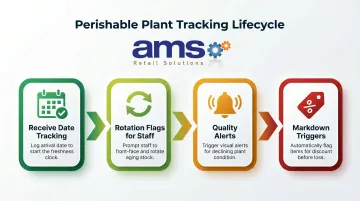
Effective perishable tracking includes:
- Receive-date tracking to identify oldest stock first
- Rotation flags for staff picking and restocking
- Quality alerts when products approach sell-by windows
- Markdown triggers to move aging inventory before total loss
Seasonal inventory controls keep your system clean and staff focused. Features to prioritize:
- Seasonal item flags to activate/deactivate products by calendar
- Bulk SKU archiving for off-season products
- Prior-season performance reports showing which items sold out early versus were marked down
- Staged product activation by planned delivery date
According to Greenhouse Management, 71% of garden centers now grow a percentage of their own plant material, meaning inventory tracking must cover both purchased and grown stock. The shift toward vegetables and herbs—up 6% in 2024—increases the perishability challenge, as these categories have shorter shelf lives than woody ornamentals.
Reporting and Demand Forecasting: The Features That Actually Change How You Buy
Raw inventory counts are only half the picture. The features that drive profitability are the reporting tools that turn transaction data into purchasing decisions. Garden center buyers should expect:
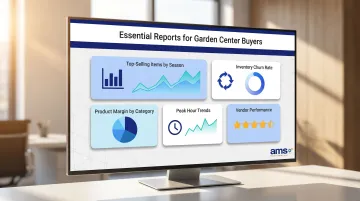
Essential Reports:
- Top-selling items by season — velocity SKUs shift dramatically between spring, summer, and fall
- Inventory churn rate — how quickly products sell relative to their carrying cost
- Product margin by category — which departments drive profit versus which drive volume
- Peak hour and day trends — staff appropriately and keep stock available during rush periods
- Vendor performance — delivery accuracy, lead times, and pricing consistency over time
Demand forecasting compares this season's sales rate to the same period in prior years, then projects when to reorder and in what quantity.
One New Hampshire nursery reviews January and February POS history to refine spring orders, identifying when to pull back on slower-moving varieties. A Texas garden center uses POS reports by department, vendor, and date to pinpoint popular sizes and varieties for open-to-buy planning.
This replaces gut-check ordering with data-backed decisions, reducing both overstock and stockout risk. According to IHL Group research, AI-powered demand forecasting can reduce forecast error by 20–40% in retail. Even basic POS-generated sales history delivers real improvements for independent garden centers — no advanced AI modules required.
Shrink Reports: Exposing Hidden Losses
Forecasting tells you what to buy. Shrink reports tell you what you're quietly losing.
Reporting can expose hidden sources of shrink — damaged goods, employee error, theft — by surfacing discrepancies between receiving records and current counts. Between 3% and 5% of daily sales data contains issues like incorrect pricing, duplicate entries, or missing data that contribute to shrinkage. Shrink reports allow management to:
- Investigate root causes rather than simply writing off losses
- Identify patterns by department, shift, or time of day
- Tighten receiving processes to catch vendor errors at delivery
- Adjust pricing and markdowns based on actual sell-through
Sales reports also inform store layout and display decisions. If a product performs well in one location or season but poorly in another, the data surfaces that pattern. Research shows that retailers reporting increased inventory accuracy are 68% more likely to also report seamless customer experiences — stockouts frustrate shoppers, while accurate inventory lets staff make confident recommendations.
Why POS Integration Is the Feature No One Talks About Enough
The critical difference between standalone inventory software and a system where inventory and point of sale are fully integrated: every transaction automatically updates stock levels in real time, eliminating the lag and manual reconciliation that standalone systems require. This integration is especially important during the fast-paced spring rush when there's no time to sync systems manually or run end-of-day batch updates.
An integrated POS-inventory system also connects customer purchase history to inventory planning. Knowing that a segment of loyal customers buys perennials in early May every year lets buyers stock appropriately and create targeted promotions. NCR Voyix Counterpoint sends targeted emails based on customer purchase history — strengthening both inventory accuracy and customer loyalty at once. The practical result: better buying decisions before the season starts, not reactive restocking after shelves run out.
Offline POS Capability: The Unsung Hero for Outdoor Retail
Garden centers face a connectivity challenge that indoor retailers don't: outdoor registers in lot areas or greenhouse stations often have unreliable network connectivity. According to AMS Retail research, approximately 22% of the rural population lacks reliable broadband access, and garden centers may generate 50-80% of annual revenue in a single month. U.S. businesses experience an average of five major payment disruptions annually, with 63% occurring during peak trading periods.
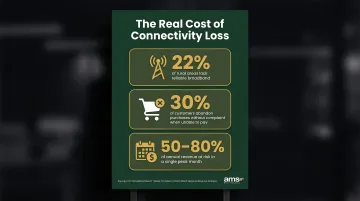
That connectivity loss during a spring Saturday rush translates directly to unrecoverable lost sales. Research shows that 30% of customers abandon a purchase without complaint when they cannot pay, and 32% stop doing business with a brand after one bad experience. A system that keeps processing transactions while offline (syncing inventory updates once the connection returns) closes that gap before it costs you.
AMS Retail's NCR Voyix Counterpoint is built around this unified POS-plus-inventory model for specialty retailers, offering offline capability, customizable tools, and 24/7 support so operations keep running whether or not the network does.
Features to Look For (And Which Ones You Can Skip)
Features Worth Having (If They Match Your Operation)
Multi-location inventory management is valuable if you operate more than one site or have a separate grow area. NCR Voyix Counterpoint is single-store and multi-store capable, allowing garden centers to manage inventory transfers, location-specific pricing, and consolidated reporting across sites. Prioritize this if you're planning expansion or currently managing inventory across disconnected locations.
E-commerce inventory sync matters if you sell online or offer curbside pickup. Weston Nurseries in Massachusetts originally used a standalone e-commerce platform that required manual entry of online orders into the POS system—creating inventory mismatches and phantom stock.
They switched to an integrated e-commerce suite to automate inventory reduction and order syncing. If your website generates meaningful revenue or you plan to launch online sales, this feature prevents the dual-entry nightmare.
Serialized inventory tracking for high-value tools or equipment rentals is useful if you rent mowers, tillers, or other equipment. This feature tracks individual units by serial number, monitors rental status, and manages maintenance schedules—but it adds complexity unnecessary for businesses focused solely on plant and hardgoods retail.
Features Often Oversold to Garden Centers
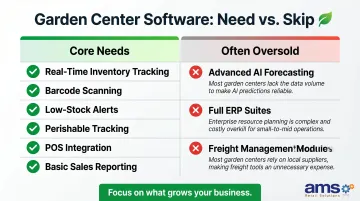
Advanced AI-driven forecasting modules add complexity without clear ROI at smaller scale. Less than 30% of AI projects in retail move past the pilot stage, and Forrester advises retailers to ensure AI use cases "prove value rather than adding incremental complexity or cost." For a garden center in the $350,000–$2 million range, basic POS-based reporting delivers proven ROI before considering AI tools.
Freight and logistics management and full ERP suites with HR or manufacturing modules are enterprise-grade features that garden centers with one to three locations rarely need. Focus budget on core inventory and POS functionality first. As Ron Vanderhoff, VP/GM of Roger's Gardens in California, warns: "Changing POS or inventory system software is a very expensive and disruptive thing to do in any company and should not be taken lightly."
The Need vs. Nice-to-Have Test
Evaluate any feature by asking:
- Does this solve a problem I have right now, or a problem I might have in two years?
- Will my team actually use this, or does it require training we don't have bandwidth for?
This framework helps buyers avoid paying for complexity they won't use. Peg Castorani, owner of Gateway Garden Center in Delaware, puts it plainly: "Support is the most critical puzzle piece to your success." Prioritize proven core features and responsive support over feature lists that don't match your operation's scale.
Frequently Asked Questions
How to control stock inventory?
Effective stock control combines real-time tracking software with disciplined processes: set reorder points for every SKU, run low-stock alerts, use barcode scanning at receiving and checkout, and review weekly sales reports to spot trends before they become stockouts.
What is in plant inventory?
Plant inventory includes all living and non-living merchandise: plant species by variety and container size, seeds and bulbs, soil and fertilizer, pest control products, tools, pots, and seasonal décor. Each category has different tracking requirements, with live plants needing the most active management due to perishability.
What is the difference between a POS system and inventory management software?
A POS handles the transaction — checkout, payment, receipts. Inventory management tracks what you have, what's selling, and when to reorder. The most effective garden center solution combines both in one integrated platform so every sale immediately updates stock counts without manual data entry.
How does seasonal demand affect garden center inventory management?
Seasonal demand — especially in spring — can multiply in a matter of weeks. That makes prior-year sales data essential for setting reorder points before the rush hits. Software that flags seasonal items and generates demand forecasts helps buyers avoid understocking at peak and excess dead stock after.
What features should a first-time buyer prioritize in garden center inventory software?
Start with three features: real-time inventory tracking integrated with your POS, automated low-stock alerts with reorder capabilities, and basic sales reporting. These solve the most common and costly garden center inventory problems without adding unnecessary complexity.
How do I reduce plant shrink and dead stock at my garden center?
Reducing shrink starts with accurate receiving — scan every shipment in and flag discrepancies immediately. For dead stock, weekly sell-through reports by category help you catch slow movers early, while automated markdown prompts let you move perishable inventory before it's a loss.