
Running a garden center during peak spring season is high-stakes: live and seasonal inventory moves fast, customers queue at outdoor checkouts, wholesale accounts and retail shoppers may share the same floor, and seasonal staff need tools they can learn quickly. A basic cash register can become a bottleneck fast.
A well-chosen POS system can improve much more than checkout. In a Garden Center magazine survey, independent garden centers using POS systems pointed to better inventory control, faster and more accurate checkout, improved customer tracking, and lower labor costs among the benefits. The same survey found that 28% of IGCs were not using POS systems before the pandemic. Garden Center magazine's POS survey
Those benefits matter because garden centers do not operate like conventional retail stores. Plants have a shelf life. Seasonal demand changes quickly. Products may be sold by the plant, flat, pallet, yard, or ton. Landscapers may receive different pricing from walk-in customers. Selling happens in greenhouses and yards as well as at the front counter.
This guide compares five POS systems for 2026, the garden-center features that matter most, and the questions to ask before choosing one.
Key Takeaways
The right garden center POS should match how the business operates, not simply offer the longest feature list. Live goods, seasonal purchasing, professional customer pricing, and outdoor selling deserve more weight than generic retail features.
AMS Garden Center POS is the strongest overall fit in this comparison for established and growing garden centers that need green-industry workflows without positioning the system only for large or enterprise retailers.
General retail systems such as Square can be a sensible fit when operations are straightforward. As inventory, customer types, purchasing, and fulfillment become more specialized, the differences between general and garden-focused POS software become more important.
E-commerce should be weighted according to the business. A strong online store does not automatically solve live-goods inventory, contractor pricing, bulk-material, or greenhouse workflows.
Do not evaluate software alone. Implementation, staff training, support, and the system's ability to fit future growth can determine whether a POS remains useful years after installation.
What Is a Garden Center POS System?
A garden center POS system combines checkout, inventory management, customer information, purchasing, reporting, and other retail functions in one platform. What separates a strong garden-center system from ordinary retail software is how well those tools account for the way green-industry businesses actually operate.
A garden center may carry living inventory alongside pottery, tools, fertilizers, decor, and bulk landscape materials. The same plant can be searched by botanical or common name. Retail customers, landscapers, contractors, and wholesale buyers may each have different pricing. Inventory might sit inside a store, across several greenhouses, or outside in a nursery yard.
That creates requirements a conventional checkout system may not prioritize.
What Sets Garden Center POS Software Apart?
Live-goods inventory: Plants can deteriorate or become unsellable, so physical inventory and recorded inventory can diverge quickly if losses are not captured.
Plant-specific product information: Botanical names, common names, sizes, varieties, and other attributes help staff identify the correct item without depending on one experienced employee.
Flexible units of measure: Garden retailers may sell one product in several ways - individual plants, flats, bags, pallets, yards, or tons.
Professional customer pricing: Landscapers, contractors, wholesale buyers, and retail customers may require different price levels, discounts, account terms, or volume breaks.
Outdoor selling: Checkout and inventory lookup often need to move beyond the front register into the greenhouse, nursery, or yard.
Seasonal purchasing: What sold last spring matters when planning this spring. Useful reporting should help buyers make those decisions without turning every answer into a spreadsheet exercise.

Best POS Systems for Garden Centers in 2026
We compared these systems based on garden-center fit rather than simply counting features.
That distinction matters. A powerful general retail system can still be the right choice for a small garden retailer. Likewise, a growing single-location garden center can have more demanding requirements than a much larger business selling standardized merchandise.
| POS System | Best Fit | Main Strength |
|---|---|---|
| AMS Garden Center POS | Growing garden centers, nurseries, and green-industry retailers | Garden-specific operations plus hands-on implementation and support |
| Rapid Garden POS | Businesses specifically comparing green-industry POS platforms | Deep garden, nursery, and landscape functionality |
| Square for Retail | Smaller or straightforward retail operations | Accessible general retail and inventory tools |
| Shopify POS | Garden retailers with e-commerce at the center of the business | Connected online and in-store commerce |
| Clover | Businesses primarily needing conventional retail checkout | Payments, hardware, and standard retail functionality |
1. AMS Garden Center POS - Best Overall for Growing Garden Centers and Nurseries
AMS Garden Center POS is AMS Retail Solutions' dedicated garden center POS system. It is built around garden centers, nurseries, greenhouses, landscape-material suppliers, and related businesses rather than treating them as another generic retail category.
That specialization shows up in the details.
The system supports seasonal inventory, live-goods management, plant attributes, botanical and common-name organization, plant tags and barcode labels, and multiple units of measure. A store can handle products sold by the plant or flat alongside bulk goods sold by the yard, ton, or pallet. Multi-location nurseries can also lean on multi-store POS software workflows when inventory and pricing need to stay aligned across sites.
It also accounts for the customer mix many independent garden centers manage. Retail, landscaper, contractor, and wholesale pricing tiers can be maintained within the system, while landscape proposals, charge accounts, volume discounts, load tickets, delivery slips, and seasonal pre-orders support operations that extend beyond walk-in checkout.
For outdoor areas, AMS offers outdoor POS and mobile options intended for nursery aisles, greenhouses, yard areas, and mobile carts.
The strongest case for AMS, however, is not simply that it has more features.
It is that those features map closely to the problems a growing garden center starts encountering. A business does not need to be a large chain before seasonal purchasing, contractor accounts, bulk products, or several selling areas become difficult to manage.
AMS also brings the service side of the deployment in-house. The company has worked in specialty retail since 1992 and reports more than 1,100 POS installations across the United States. Its process includes consultation, installation, training, and ongoing support; AMS also offers 24/7 telephone and remote support for managed-service customers.
Best for: garden centers and nurseries that have moved beyond simple checkout requirements and want software that can accommodate more of the operation without making "more capable" synonymous with "only for large retailers."
2. Rapid Garden POS - Best for Comparing Another Green-Industry Specialist
Rapid Garden POS is the closest specialist comparison in this list.
Like AMS, Rapid focuses heavily on garden centers, nurseries, growers, landscape businesses, and material suppliers. Its current platform includes plant and bulk inventory management, plant labeling, multiple pricing levels, growing and production tools, landscape-service management, mobile hardware, and extensive reporting.
That makes Rapid materially different from Square, Shopify, or Clover. A garden center evaluating Rapid is already looking at software designed around many of the peculiarities of the green industry.
For that reason, this comparison should go beyond the feature checklist.
Ask both specialist providers to demonstrate your actual workflows: receiving plants, searching varieties, selling bulk goods, applying a landscaper's pricing, processing a special order, handling a delivery, and training a seasonal employee. Then compare configuration, migration, training, hardware, ongoing support, and who is responsible when something does not work as expected.
Best for: garden centers that want a specialist platform and are prepared to compare implementation and service models as closely as software features.
3. Square for Retail - Best for Straightforward Retail Operations
Square deserves more credit than simply calling it an entry-level POS.
Its current retail platform supports inventory counting, purchase orders, vendor management, barcode labels, inventory across locations, online selling, reporting, and offline payments on supported configurations. Square also explicitly markets its retail product to plant-and-garden businesses.
That makes it a practical option for a smaller garden retailer whose operation looks mostly like conventional retail.
The question is what happens beyond that.
Square's published retail feature set is broad, but it is not built around green-industry workflows such as plant-specific inventory structures, landscape proposals, multiple professional customer tiers, and the various ways garden centers handle bulk and live goods.
If those requirements matter, do not assume they are covered simply because the platform has "inventory management." Ask for each workflow to be demonstrated.
Best for: smaller garden retailers that want strong general retail tools without requiring extensive green-industry-specific functionality.
4. Shopify POS - Best for E-Commerce-First Garden Retailers
Shopify POS makes the most sense when online and physical retail need to operate as one commerce system.
Shopify can maintain inventory across locations, move inventory between stores, connect online and in-person orders, and support offline checkout, including offline card payments when the required settings and compatible hardware are in place.
For a garden retailer that sells heavily through its website, that connected commerce model can be compelling.
Its center of gravity, however, is commerce rather than garden-center operations. A nursery should still determine how it will manage plant attributes, seasonal live-goods workflows, contractor pricing, bulk materials, landscape-related orders, and other requirements specific to its physical operation.
That does not diminish Shopify's strength. It simply defines where that strength sits.
Best for: garden retailers where e-commerce and unified online/in-store selling carry more weight than specialist green-industry workflows.
5. Clover - Best for Conventional POS and Checkout
Clover combines POS software with a broad selection of payment and hardware options. Its retail system supports inventory, payments and returns, customer-facing functions, reporting, online selling, and offline payment processing.
For a garden store primarily looking to improve checkout and standard retail management, that may cover a substantial portion of what is needed.
As with any general retail platform, the important step is separating "can manage inventory" from "can manage our inventory the way we manage it."
A business carrying straightforward packaged goods has very different requirements from a nursery moving plants among growing areas, maintaining contractor price levels, selling mulch by the yard, or coordinating deliveries.
Best for: garden retailers whose POS requirements remain close to conventional retail and payment processing.

Must-Have Features in a Garden Center POS System
The feature list should start with the work your staff does every day.
Perishable and Botanical Inventory Management
Live goods cannot be managed exactly like boxes sitting on a shelf.
Garden centers need clear visibility into what arrived, what sold, what was lost, and what remains available. Product records should also make it practical to organize plant information such as botanical and common names, varieties, sizes, and other useful attributes.
AMS Garden Center POS supports plant attributes, botanical/common-name organization, shrinkage management, seasonal inventory, and specialized plant labels.
For a deeper look at the inventory side, see Garden Center Inventory Management Software: Features You Actually Need.
Seasonal Purchasing and Reporting
A useful report should answer an operational question.
Which varieties moved fastest last spring? What was overbought? Which products are slowing down now? What needs to be reordered before the next rush?
Historical sales do not remove judgment from purchasing. They give that judgment a better starting point.
AMS Garden Center POS includes seasonal purchasing templates, forecasting, reorder-point functionality, and reporting by category, season, vendor, or location.
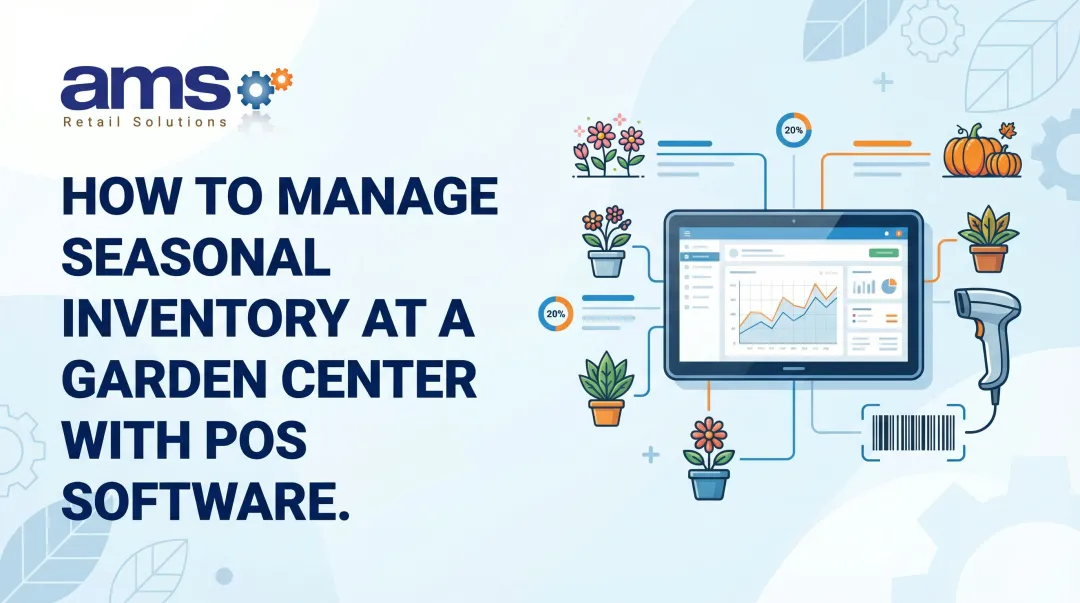
See How to Manage Seasonal Inventory at a Garden Center With POS Software for a more detailed seasonal workflow.
Mobile, Outdoor, and Offline Operations
Garden centers rarely sell from one tidy indoor counter.
Staff may need inventory information or checkout capability in a greenhouse, outdoor nursery, yard, or loading area. Mobile POS can reduce unnecessary trips back to the main register and help relieve lines during peak periods.
Offline capability is a separate question.
Do not assume a system can complete every function without connectivity simply because it offers mobile hardware. Ask what happens to card payments, inventory updates, customer lookup, receipts, and synchronization during an outage.
Retail, Landscaper, Contractor, and Wholesale Pricing
Professional customers create different requirements from ordinary consumer checkout.
A landscaper may have negotiated pricing. A wholesale customer may buy in volume. A contractor may use an account or need an itemized proposal.
If staff have to remember those arrangements or calculate discounts manually, errors are inevitable.
AMS Garden Center POS supports multiple pricing tiers, volume discounts, contractor charge accounts, landscape proposals, load tickets, and delivery-related workflows for businesses serving both retail and professional customers.
Flexible Units of Measure and Bulk Goods
Plants are not always sold one at a time, and landscape materials are not always sold in bags.
The same operation may sell plants by the each, flat, or basket, then sell soil, mulch, or stone by the yard, ton, or pallet.
The POS should keep those transactions tied to meaningful inventory records rather than forcing staff to maintain separate calculations outside the system.
Accounting and E-Commerce Connections
The best POS does not have to perform every business function itself.
It does need to exchange information with the systems you rely on.
Accounting, e-commerce, payment processing, and other integrations should be evaluated according to what information moves between platforms, how often it syncs, and what still requires manual entry.
For online selling in particular, make sure inventory changes from web orders are reflected quickly enough to prevent customers from purchasing plants that are no longer available.
Ease of Use and Staff Training
Mike's concern about "complex" systems points to something genuinely important for the buyer.
Capability is valuable. Complexity is not.
A seasonal employee should be able to learn the core workflow without becoming a POS specialist. During a demonstration, have someone who actually works a register try to find a plant, apply the correct customer pricing, check inventory, and finish a sale.
A system that looks impressive from the back office but slows down the front counter has missed the point.
Which POS System Is Right for Your Garden Center?
Start with the operation rather than the company size.
If you run a small plant shop or seasonal retail operation with fairly conventional inventory and checkout, Square may be more system than you need already. Clover can also make sense when payments and ordinary retail management are the priority.
If digital commerce drives a large share of the business, Shopify POS deserves stronger consideration because online and store operations are where the platform naturally connects.
If you already know you need garden-industry-specific functionality, Rapid Garden POS is a legitimate specialist alternative worth comparing.
AMS Garden Center POS becomes the stronger fit when several garden-specific requirements start appearing together: seasonal and live-goods inventory, landscaper or contractor customers, different pricing structures, bulk products, outdoor selling, proposals, deliveries, and a need for hands-on implementation and support.
That can happen at one location.
Garden Center magazine's interviews with independent operators make the same broader point: garden centers should choose according to their existing and future needs, not assume that large businesses need sophisticated systems and small businesses always need simple ones. Read the Garden Center magazine POS guidance
The practical question is simple:
What work are you currently doing outside your POS because the POS cannot handle it cleanly?
That answer tells you more than employee count or annual revenue.
How We Chose the Best Garden Center POS Systems
We evaluated these systems around the jobs a garden-center POS needs to perform:
- garden-industry inventory fit;
- live and seasonal inventory management;
- ease of everyday checkout and staff use;
- outdoor and mobile selling;
- retail, contractor, landscaper, and wholesale workflows;
- purchasing and order management;
- bulk and flexible-unit sales;
- e-commerce and integration capability;
- room to support a growing operation; and
- implementation and ongoing support.
We did not rank systems primarily by advertised monthly price.
Hardware, payment processing, registers, implementation, integrations, support, locations, and configuration all affect total cost. More importantly, the cheapest software is not necessarily inexpensive if staff spend years building manual processes around it.
Support also deserves more weight than most comparison charts give it.
Garden Center magazine interviewed operators who described provider knowledge and support as central to successful POS transitions. One operator called support the most critical part of the puzzle; another warned that changing POS or inventory systems is expensive and disruptive.
That is why a serious evaluation should include the provider as well as the product.

Conclusion
The best POS system for a garden center is not automatically the system with the most features, the lowest advertised price, or the biggest name behind it.
It is the one that fits the way your business sells today and gives you enough room for what comes next.
For a straightforward operation, a general retail platform may be exactly the right choice. But as seasonal inventory, live goods, bulk materials, outdoor selling, professional customer pricing, landscape orders, and purchasing become more important, a system designed around green-industry workflows becomes easier to justify.
AMS Garden Center POS is built for that point in the journey. It combines garden-specific operational tools with AMS Retail Solutions' consultation, implementation, training, and support model. Operators comparing platform heritage can also review how NCR Counterpoint for garden centers fits specialty retail deployments.
If your current POS is forcing too much of the business into spreadsheets, manual discounts, or workarounds, talk to AMS Retail Solutions about your garden center setup. The right conversation starts with how your store actually works - not with a generic feature demo.
Frequently Asked Questions
Which POS system is best for a garden center?
It depends on the operation. For established and growing garden centers that need seasonal inventory, live-goods management, professional customer pricing, outdoor selling, and garden-specific workflows, AMS Garden Center POS is the strongest overall fit in this comparison. Smaller businesses with straightforward retail needs may find Square or Clover sufficient, while e-commerce-heavy retailers may place greater value on Shopify.
What features should a garden center POS system have?
Look for inventory management suited to live and seasonal goods, flexible product information, outdoor or mobile POS, different customer price levels, purchasing, reporting, flexible units of measure, and the integrations your business needs. Garden centers serving landscapers or contractors should also evaluate quotes, account customers, volume pricing, deliveries, and special orders.
Can a garden center POS track plants by botanical and common name?
Garden-focused systems can. AMS Garden Center POS allows products to be organized using botanical and common names along with plant attributes such as size, color, and variety. This is useful when customers and employees use different names for the same plant.
What POS works best for a small garden center?
Business size alone is not a reliable way to choose. A small plant shop with conventional checkout and inventory may be well served by a general retail system such as Square. A similarly sized nursery managing significant live inventory, contractor customers, bulk materials, seasonal purchasing, or several selling areas may benefit from garden-specific POS software much earlier.
Can a garden center POS handle both retail customers and landscaper accounts?
Yes, if the system supports multiple customer price levels and account workflows. AMS Garden Center POS supports separate pricing for retail, landscaper, contractor, and wholesale customers, along with volume discounts, charge accounts, landscape proposals, and related order workflows.
Can garden center POS systems work outside or without internet access?
Mobile and outdoor POS are increasingly common, but offline capability varies by platform and configuration. Ask vendors to demonstrate exactly what continues working when connectivity fails, including card payments, customer lookup, receipts, inventory updates, and later synchronization. Do not treat "mobile" and "offline" as interchangeable features.
How long does it take to implement a garden center POS system?
Implementation depends on data migration, hardware, number of locations, integrations, configuration, and staff training. A relatively simple setup can be easier to deploy than a fully configured garden-center system. Plan the change well before the spring rush and ask the provider for a written implementation process rather than relying on a generic timeline.