Unlike the immediate payment that comes with retail transactions, B2B credit sales create a gap: inventory leaves your yard before cash arrives. A single contractor client may place dozens of orders per month for bulk stone, mulch, soil, or plants, each generating a separate invoice. Without a systematic process, invoices can pile up, get disputed, or go unpaid altogether. Add in the seasonal dimension—spring and early summer bring massive revenue spikes with contractors ordering at high frequency, but payment may not arrive until summer is underway—and the need for deliberate AR management becomes clear.
This guide covers the key areas landscape supply owners and managers need to master: setting up contractor accounts, B2B invoicing best practices, collections processes, seasonal cash flow planning, and the tools that can automate it all.
Key Takeaways
- B2B AR in landscape supply means longer payment cycles, larger orders, and seasonal volume swings—all requiring deliberate credit policies
- Set credit applications, account limits, and written payment terms before extending credit to any contractor
- B2B invoices must include specific elements to be legally sound and to prompt faster payment
- Use an aging AR report and consistent collections follow-up to protect cash flow
- The right POS software automates invoicing, tracks aging balances, and cuts manual AR work
Why B2B Accounts Receivable Is Different for Landscape Supply Companies
When landscape supply companies sell to contractors on account—whether on net 30, net 60, or open charge accounts—payment is deferred. Inventory leaves the yard before cash arrives. Unlike retail, there's no immediate payment to offset the cost of goods, creating a gap that must be actively managed.
Volume and Complexity Challenges
A single contractor client may place dozens of orders per month for bulk materials. Each delivery generates a separate invoice. Without a systematic process, invoices can pile up, get disputed, or go unpaid altogether. This volume requires dedicated tracking and follow-up procedures that go well beyond point-of-sale management.
The Seasonal Cash Flow Squeeze
Spring and early summer bring massive revenue spikes, with contractors ordering at high frequency — but payment may not arrive until summer is well underway. That timing gap puts real pressure on operating cash.
The numbers back this up. According to the 2025 Atradius Payment Practices Barometer, only 52% of B2B invoices are paid on time in the United States, and overdue invoices affect 43% of the value of credit-based B2B sales. In construction and building materials — closely adjacent to landscape supply — many projects run on net 60 to net 90 payment cycles.
Customer Concentration Risk
Many landscape supply yards depend heavily on a small number of large contractor accounts. A single delinquent account can represent a disproportionate share of outstanding AR and create significant risk for the business. Finance professionals typically flag concentration risk when any single customer accounts for 10% or more of revenue or when the top five customers account for 25% or more.
B2B vs. Retail AR
Managing retail AR involves minimal credit exposure—customers pay at checkout or settle small charge balances quickly. B2B AR requires credit limits, terms negotiations, formal collections processes, and ongoing monitoring of account health. In practice, that means landscape supply businesses need dedicated AR workflows — not just a register and an end-of-day report.
Setting Up Contractor Credit Accounts and Payment Terms
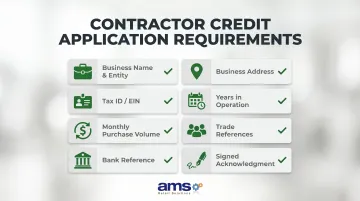
A written credit application is the foundation of any B2B AR program. Your landscape supply credit application should include:
- Business name, legal entity type, and DBA (if applicable)
- Contact information, physical address, and billing address
- Tax ID or EIN
- Years in operation and type of business
- Estimated monthly purchase volume
- Three to five trade references with contact details
- Bank reference with signed authorization
- Signed acknowledgment of payment terms, credit limits, and penalty clauses
According to NACM (National Association of Credit Management) best practices, comprehensive credit applications should also include language on late charges, collection costs, change-of-ownership notices, and authorized signatures.
Evaluating Creditworthiness
Before extending a charge account, evaluate creditworthiness by:
- Checking trade references—call other suppliers to review payment history
- Running a business credit report through Dun & Bradstreet or a similar bureau
- Reviewing years in operation and estimated monthly volume against credit requested
- Noting any suits, liens, or judgments on file
Even a quick phone call to two or three trade references can surface payment problems before they become your problem.
Common Payment Term Structures
The most common B2B payment term structures for landscape supply include:
- Net 30: Standard for established contractor accounts with proven payment history
- Net 60: Appropriate for large-volume buyers or custom/project-based orders
- 2/10 Net 30: Early-pay discount structure offering 2% off if paid within 10 days, net due in 30 days
Construction materials suppliers commonly use Net 30 for smaller orders, Net 60 for mid-sized or custom orders, and Net 90 for large private commercial projects. Choose terms based on how long you've worked with the customer, order size, and seasonal timing.
Setting and Enforcing Credit Limits
A credit limit is the maximum outstanding balance before new orders are held. Set limits based on the customer's monthly purchase volume and payment history.
A useful rule of thumb: if a contractor orders $3,000 per month on Net 30 terms, a credit limit of $6,000–$9,000 provides reasonable flexibility while limiting your exposure.
Document all credit terms, credit limits, and penalty clauses (such as late fees or interest on overdue balances) in a signed account agreement. This protects you legally and gives customers a clear reference point that reduces billing disputes.
How to Create and Send B2B Invoices That Get Paid Faster
A valid B2B invoice must include:
- Unique invoice number
- Invoice date and due date
- Seller's full business name, address, and contact details
- Buyer's full business name and billing address
- Itemized description of goods (product name, quantity, unit of measure, unit price)
- Subtotals and applicable taxes
- Total amount due
- Payment terms (e.g., Net 30)
- Accepted payment methods
These fields matter in any B2B transaction — but landscape supply adds a layer of complexity. Invoices here often reflect bulk materials sold by weight or volume: tons of gravel, cubic yards of mulch, pallets of sod. Unit-of-measure accuracy is critical to avoiding disputes that delay payment.
Invoice Timing Matters
Invoices sent the same day as delivery or pickup are paid faster than those batched weekly or monthly. Delayed invoicing creates cash flow lag and customer confusion about what they owe. Research on e-invoicing and payment times shows that manual invoice processing alone can take 23–25 days. Send invoices immediately — keeping the transaction fresh in the customer's mind is the simplest way to accelerate payment.
Purchase Order Matching
Many contractor buyers require that the supplier invoice reference a buyer-issued PO number. Capture PO numbers at the point of sale — missing PO references stall invoices in the customer's approval queue. Three-way matching (PO, receipt, invoice) is a standard accounts payable control for goods. A missing PO reference alone can delay payment by weeks.
Best Practices for Invoice Delivery
- Email invoices as PDFs with a clear subject line (e.g., "Invoice #12345 – Net 30 Due [Date]")
- Include a payment portal link if available
- Follow up with a confirmation that the invoice was received, especially for first-time or high-value orders
- Avoid batching invoices—send them as transactions occur
Managing Aging Accounts and the Collections Process
An AR aging report organizes outstanding invoices by days outstanding:
- Current: Not yet due
- 1–30 days: 1 to 30 days past due
- 31–60 days: 31 to 60 days past due
- 61–90 days: 61 to 90 days past due
- 90+ days: More than 90 days past due
Reviewing aging weekly allows suppliers to catch problems early before they become write-offs. According to the 2025 Atradius Payment Practices Barometer, most US companies report writing off no more than about 5% of the value of B2B receivables as bad debt. The key is intervention before accounts reach the 90+ day bucket.
Tiered Collections Follow-Up Sequence
Implement a consistent, tiered collections follow-up sequence:
- 7 days past due: Friendly reminder via email or phone call—"We noticed Invoice #12345 is now past due. Can we help resolve any questions?"
- 30 days past due: Firmer notice referencing the account agreement and payment terms
- 45–60 days past due: Hold on new orders until the balance is cleared or a payment plan is established
- 90+ days past due: Escalate to a collections agency or pursue legal action
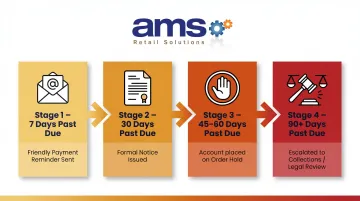
The process only works when you apply it uniformly across all accounts. Selective enforcement undermines credibility and signals that payment terms are negotiable — which they shouldn't be.
Pausing New Orders
Pause new order fulfillment for customers over their credit limit or past a defined overdue threshold (typically 45–60 days). Do this respectfully but firmly. Communicate that payment terms are real, not optional. A hold on new orders often prompts immediate payment.
Seasonal Cash Flow and AR Planning for Landscape Suppliers
Spring and early summer create high-volume credit sales that generate large AR balances. If collections aren't accelerated during peak season, cash flow pressure builds precisely when the business needs capital to restock inventory.
Two Practical Tools for Managing Seasonal AR
- Tighten payment terms for new accounts during peak season. For contractors opening accounts in March or April, start with Net 15 or Net 30 and a lower credit limit until payment history is established.
- Offer early-pay discounts (e.g., 2/10 Net 30) to speed up collections. A small discount can pull payments in by weeks when cash flow matters most.
Forecasting AR Collections
Landscape supply owners should project expected AR collections monthly based on outstanding balances and historical payment patterns. 82% of small business failures are tied to cash flow mismanagement — a finding consistent with broader research linking cash flow practices to firm performance.
A basic AR forecast covers three things:
- Open balances by aging bucket (current, 30, 60, 90+ days)
- Expected collection dates based on each customer's payment history
- Projected shortfalls that require a line of credit or early collection outreach
Using Technology to Automate B2B AR in Landscape Supply
Managing contractor accounts, invoicing, and AR manually in spreadsheets is error-prone and time-consuming as the number of B2B accounts grows. Purpose-built retail and point-of-sale software can automate much of the AR workflow.
Features to Look For
When evaluating a POS or business management system for landscape supply AR, prioritize these capabilities:
- Charge account setup per customer with configurable payment terms by account
- Real-time balance and credit limit visibility at checkout
- Automated invoice generation at the point of sale
- Batch statement generation and delivery
- AR aging reports with customizable buckets
- Integration with accounting software (QuickBooks, etc.)
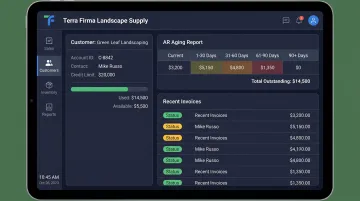
NCR Voyix Counterpoint for Landscape Supply AR
NCR Voyix Counterpoint, offered through AMS Retail Solutions, is built for specialty retailers including garden centers and landscape supply businesses. It checks each of the criteria above out of the box.
Key AR capabilities include:
- Customer charge accounts with configurable credit limits and payment terms
- Outstanding balance visibility at the register, with automatic flagging for over-limit accounts
- Finance charges, aging reports, and batch statement delivery
- Direct integration with QuickBooks and other accounting platforms
That QuickBooks integration eliminates duplicate data entry and keeps your back-office books in sync with what's happening at the counter. For businesses managing dozens or hundreds of contractor accounts, that kind of automation directly reduces bad debt risk and keeps cash flow predictable.
Frequently Asked Questions
What is required for a B2B invoice?
A valid B2B invoice must include a unique invoice number, invoice and due dates, seller and buyer business details, itemized goods description with quantities and unit prices, applicable taxes, total amount due, payment terms, and accepted payment methods.
How to bill for landscaping jobs?
Landscape supply companies should invoice at point of sale or delivery using an itemized invoice that references any buyer PO number, includes clear payment terms, and is sent electronically the same day to minimize payment delays.
What are typical payment terms for B2B landscape supply accounts?
Net 30 is the most common standard for established contractor accounts. Some suppliers offer Net 60 for large-volume buyers or a 2/10 Net 30 early-pay discount structure to accelerate cash collection.
How do you handle a contractor who consistently pays late?
Send a written reminder, hold new orders until the balance is cleared, reduce the credit limit, and if the pattern continues, require prepayment or cash-on-delivery terms for future orders.
How can a POS system help manage B2B accounts receivable?
A POS system with built-in customer account management tracks real-time charge balances, enforces credit limits at checkout, and generates aging reports and statements. Integration with accounting software reduces manual AR work and improves collection rates.
What is a good days sales outstanding (DSO) target for a landscape supply business?
According to the 2025 Atradius Payment Practices Barometer, average US payment terms are 45 days, with 52% of invoices paid on time. A DSO target of 40–50 days is reasonable for landscape supply businesses on Net 30 terms, though your customer mix and seasonal patterns will shift that range.