
Introduction
Processing a return in your POS is routine — but what happens when the return itself was entered by mistake? Voiding a return is not the same as voiding a standard sale. It reverses a return that was processed incorrectly, canceling it and restoring the original sale state.
You'll need this when a return was entered for the wrong item, a customer changed their mind before the transaction settled, or a cashier simply made a processing error.
Mishandling voids and returns carries real financial consequences. Return fraud cost retailers $101 billion in 2023, while inventory distortion from transaction errors contributes to an estimated $1.73 trillion in annual global losses. Getting this right matters.
This guide covers the difference between voiding and refunding a return, the exact steps to void a return transaction in a POS system, what you need in place before doing so, and the most common mistakes to avoid.
Key Takeaways
- Voiding a return cancels a return processed in error and restores the original sale state
- Most systems only allow voids on unsettled transactions before end-of-day batch processing
- Manager-level permissions are required to execute return voids in nearly all POS systems
- Inventory adjustments reverse automatically—items revert to "sold" status when the return is voided
- Same-day voids are simpler to process and produce cleaner audit trails
Void vs. Refund: Understanding the Difference for Return Transactions
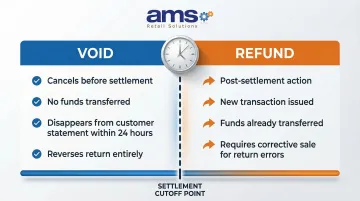
A void and a refund are two distinct operations. A void cancels a transaction entirely before settlement—as if it never happened. The pending charge disappears from the customer's statement within 24 hours.
A refund is a post-settlement action: a new transaction that returns money after the original has already settled and funds have transferred.
When applied to returns, voiding the return undoes it completely. Processing a "refund on a refund" typically requires a separate corrective sale or exchange transaction instead.
Timing Determines Which Option Is Available
The settlement window is the deciding factor. Transactions stay "unsettled" from authorization until your processor submits them in a batch file for settlement. Both Visa and Mastercard require merchants to submit reversals within 24 hours of cancellation, but the practical void window is often much shorter.
Your specific processor's batching schedule sets the real limit. Some batch every three hours; others close at end of day. Once that batch closes, the transaction has settled and can no longer be voided.
How Return Voids Affect Inventory
When a return is voided, inventory adjustments reverse automatically. Items added back to stock during the return must come out again—they revert to sold/out-of-stock status. Failing to verify this reversal contributes to inventory distortion, which costs the global retail industry $1.73 trillion annually according to IHL Group research.
Always verify inventory counts after voiding a return to prevent phantom stock discrepancies.
When Should You Void a Return Transaction?
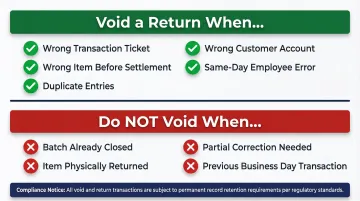
Voiding a return is appropriate only in specific circumstances. Use a void when:
- The return was scanned or entered on the wrong transaction ticket
- The customer handed back the wrong item and the return hasn't settled yet
- Duplicate return entries were created in the system
- The return was started for the wrong customer account
- An employee error occurred during return processing before end of day
When Voiding Is Not Appropriate
Do not void a return if:
- The return has already settled to the payment processor (batch has closed)
- The customer physically returned the item and left the store
- Only a partial correction is needed (use an adjustment transaction instead)
- The transaction occurred on a previous business day
In these cases, process a new sale, exchange, or adjustment transaction instead.
Compliance and Policy Considerations
Regulatory requirements add another reason to use voids carefully. Some regulated retail environments restrict or log voids differently. The Bureau of Alcohol, Tobacco, Firearms and Explosives (ATF), for example, requires that all original transaction records be permanently retained, even for sales that were not completed. Deletion or alteration of original entries is prohibited. Corrections must be documented as new entries that preserve the initial record.
Check both your store's return policy and applicable processor or regulatory rules before voiding.