Introduction
When a customer walks up to your counter asking for brake pads for their 2021 Ram 1500 with the 5.7L HEMI, and your cashier sells them the pads for the 3.5L EcoBoost instead, the cost isn't just a $40 return. You've lost labor processing the return, damaged trust with that customer, and created an inventory problem — the correct part now shows as in stock when it's actually sitting in someone's garage, unusable. For aftermarket auto parts and truck accessories retailers, this scenario plays out daily when generic POS systems try to manage what is fundamentally a fitment-driven business.
Unlike general retail, where a wrong size shirt can be exchanged easily, a wrong part for a specific vehicle configuration can't be sold to the next customer. The auto aftermarket has the highest return rate of any retail industry at 22.6%, nearly double that of clothing and apparel. The core problem is straightforward: generic retail POS systems have no concept of Year/Make/Model/Trim fitment — they see SKUs and prices, not vehicle applications.
Below, we break down what makes aftermarket and truck accessories retail uniquely demanding, why fitment data must live inside your POS (not just on your website), and what features to prioritize when choosing a system that actually prevents wrong-part sales at checkout.
Key Takeaways
- Aftermarket parts are application-specific: one brake pad category can hold 40 identical-looking SKUs that fit completely different vehicles
- Fitment data (Year/Make/Model/Trim compatibility) must be searchable at checkout, not just online
- Incorrect fitment data drives nearly 20% of all auto parts returns — a preventable, costly problem
- A specialized POS should support VIN decode, ACES data integration, and supersession tracking
- 67% of consumers won't return after a bad return experience — preventing wrong-part sales protects repeat business
Why Aftermarket Auto Parts and Truck Accessories Retail Is Different
Aftermarket parts retail operates under a constraint that general merchandise retail never faces: application specificity. A cold air intake, leveling kit, or set of brake pads may exist in dozens of SKUs that are visually identical but fit entirely different vehicle configurations. Unlike managing T-shirt sizes where Small/Medium/Large covers nearly all customers, a part designed for a 2019 Ford F-150 with the 5.0L V8 will not fit the same year truck with the 3.5L EcoBoost.
Truck accessories add layers of complexity beyond standard Year/Make/Model:
- Cab configuration (regular, extended, crew)
- Bed length (5.8-foot vs. 6.5-foot vs. 8-foot)
- Trim level and package options
- Towing packages and factory equipment
A tonneau cover for a 6.5-foot bed won't fit a 5.8-foot bed on the same model year truck. Yet to a generic POS system, both are just "tonneau covers" differentiated only by SKU.
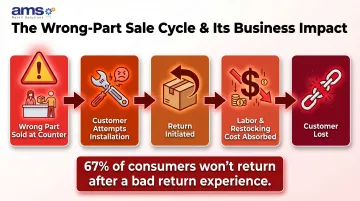
Wrong fitment sales carry a steep operational price. Online auto parts returns run at 19.4% according to the National Retail Federation — the highest of any retail category. When that happens:
- The customer drives away, discovers incompatibility during installation
- Returns the item (absorbing your labor and restocking cost)
- May never return to your store again
67% of consumers say a negative return experience would discourage them from shopping with a retailer again. For a specialty retailer dependent on repeat professional installers and DIY enthusiasts, one bad fitment return can cost years of future revenue from that account.
The root cause is the POS system itself. Generic retail platforms are built for flat product catalogs with no concept of vehicle fitment, ACES data, or part supersessions. A cashier using a generic system has no way to verify compatibility at checkout — they're relying entirely on the customer knowing what they need, which often isn't the case.
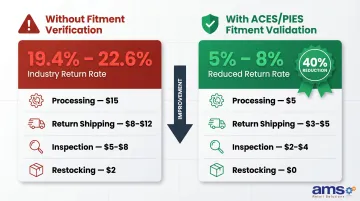
That gap is solvable. One aftermarket shop reduced its return rate from industry average to 5-8% after implementing VIN-based digital ordering, demonstrating that fitment verification at the point of sale produces measurable results.
What Is Fitment Data — and Why It Belongs in Your POS
Fitment data is the structured set of attributes that describes which vehicles a specific part is compatible with — typically expressed as Year/Make/Model/Trim/Engine/Submodel. Without fitment data at the counter, your staff are guessing or looking up compatibility in external catalogs, which slows transactions and introduces errors.
ACES (Aftermarket Catalog Exchange Standard)
ACES is the aftermarket industry data standard for managing and communicating product fitment data. Governed by the Auto Care Association, ACES uses machine-readable XML format to map part numbers to specific vehicle configurations. The current version, ACES 5.0 (released April 2026), uses multiple supporting databases:
- VCdb (Vehicle Configuration database) — vehicle attributes
- Qdb (Qualifier database) — fitment qualifiers
- PCdb (Product Classification database) — product categories
- PAdb (Product Attribute database) — product specifications
- Brand Table — manufacturer brands
Stores that import ACES files into their POS have a structural advantage: they can answer "does this part fit this truck?" in seconds, not minutes.
PIES (Product Information Exchange Standard)
PIES is ACES's companion standard, also governed by the Auto Care Association. Where ACES defines what vehicles a part fits, PIES defines what the part is: features, benefits, marketing descriptions, pricing, warranty information, product attributes, dimensions, weight, UPC, and packaging. The current version, PIES 8.0 (released April 2026), works alongside ACES to provide complete product records in one system.
The Data Flow from Manufacturer to Counter
Fitment data originates with the manufacturer, flows through distributors or industry data providers, and lands inside the store's POS catalog — or should. A modern vehicle contains approximately 30,000 parts, and a typical auto parts store carries 20,000 to 25,000 SKUs. Larger market hubs carry 75,000–85,000 SKUs.
Many stores load fitment data into their website for e-commerce but leave counter staff without lookup capability. This creates a two-system problem that slows checkout and causes errors.
In practice: when a customer says "I need a leveling kit for my 2021 Ram 1500 with a 5.7 HEMI," staff should type that vehicle configuration into the POS and immediately see every compatible SKU in stock, with pricing and bin location. A generic POS simply wasn't built for this.
Must-Have POS Features for Aftermarket and Truck Accessories Stores
Vehicle Lookup and Fitment Search at the Counter
A purpose-built POS should allow staff to search inventory by Year/Make/Model/Trim or by VIN decode. When a VIN is entered, the system auto-populates the vehicle's configuration and filters the product catalog to only show compatible parts. Counter staff stop guessing — and wrong-part returns drop accordingly.
The POS should either include a licensed automotive fitment database or have the ability to import ACES files from suppliers, ensuring compatibility data stays current as new model years are released.
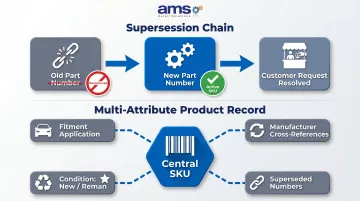
Multi-Attribute Inventory Management
Parts in this niche often have attributes beyond a simple SKU:
- Fitment application
- Superseded part numbers
- Manufacturer cross-references
- Condition (new vs. remanufactured)
A POS must support multi-attribute product records so that all these identifiers point to the same physical item in inventory. Global inventory distortion costs retailers $1.73 trillion annually, representing 6.5% of global retail sales, with specialty hardgoods facing the highest distortion costs of any segment.
The supersession chain problem: when a manufacturer replaces a part number with a new one, the old number must automatically redirect to the new SKU in the POS. Without this, counter staff sell parts that are technically discontinued, creating fulfillment gaps and customer frustration.
Customer and Vehicle History Tracking
Tying purchases to a specific customer's vehicle profile creates a service history that benefits both staff and the customer on return visits. Staff can:
- See what was already purchased for that truck
- Flag compatibility conflicts
- Suggest complementary accessories
Customers no longer need to remember part numbers from a prior visit — and staff spend less time searching, more time selling.
Reporting and Analytics Tuned to Fitment Patterns
Standard sales reports show what sold; fitment-aware reporting shows what sold for which vehicles. Stocking decisions should reflect the vehicle mix of your local customer base — a store near Ford F-150 owners needs different inventory depth than one near a RAM or Tacoma market.
The right POS surfaces dead stock by application group, not just by SKU. O'Reilly Automotive reported inventory turnover of 1.6x in 2025 with average inventory per store of $870,000 — far below fashion (6-12x) or electronics (4.5-8x), reflecting the long-tail nature of parts catalogs.
That gap means capital tied up in the wrong applications. Application-aware reorder triggers let you restock what your specific customer mix actually buys, rather than defaulting to category-level averages.
Managing Inventory Complexity: Supersessions, Cross-References, and Reorder Triggers
The same physical part is often sold under several part numbers by different manufacturers — an OEM number, a Gates number, and a Duralast number can all point to the same belt. A POS with cross-reference lookup lets staff find the item regardless of which number the customer brings in, eliminating "we don't carry that" responses when the part is already on the shelf under a different SKU.
Reorder triggers need to work the same way. Rather than alerting only when total SKU quantity drops below a threshold, a fitment-aware POS can flag when stock for a high-demand application runs low — brake pads for a popular truck fitment, for example — so buyers can prioritize stock where vehicle demand is highest. IHL Group estimates that out-of-stocks account for approximately $1.2 trillion in global losses annually, making proactive replenishment a direct revenue issue.
For multi-location operations, that same logic needs to scale across the network. A capable POS should:
- Show which location holds which fitment-specific stock
- Support inter-location transfers to fill demand gaps quickly
- Consolidate reorder triggers across all sites so inventory investment follows actual demand by location
How the Right POS Reduces Returns and Builds Customer Loyalty
When the POS confirms compatibility before the transaction completes, the primary cause of returns in this category — wrong part, wrong vehicle — is eliminated at the source. General retail return processing costs include direct processing averaging $15 per item, return shipping at $8-12, inspection at $5-8, and restocking at approximately $2 per item. More than 80% of returned items cannot be restocked immediately — they must first be inspected, tested, refurbished, or repaired.
One aftermarket distributor achieved a 40% reduction in product returns after implementing ACES/PIES data validation, which identified thousands of duplicate fitment records and invalid vehicle applications.
Fewer returns are only half the equation. The other half is giving customers a reason to come back.
Customers who feel a store "knows their truck" — remembers what lift kit they already installed, flags if a new purchase conflicts with a previous one, and can proactively surface a compatible accessory — are far more likely to return than customers treated as anonymous transactions. Vehicle profiles and purchase history stored in the POS make that kind of service possible at the counter, without requiring staff to memorize anything.
AMS Retail Solutions, powered by NCR Voyix Counterpoint, gives aftermarket parts and truck accessories stores the tools to do both: reduce compatibility-driven returns through fitment-aware inventory management, and build repeat business through customer vehicle tracking and purchase history. The same system scales from a single location to multiple stores without requiring a platform change.
Frequently Asked Questions
What is fitment data?
Fitment data is the structured compatibility information linking a specific part to the Year/Make/Model/Trim/Engine it fits. It's the foundation of accurate parts sales in aftermarket retail, enabling staff to verify compatibility at the counter.
What is an ACES file?
ACES (Aftermarket Catalog Exchange Standard) is the XML-based industry standard format used by manufacturers and distributors to communicate vehicle fitment data. POS systems that can import ACES files can offer vehicle-specific part lookups at the counter.
What is the best automotive database?
Widely used options include AutoCare's ACES/PIES data standard, TecDoc, and WHI Solutions (Nexpart). The best fit depends on your supplier relationships and which databases your POS system supports natively.
What are the main features of POS?
Core POS features for aftermarket auto parts stores include inventory management with fitment support, vehicle lookup, customer/vehicle history, payment processing, reporting, and supplier integration.
What is the best software for parts inventory?
The best parts inventory software for aftermarket retailers supports multi-attribute SKUs, cross-referencing, supersession chains, and fitment-based search. Specialty retail POS platforms built for complex inventory — such as NCR Voyix Counterpoint — handle this level of detail without requiring heavy customization.
What types of POS systems work best for auto parts stores?
The five main types are cloud-based, on-premise, hybrid, mobile, and legacy/traditional POS systems. For aftermarket parts and truck accessories retailers, cloud-based or hybrid systems are the strongest fit — especially those with offline capability to keep sales running during connectivity outages.