Introduction
Nursery inventory shrinks before it ever reaches the register. Plants grow, wilt, or die between receiving and checkout. Seasonal demand swings wildly from spring rushes to winter lulls. Outdoor conditions degrade tags and labels fast. And dozens of varieties that look nearly identical create confusion at every stage of operations.
Manual tracking methods consistently fail under these pressures. Clipboard counts become outdated within hours, handwritten tags fade or fall off, and staff struggle to remember which flat of petunias is $2.99 versus $3.49.
The result: shrink rates that can reach 33% at retail level, checkout errors that frustrate customers during peak season, and stockouts that blindside you when demand is highest.
A barcode plant nursery management system connects every operational stage into one digital workflow: receiving shipments, labeling plants, processing POS checkout, and generating inventory reports. This guide covers how these systems work, which barcode technologies fit nursery environments, what features matter most, and how to implement a system that reduces shrink, speeds checkout, and keeps you informed on exactly what's in stock.
TLDR: Key Takeaways
- Barcode systems connect plant tags, scanning hardware, inventory software, and POS into one unified workflow
- QR codes beat traditional 1D barcodes for nurseries — more data capacity, better outdoor durability, and no directional scanning required
- Automated barcode tracking reduces shrink and human error across receiving, floor management, and checkout
- When evaluating software, prioritize real-time inventory visibility, mobile scanning, POS integration, and nursery-specific reporting
- A phased rollout (audit first, then label, train, and integrate) keeps disruption low and adoption on track
What Is a Barcode Plant Nursery Management System?
A barcode plant nursery management system combines three components — barcode labels on plants, scanning hardware (handheld scanners, mobile devices, POS terminals), and software — to track plant identity, location, quantity, and pricing across your entire operation.
Generic retail inventory systems track static SKU counts. Plant nurseries are a different problem entirely. Each plant is a living SKU with multiple attributes:
- Species, variety, and container size
- Growth stage and current location on the property
- Availability tied to growing cycles, not simple restocking
- Shrink risk from damage or death before sale
Standard retail software isn't designed to handle any of this.
That complexity shapes how these systems are built — and which features matter most depending on your operation. Most nurseries fall into one of two contexts:
Retail nurseries and garden centers focus on customer-facing checkout and floor stock management, where fast transactions and accurate pricing during seasonal peaks are critical.
Production nurseries track plants through propagation, growing stages, and wholesale order fulfillment, where batch tracking and shipping accuracy drive profitability.
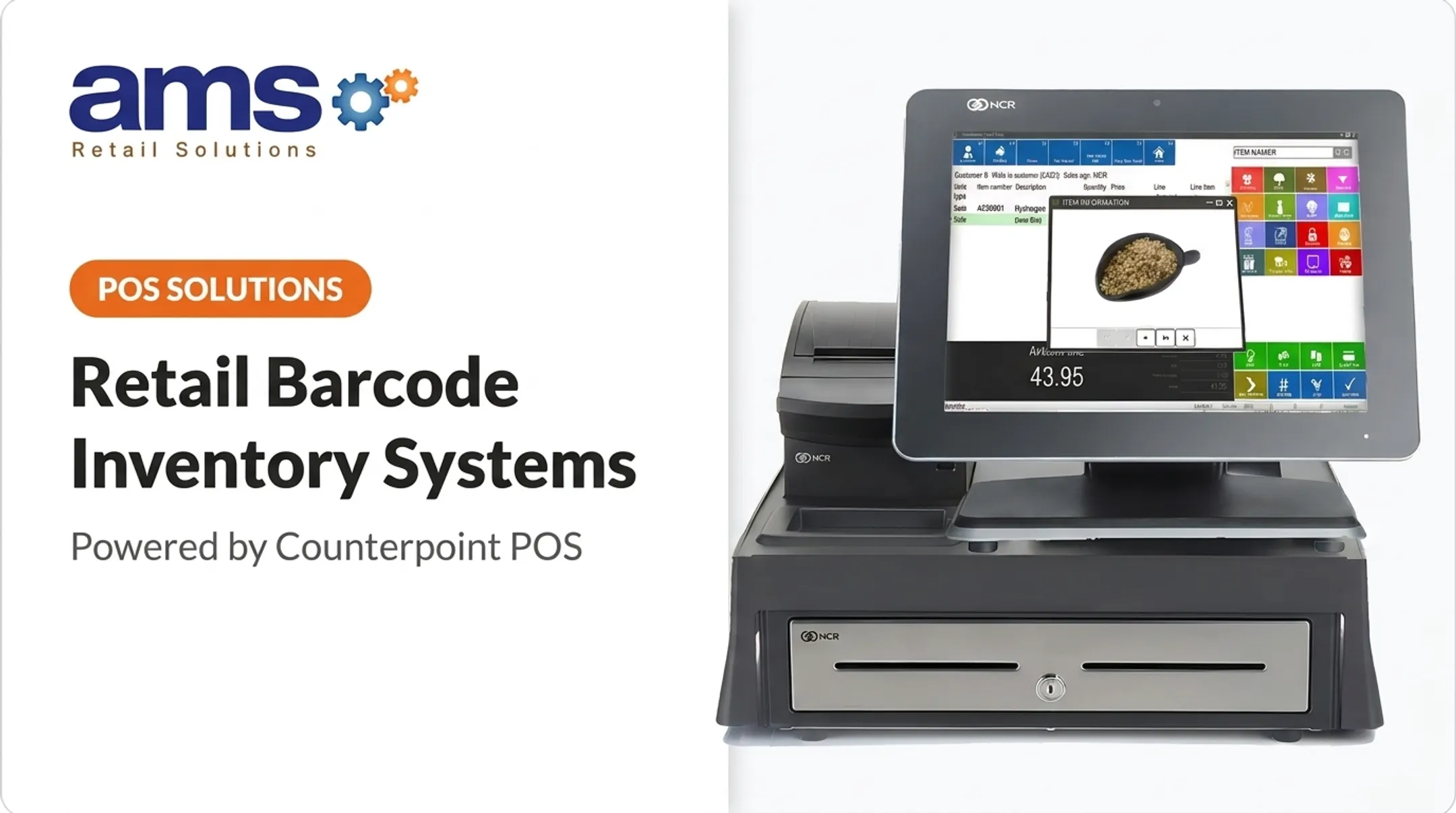
AMS Retail's NCR Voyix Counterpoint platform is built for both contexts — giving garden centers and nurseries a barcode-enabled POS and inventory system in one place, rather than patching together separate tools for checkout, stock tracking, and reporting.
Barcode Label Types for Plant Nurseries: 1D, QR, and RFID
Three main barcode technologies are used in nurseries:
1D (linear) barcodes like EAN-13 and Code 128 encode data in parallel vertical lines read by a laser scanner. EAN-13 stores exactly 13 numeric digits and requires GS1 registration. Code 128 can encode up to 48 characters using Application Identifiers for supply chain data.
QR codes are 2D matrix barcodes that store data in a square grid of black and white modules, readable from any angle by image-based scanners or smartphones.
RFID tags contain a microchip and antenna that transmit a unique Electronic Product Code wirelessly — no line-of-sight required, and multiple tags can be read simultaneously.
QR Codes vs. 1D Barcodes for Nursery Use
For most nursery applications, QR codes deliver clear advantages:
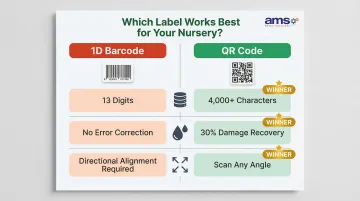
- Data capacity: EAN-13 holds just 13 numeric digits — enough for a product ID, nothing more. QR codes store over 4,000 alphanumeric characters, so you can encode plant name, variety, care instructions, price, bin location, and batch number on a single label.
- Outdoor durability: Built-in Reed-Solomon error correction recovers up to 30% of damaged data (Level H), keeping QR codes readable even when labels are dirty, wet, or worn — a real advantage in garden center conditions.
- Scan flexibility: QR codes read from any angle and orientation. 1D barcodes require precise horizontal alignment, which matters when staff are scanning tags on hanging baskets or plants in awkward positions.
Label Material Matters
Weatherproof materials are non-negotiable for outdoor nursery labels. Thermal-transfer printing on synthetic polyester or polypropylene substrates with resin ribbons produces labels that hold up 1-2 years in typical outdoor conditions. Avoid direct thermal printing — it fades quickly in sunlight.
RFID for Large Operations
RFID suits large production nurseries or wholesale operations where bulk scanning hundreds of tags simultaneously justifies the higher cost ($0.07-$0.15 per passive tag vs. pennies for printed labels). Knox Nursery reduced a 32+ man-hour inventory count to under 3 hours using RFID, achieving 12-month payback.
For most retail and mid-size production nurseries, QR code labels on weatherproof substrates — pot stakes, hang tags, or pot wraps — offer the best balance of data capacity, durability, cost, and scanning ease.
How Barcodes Power Your Nursery's End-to-End Workflow
Receiving and Intake
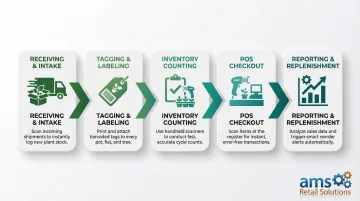
Scanning barcodes on incoming shipments—whether supplier-printed or nursery-generated receiving labels—immediately logs new inventory with quantity, species, container size, cost, and location. This eliminates manual data entry and ensures accurate stock records from day one.
Tagging and Labeling on the Floor
Generate and print nursery-specific barcode labels via connected label printers. Each label encodes key data that ties the physical plant to its digital inventory record:
- Plant identity and species details
- Retail price and container size
- Care information for staff and customers
- Bin or zone location for fast floor lookup
Inventory Counting and Location Tracking
Staff use handheld or mobile barcode scanners to keep inventory accurate across the floor. Key tasks include:
- Conducting cycle counts by zone or bench without clipboards
- Verifying plant locations and flagging misplaced stock
- Logging discrepancies in real time so records update instantly
POS Checkout
At checkout, the cashier scans the plant's barcode tag. The POS system instantly retrieves the correct price and product details, processes the sale, and decrements inventory—all without manual price lookup. This reduces checkout time, eliminates transaction errors, and feeds clean sales data directly into your reporting layer.
Reporting and Replenishment
Every scan event—receive, move, sell, count—feeds into actionable reports that nursery managers can act on immediately:
- Inventory by species and location: see exactly what's on hand and where
- Sales velocity: identify fast movers and adjust reorder timing
- Shrink rates: spot loss patterns before they compound
- Reorder alerts: replenish based on actual stock levels, not estimates
These insights shift buying and pricing decisions from gut feel to hard data.
Key Features to Look for in a Barcode-Enabled Nursery Management System
Real-Time Inventory Tracking with Multi-Attribute Support
The system must handle plant-specific data fields—species, variety, container size, growing stage, availability date—and update counts instantly with each scan event. Generic SKU tracking isn't enough for living inventory.
Integrated POS with Barcode Scanning
Look for a system where the inventory database and point-of-sale terminal share a single data source. When a tag is scanned at checkout, the system should automatically:
- Pull up the correct price for that specific plant and container size
- Trigger an immediate inventory deduction
- Record the transaction without manual reconciliation between separate systems
AMS Retail's NCR Voyix Counterpoint platform takes this approach for garden centers and nurseries specifically, combining barcode-enabled POS with inventory management under one data source rather than two systems patched together.
Mobile Scanning Capability
Staff should be able to use handheld scanners or mobile devices on the nursery floor for receiving, cycle counts, and price verification—not just at a fixed checkout terminal. This is essential for outdoor operations where plants are spread across greenhouses, benches, and display areas.
Reporting and Analytics for Living Inventory
The system should generate actionable reports specific to nursery operations:
- Shrink tracking for dead or damaged plants
- Sales by plant category and variety
- Seasonal demand patterns
- Reorder triggers based on sales velocity
- Slow-moving inventory identification
Without these reports, you're managing living inventory with tools built for shelf-stable merchandise.
Scalability and Offline Capability
For nurseries with multiple locations or unreliable outdoor Wi-Fi coverage, look for a system that can:
- Operate offline and sync when reconnected
- Scale from a single store to multi-location operations without requiring a platform change
- Handle seasonal fluctuations in transaction volume
Steps to Implement a Barcode System in Your Plant Nursery
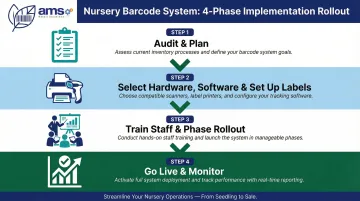
Audit and Plan
Before purchasing hardware or software, document:
- Current inventory categories and plant varieties
- Label requirements (what data needs to be encoded)
- Scanning touchpoints (receiving dock, greenhouse zones, checkout)
- Integration needs (accounting software, e-commerce, supplier EDI)
Getting this foundation right shapes every hardware and software decision that follows.
Select Hardware and Software, Then Set Up Labels
Choose label printers, scanner types (fixed mount, handheld, or mobile), and barcode-enabled nursery management software that fits your scale.
Before go-live, generate and apply barcode labels to all existing inventory — start with your highest-volume or highest-value plants to get early wins and build team confidence.
Typical hardware components:
- Thermal transfer label printer for durable outdoor tags
- Handheld or mobile 2D barcode scanners for floor operations
- POS terminal with scanning capability at checkout
Entry-level thermal transfer printers start around $200-$850, while handheld 2D scanners range from $100-$400, making the technology accessible even for small independent nurseries.
Train Staff and Phase the Rollout
Roll out training before switching off manual processes, and keep both systems running briefly in parallel to catch errors early. Key steps for a smooth transition:
- Train each role separately — receiving staff, floor staff, and cashiers have different scanning workflows
- Run barcode and manual processes side-by-side for one to two weeks during initial go-live
- Designate an internal champion to troubleshoot issues and support team adoption
- Schedule a brief check-in at the 30-day mark to address recurring questions
Benefits and ROI: What Barcodes Deliver for Nursery Operations
Reduced Inventory Shrink and Loss
Real-time scan-based tracking makes it immediately visible when plant counts drop unexpectedly—whether from theft, damage, or misplacement. This allows managers to investigate and address causes quickly.
Nurseries face outsized shrink challenges: general retail averages 1.6% shrink, but nurseries see 8-33% at the retail level, with up to 78% tied to plant spoilage. Barcode tracking creates a precise digital record of every plant received, moved, and sold, making count discrepancies immediately visible.
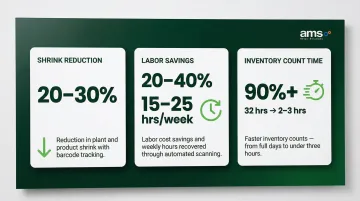
Industry data shows barcode adoption can reduce shrink by 20-30%. RFID systems push accuracy even further — 98-99% vs. 65-75% with manual methods.
Faster Checkout and Improved Customer Experience
A cashier scanning a barcode completes a transaction in seconds versus manually looking up prices or keying in plant names. This reduces checkout lines during peak seasons (spring and autumn), decreases transaction errors, and directly supports revenue throughput on high-traffic days.
The numbers make a strong case for scanning over manual entry:
- Pricing error rate: drops from 4.4–16% (manual) to ~2% (barcode)
- Throughput: increases from 50–60 items per hour to 300–500 items per hour
- Lost sales: 39% of shoppers have left a store without buying due to long checkout lines
Fast, accurate checkout isn't just convenient — it's a direct revenue driver on your busiest days.
Labor and Operational Efficiency
Automated receiving, cycle counting, and sales recording reduces the staff hours spent on manual data entry and reconciliation—freeing team members for higher-value tasks like customer service and plant care.
Industry benchmarks show barcode systems can reduce labor costs by 20-40%, saving 15-25 labor hours per week in a mid-sized operation. Knox Nursery's RFID implementation reduced a 32+ man-hour inventory count to just 2-3 hours—a 90%+ reduction in time spent on that single task.
Frequently Asked Questions
What type of barcode is best for outdoor plant nursery tags?
QR codes are generally the best choice for nursery environments because they hold more data (over 4,000 characters vs. 13 digits for EAN-13), have built-in error correction for durability in outdoor and wet conditions (up to 30% damage recovery), and can be scanned from any angle—compared to 1D barcodes which are more fragile and data-limited.
Can a barcode system handle the seasonal and living nature of nursery inventory?
Specialized nursery management systems like NCR Voyix Counterpoint track plant-specific attributes—growth stage, availability dates, container size, and botanical names—that generic retail software ignores. They also handle rapid inventory turnover during peak seasons and the unique demands of living inventory.
What hardware is needed to set up a barcode system in a nursery?
Core hardware components include a thermal transfer label printer (for durable outdoor tags), handheld or mobile 2D barcode scanners for floor operations, and a POS terminal with scanning capability at checkout. Entry-level systems start around a few hundred dollars, making the technology accessible even for small independent nurseries.
How does barcode scanning integrate with a nursery POS system?
When a plant's barcode is scanned at the POS terminal, the system retrieves price and product data from the shared inventory database, processes the sale, and simultaneously updates stock counts—all in real time and without manual data entry. This integration ensures inventory accuracy and eliminates the need to reconcile separate systems.
How do barcodes help reduce inventory shrink in a plant nursery?
Barcode tracking creates a precise digital record of every plant received, moved, and sold—making discrepancies immediately visible and enabling faster investigation of theft, damage, or misplacement. Industry data shows barcode adoption can reduce shrink by 20-30%, which matters in nurseries where shrink rates can reach 33% at retail level.
Can small independent nurseries afford a barcode management system?
Entry-level barcode systems are well within reach for small nurseries. Thermal label printers start around $200 and 2D scanners around $100, with efficiency gains and shrink reduction typically delivering payback in under 12 months.
Ready to reduce shrink, speed up checkout, and gain real-time visibility into your nursery inventory? Contact AMS Retail at 757.495.4995 or schedule a consultation to learn how NCR Voyix Counterpoint can transform your nursery operations.