Introduction
Running a successful plant nursery means mastering two distinct disciplines simultaneously: horticulture and business management. Many nursery owners excel at growing healthy plants but struggle with inventory losses, staffing challenges, and cash flow problems because they focus on cultivation while neglecting operational systems.
Even the most skilled grower will face financial difficulties without proper inventory tracking, recordkeeping, and staff management.
Fixing that gap is what this guide is for. It covers the essential operational components of nursery management: choosing the right business model, managing daily tasks, tracking plant inventory, maintaining financial records, and building effective staff and customer relationships. Horticultural expertise is foundational — but operational systems determine whether a nursery stays profitable long-term.
Key Takeaways
- Plant nurseries must balance growing operations with retail and business management functions
- Daily tasks like watering, crop monitoring, pest control, and recordkeeping directly affect plant health and business continuity
- Accurate inventory tracking prevents shrink and keeps cash flow under control
- Strong financial recordkeeping and staff management matter just as much as knowing how to grow plants
- Modern POS and inventory software automate operational tasks, reducing labor costs and errors
Types of Plant Nurseries: Choosing the Right Business Model
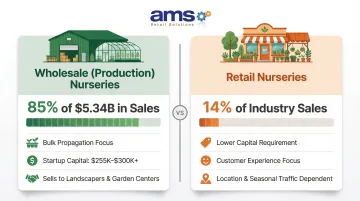
The nursery industry divides into two primary business models, each with distinct operational demands and capital requirements:
- Retail nurseries sell directly to consumers, prioritizing customer experience through attractive greenhouse layouts, knowledgeable staff, and smooth checkout processes.
- Wholesale (production) nurseries focus on bulk propagation, selling to landscapers, garden centers, and contractors — maximizing growing space and production efficiency over foot traffic.
According to 2024 USDA data, wholesale operations represent 85% of the industry's $5.34 billion in nursery stock sales, while retail accounts for 14%. The wholesale model demands higher upfront investment—startup costs for a 17-acre operation range from $255,550 to $300,000 in capital alone—but generates volume-based revenue. Retail nurseries require less capital but depend heavily on location, customer service, and seasonal traffic patterns.
A third option — the hybrid model — offers a practical middle ground. These nurseries grow their own specialty stock while sourcing complementary plants from wholesale suppliers, which works well when space, labor, or capital prevents full in-house production. A retail nursery might propagate high-margin native perennials, for example, while purchasing commodity annuals from regional growers.
Your choice of model shapes everything downstream — facility layout, staffing ratios, equipment investment, and day-to-day operational focus. Getting clear on this early prevents costly redesigns later.
Roles and Responsibilities of a Nursery Manager
The nursery manager holds ultimate responsibility for crop health, production schedules, and day-to-day profitability. This role encompasses overseeing all phases of plant development—from propagation through sale or delivery—while ensuring the operation runs efficiently and meets financial targets. According to NC State Extension, nursery managers "manage agricultural workers who propagate, cultivate and harvest plants" and "gather data to monitor greenhouse and nursery growing conditions and yields."
Why Single Accountability Matters
Managing a living crop requires one person with clear decision-making authority rather than a committee approach. Plants respond to environmental conditions in real time, and delayed decisions during pest outbreaks, irrigation failures, or weather events can result in significant crop losses. In small operations, the owner typically serves as manager. Larger nurseries designate a production manager who reports to ownership but maintains operational autonomy for crop decisions.
Essential Management Attributes
Effective nursery managers develop four core competencies:
- Detect subtle changes in plant appearance, growth rates, and environmental conditions before problems escalate
- Adapt daily priorities as crops develop, weather shifts, or equipment fails
- Make decisions from the plant's perspective rather than human convenience
- Balance scientific knowledge with the art of growing, where variables constantly shift
Planning Responsibilities
Managers must balance strategic planning with daily execution. Weekly "big picture" planning sessions should review crop schedules, assess current growth phases, prioritize upcoming tasks, and delegate work to staff. These sessions prevent managers from becoming absorbed in routine tasks at the expense of forward planning. Production scheduling requires mapping the entire crop cycle with specific lead times for propagation, potting, hardening, and delivery readiness.
Systematic Problem-Solving
When unexpected issues arise—crop failures, pest outbreaks, equipment breakdowns—managers need a structured approach:
- Identify the problem precisely through observation and data review
- Analyze root causes rather than symptoms
- Generate multiple solution options before committing resources
- Test hypotheses on a small scale when possible
- Implement solutions decisively and monitor results
This framework prevents reactive decision-making that often worsens problems or wastes resources.
Qualifications and Career Development
Formal horticulture degrees or certificates provide valuable core knowledge, but practical growing experience, strong observational skills, business acumen, and willingness to learn continuously are equally important. Many successful managers develop expertise through hands-on work supplemented by ongoing education through industry associations, conferences, and peer nursery visits.
AmericanHort launched a competency-based Greenhouse Technician Certification in 2024 to standardize technical skills for production staff. It offers a structured pathway for growers looking to formalize their expertise.
Day-to-Day Plant Nursery Operations
Daily Task Management
Non-negotiable daily tasks form the backbone of nursery operations:
- Watering appropriate crop sections — container plants in summer require approximately 0.6 inches of water per day, adjusted for evapotranspiration rates and system efficiency
- Monitoring plant health through visual inspection and sensory checks (appearance, smell, sound of irrigation systems, feel of growing media moisture)
- Recording observations in a daily log
- Performing routine maintenance including weeding, fertilizing, and pest control
A well-kept daily log is where operational insight accumulates. Each entry should capture:
- Environmental conditions (temperature, humidity, rainfall)
- Labor hours broken down by activity
- Crop movements between benches or structures
- Supplies purchased and any anomalies observed
Over time, this data enables accurate scheduling for future crops and reveals patterns that prevent recurring problems.
Crop Growth Phases and Production Scheduling
Every nursery manager must understand and actively manage three distinct crop development phases:
| Phase | Duration | Key Focus | Moisture Target |
|---|---|---|---|
| Establishment | 4–12 weeks | Germination, uniform emergence | Block weights at 80–85% capacity |
| Rapid Growth | Varies | Shoot expansion to target size | Standard; high nitrogen inputs |
| Hardening | 4–12 weeks | Root development, stress conditioning | Block weights reduced to 60–70% |
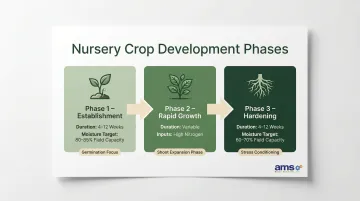
The hardening phase is the one managers most often underestimate. Cutting it short produces plants that look sale-ready but fail in the field — non-hardened stock consistently shows poor growth and survival after outplanting compared to properly conditioned material.
Seasonal Cleanup and Strategic Planning
Once a crop cycle wraps up, the physical reset and the strategic reset happen together. Between crops or at season's end, the standard cleanup checklist includes:
- Disposing of holdover stock
- Deep-cleaning floors and tables
- Sterilizing containers with a 10% bleach solution (10–15 minute contact time)
- Flushing irrigation systems
- Completing equipment maintenance checks
These downtime windows are also the best time for honest operational reviews — what worked, what didn't, and what changes to prioritize before the next season starts.
Plant Inventory Management for Nurseries
Why Accurate Plant Inventory Is Critical
Inaccurate inventory creates compounding problems across your entire operation. Common consequences include:
- Selling plants that aren't available, disappointing customers and damaging reputation
- Buying stock you already have on hand, wasting capital and growing space
- Missing shrink from disease, theft, or misplacement, which quietly erodes profitability
- Making incorrect purchasing and pricing decisions that ripple through multiple production cycles
Industry data reveals the financial impact: retail shrink averages 1.6% of sales, costing retailers $112.1 billion annually. For garden centers specifically, up to 78% of shrinkage stems from plant deterioration, spoilage, and discards rather than theft—a unique challenge requiring active crop health management alongside traditional loss prevention.
How to Conduct Plant Inventory in a Nursery
Effective inventory management requires systematic physical counting combined with real-time record updates:
- Walk each growing area and bench methodically
- Count by species, container type, and growth stage
- Note plant condition and flag diseased or damaged stock for removal
- Reconcile counts against purchase and sales records
- Update records immediately rather than batching changes
Proper inventory records should include all plants listed by bench or structure location, current development stage (establishment, rapid growth, hardening, or sale-ready), client or order assignment if applicable, and anticipated availability date. Update records at least weekly or whenever stock changes hands.
Update inventory in real time at the point of sale — don't rely on periodic manual counts. When sales aren't immediately reflected in your records, discrepancies accumulate fast, creating "ghost stock" (inventory that appears available in your system but doesn't physically exist) and triggering unnecessary reorders or stockouts.
Using Technology to Manage Nursery Inventory
Purpose-built retail POS and inventory management systems designed for garden centers and nurseries automate inventory tracking, trigger reorder points, reduce shrink, and provide real-time visibility into stock levels. Integrated systems like NCR Voyix Counterpoint from AMS Retail Solutions connect checkout transactions directly to inventory records, eliminating manual reconciliation and reducing human error.
Modern POS systems provide several operational advantages for nurseries:
- Real-time inventory decrements when sales complete
- Multi-location stock visibility for operations managing multiple sites
- Slow-moving inventory identification to prevent holdover stock problems
- Detailed purchasing history to optimize reorder timing and quantities
- Shrink reporting to identify loss patterns and control costs
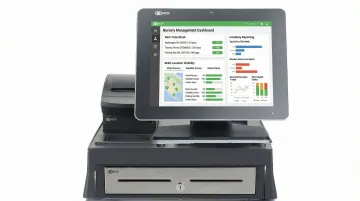
For nurseries still relying on spreadsheets or manual counts, the shift to an integrated POS system is one of the highest-leverage operational changes available. Less time spent reconciling records means more time managing plants, serving customers, and making informed buying decisions.
Financial Recordkeeping and Business Management
Accurate financial records form the backbone of nursery profitability. At minimum, every operation should track:
- Labor hours broken down by activity and crop
- Materials and input costs (seeds, growing media, containers, fertilizers)
- Overhead costs (utilities, rent, equipment maintenance)
- Per-crop profitability calculations
These records enable accurate pricing and informed budgeting for future production cycles.
Those financial records don't operate in isolation. Cross-referencing them with horticultural records — daily logs, plant development records, propagation protocols — gives you complete operational visibility. When production costs meet sales data, you can identify which species and container types deliver the best margins and adjust future production accordingly.
Key Financial Management Disciplines
Cash Flow Monitoring
Nurseries face extended cash cycles — industry data shows an average inventory holding period of 503 days and a cash cycle of 116 days. That lengthy gap between paying for inputs and receiving revenue demands careful planning. Tools like Purdue's "Preparing a Projected Cash Flow Statement" and UF/IFAS's Interactive Cash Flow Analysis Tool help operators project monthly cash balances and avoid shortfalls.
Holdover Stock Management
Unsold plants tie up capital, consume growing space, and demand ongoing care. Calculate carrying costs using a per-square-foot, per-week rental approach that folds in overhead, labor, and utilities. Plants held too long in small containers become root-bound, raising mortality rates and frequently requiring repotting into larger containers at added expense.
Strategic Pricing
Labor represents 36% of nursery expenses on average, with typical net profit margins of just 6.7% before taxes. University extension programs recommend targeting gross margins of 30–40% to cover costs and sustain profit. Cost-of-production calculators — including Michigan State's Nursery Cost-of-Production Calculator and Penn State's Cost of Production Calculator — help determine breakeven prices and appropriate markup before you set a price tag.
Capital Expenditure Planning
Equipment purchases and facility expansions should align with growth targets and available capital. Major investments — greenhouse construction, irrigation system upgrades, potting machines — need to tie directly to production capacity needs and projected revenue increases. Buying ahead of demand strains cash flow; buying too late limits growth.
Staff Management and Customer Relations in a Nursery
Managing Nursery Staff
Labor shortages affect 20% of nursery operations according to industry surveys, making effective staff management critical for operational continuity. Core management responsibilities include assigning clearly defined roles and tasks, training all team members to observe crops and recognize early warning signs of problems, and maintaining open communication channels.
Implement structured communication rhythms:
- Monday morning planning meetings (15-20 minutes) to review the week's priorities and assign tasks
- End-of-week review sessions to assess progress, discuss challenges, and gather staff observations
- Daily check-ins during peak seasons or critical crop phases
Foster a staff culture of observation and curiosity. Every team member who notices anomalies—unusual smells, off-color leaves, irregular equipment noise—and reports them prevents small issues from becoming crop-wide emergencies. This observation culture reduces crisis situations and improves overall operational resilience.
AmericanHort's Greenhouse Technician Certification program and Oregon State University's Safe Procurement and Production Manual provide structured frameworks for training staff on plant fundamentals, pest scouting, pesticide safety, and standard operating procedures.
Building Strong Customer Relationships
For contract growing operations, create written agreements specifying species, quantities, container type, delivery schedule, and payment terms. Provide regular crop progress updates before delivery and establish feedback loops once orders are fulfilled to improve future service.
Retail nursery customers are a different equation. The shopping experience matters as much as plant quality — and the checkout moment is where it can fall apart. Research published in LGR Magazine found that customer impressions "plummet every minute" they wait in slow lines, undoing every positive aspect of their visit.
The following factors drive repeat business and loyalty in retail nursery settings:
- Intuitive store layout and clear signage that helps customers find what they need
- Staff who can answer plant care questions confidently
- Fast, frictionless checkout that respects customers' time
- A loyalty program — members spend 78% more than non-members and account for 63% of purchases
NCR Voyix Counterpoint supports fast transaction processing, customizable touchscreen interfaces, and loyalty program integration built for garden centers — making it a practical fit for nurseries looking to tighten up the checkout experience.
Frequently Asked Questions
What does a plant nursery manager do?
A nursery manager oversees all aspects of plant production and business operations—from crop health monitoring and production scheduling to staff management, inventory control, financial recordkeeping, and customer relations. They maintain ultimate responsibility for ensuring crops develop properly while the operation runs profitably.
What are the management practices in a nursery?
Core practices span both horticultural and business management. Key routines include:
- Daily crop observation and logging
- Weekly planning and staff task delegation
- Seasonal cleanup between production cycles
- Accurate inventory tracking
- Horticultural records (growth notes, pest scouting) and financial records (labor costs, per-crop profitability)
How to conduct plant inventory?
Physically count all plants by bench location, species, container type, and growth stage. Flag diseased or damaged stock for removal. Update records immediately whenever stock is sold, moved, or discarded. Use POS or inventory software to maintain accurate counts in real time rather than periodic manual counts alone.
How hard is it to start a nursery business?
Starting a nursery requires significant planning around capital (startup costs for a 17-acre operation range from $255,000-$623,000), facilities, licensing, plant sourcing, and operational systems. However, starting small with a retail or hybrid model and building systems gradually makes the process manageable for new operators willing to learn continuously.
Why is accurate plant inventory crucial for a nursery's success?
Accurate inventory prevents overselling, reduces stock losses from undetected disease or theft, and avoids both overstocking and stockouts. It also gives managers the data they need to price plants profitably and manage cash flow through seasonal swings.
What is the best software for inventory management?
Software built specifically for garden centers and nurseries outperforms generic retail tools. NCR Voyix Counterpoint, offered by AMS Retail Solutions, connects POS transactions directly to inventory tracking—keeping stock counts accurate across growing areas and the sales floor while reducing manual errors and stock loss.