Introduction
Managing a hunting and fishing store means juggling serialized firearms, bulk fishing supplies, ammunition by caliber, seasonal apparel, and strict compliance requirements—all under one roof. The wrong POS system creates costly gaps: missed sales during peak seasons, compliance exposure from incomplete disposition logs, and manual workarounds that drain staff time.
According to the U.S. Fish and Wildlife Service's 2022 National Survey, 39.9 million fishing participants and 14.4 million hunters spend a combined $144.6 billion annually—a market too large to lose to inventory errors.
The right POS system directly affects inventory accuracy, regulatory compliance, and customer experience—and for specialty outdoor retailers, it's not optional. This guide walks store owners through the key features to evaluate when choosing a platform that handles the unique complexity of hunting and fishing retail without forcing you into manual logs and disconnected systems.
Key Takeaways
- A POS built for hunting and fishing retail handles serialized firearm tracking, seasonal forecasting, license sales, and bulk inventory in one platform
- The wrong system causes manual workarounds, compliance gaps, and stockouts at hunting opener
- Must-have features: serialized tracking, auto-reorder, license management, bulk product handling, and omnichannel sync
- Key buying factors: scalability, compliance readiness, reporting depth, offline capability, and integration options
- AMS Retail Solutions runs on NCR Voyix Counterpoint — a single-platform POS built specifically for specialty outdoor retailers
What Is a POS System for Hunting and Fishing Stores?
A POS system in this context is the central software and hardware platform that processes sales, manages inventory in real time, and generates business intelligence—replacing manual logs, spreadsheets, and disconnected cash registers. Generic POS systems handle basic retail transactions, but hunting and fishing stores require platforms capable of managing serialized items (firearms), regulated products (ammunition, licenses), bulk goods (fishing line, bait), and highly seasonal demand cycles simultaneously.
The difference matters: a general retail POS might track SKUs and process payments efficiently, but it won't generate the ATF-compliant disposition records required for firearms sales or automatically sync state license issuance with your inventory system. These gaps force owners into manual workarounds that multiply compliance risk and operational inefficiency.
Why these stores face unique inventory complexity
The product diversity challenge alone sets hunting and fishing retail apart. A single store may carry thousands of SKUs across fundamentally different inventory types, each with its own tracking requirements:
- Serialized firearms (individual unit tracking by serial number)
- Bulk consumables like ammunition, fishing line, and bait (lot sizes and weights)
- Apparel tracked by size, color, and style
- Non-serialized accessories and hard goods
A POS system needs to handle all of these within the same interface—without forcing staff to switch between systems or maintain separate logs.
Product complexity is only part of the challenge. Selling firearms and hunting/fishing licenses adds documentation, age verification, and audit-trail requirements that standard retail POS software isn't built to meet. The ATF conducted 9,696 compliance inspections in FY 2024, resulting in 195 license revocations and 721 warning letters. For a firearms dealer, record-keeping failures can mean losing your FFL—and your ability to operate.
Must-Have POS Features for Hunting and Fishing Store Inventory
Not every POS system is built for the compliance demands, seasonal swings, and product complexity of hunting and fishing retail. Here's what to verify before you buy.
Serialized Inventory Tracking for Firearms and High-Value Items
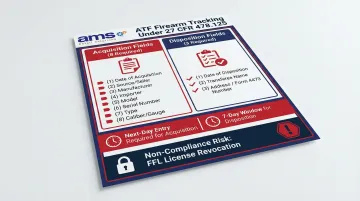
Serialized tracking assigns a unique identifier to each firearm or high-value item, enabling the store to trace every unit from acquisition to sale. Under 27 CFR 478.125, every FFL dealer must log eight acquisition fields (date, source, manufacturer, importer, model, serial number, type, caliber/gauge) and three disposition fields (date, transferee name, address or Form 4473 transaction number) for every firearm.
Critical requirements:
- Searchable fields by serial number, make, model, and location tag
- Automated disposition records generated at point of sale
- Next-day compliance for acquisition entries (required by close of next business day)
- Seven-day window for disposition entries
This feature isn't optional—it's the foundation of ATF compliance and theft deterrence. NSSF's Operation Secure Store reports a 60% reduction in firearms stolen during FFL burglaries between 2024 and 2025 (from 4,389 to 1,748 firearms), demonstrating how accurate inventory accountability reduces shrink.
Seasonal Demand Forecasting and Automated Reordering
Outdoor retail demand is tied to seasonal calendars—hunting opener, fishing season, holidays—and weather patterns. A POS that analyzes historical sales data can generate accurate demand forecasts and trigger purchase orders before stockouts occur.
The cost of getting this wrong is significant: IHL Group research finds global retail loses $1.73 trillion annually to inventory distortion, with 66.9% from out-of-stocks and 33.1% from overstocks. For seasonal specialty retailers, one missed stockout during opening weekend of deer season can be devastating—average hunter spend runs $3,146 annually.
What to look for:
- Historical sales analysis by season and product category
- Automated reorder triggers based on velocity and lead time
- Slow-moving inventory identification to prevent overstocks
- Integration with supplier ordering systems
License and Compliance Management
Hunting, fishing, and trapping licenses are a revenue driver that brings foot traffic into the store. A POS system should support the creation and sale of licenses as a service line item directly on the invoice, keeping the transaction in one place and ensuring compliance with state Electronic Data Systems (SEDS).
According to USFWS guidance, all 50 states operate SEDS to sell licenses, originally evolving from automated point-of-sale systems. Integration with these state systems eliminates manual entry and ensures data accuracy.
Additional compliance features should include:
- Age-verification prompts at checkout for restricted items (federally mandated: 21 for handguns/handgun ammunition, 18 for long guns)
- Employee permission controls for sensitive product categories
- Customizable audit reporting for state or federal regulatory requirements
- Role-based access to prevent unauthorized transactions
Bulk and Variable Product Management
Fishing line, bait, and ammunition are sold in quantity without unique serial numbers, requiring the POS to track units, weights, or lot sizes accurately. The system should handle both serialized and non-serialized product types in a unified interface—not require separate systems for each product type.
Key capabilities:
- Weight-based sales with scale integration
- Fractional quantity tracking (selling by foot, ounce, or custom unit)
- Lot number tracking for inventory traceability
- Seamless interface switching between serialized and bulk items during checkout
Integrated E-Commerce and Omnichannel Inventory Sync
Customers increasingly research and purchase outdoor gear online before visiting in-store. The Outdoor Industry Association's 2024 report found outdoor participation grew 4.1% to a record 175.8 million participants—57.3% of all Americans aged six and older.
A POS must sync inventory in real time across physical and online storefronts to prevent overselling and backorders. Integration with platforms like Shopify or WooCommerce should be direct and automatic, with inventory deducted the moment a sale occurs on any channel.
Key Factors to Evaluate When Choosing a Hunting and Fishing Store POS
The right POS system does more than ring up sales. In a specialty outdoor retail environment, it has to handle compliance, seasonal inventory swings, rural connectivity gaps, and potential multi-location growth—all without requiring a system replacement every few years.
Scalability and Multi-Location Support
A store that starts with one location or one product category may expand its range, add a second location, or launch online sales. A POS system that cannot grow with the business forces a costly migration later.
Operational KPIs affected:
- Inventory synchronization across locations
- Centralized reporting across all channels
- Inter-store stock transfers without data discrepancies
- Unified customer database for loyalty programs
Compliance and Regulatory Readiness
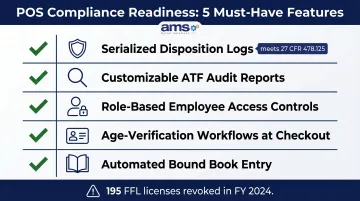
Hunting and fishing stores operating as FFL dealers or selling age-restricted goods face real regulatory exposure. With 195 license revocations in FY 2024, a POS lacking built-in compliance tools shifts that burden onto staff, increasing the risk of errors, violations, and potential fines.
Compliance readiness includes:
- Serialized disposition logs meeting 27 CFR 478.125 requirements
- Customizable audit reports for ATF inspections
- Role-based employee access controls
- Integrated age-verification workflows at checkout
- Automated bound book entry at acquisition and disposition
Real-Time Reporting and Sales Analytics
Purchasing decisions, promotional planning, and staffing all depend on accurate, timely data. Without reliable reporting, owners make purchasing calls by intuition—over-ordering slow movers while running out of top sellers.
Essential reports include:
- Top-selling SKUs by season
- Gross margin by product category
- Inventory turnover rates
- Supplier reorder histories
- Out-of-stock frequency by item
- Sales velocity during peak seasons
Offline POS Capability
Connectivity disruptions are a real risk, especially in rural or semi-rural store locations common to hunting and fishing retail. Pew Research Center data shows only 72% of rural Americans have home broadband, and rural adults are far less likely to be "almost constantly" online (23% vs. 37% urban).
When internet access drops, a POS without offline capability halts sales, frustrates customers, and creates inventory data gaps. Offline capability means the system continues processing transactions and logging changes locally, then syncs automatically when connectivity returns. It's a critical buying criterion that many vendors overlook—and one worth confirming explicitly before signing any contract.
AMS Retail Solutions' NCR Voyix Counterpoint platform includes offline functionality as a standard feature, keeping operations running through network outages without manual workarounds.
Integration Ecosystem
A POS system needs to connect to accounting software, e-commerce platforms, payment processors, and distributor ordering systems. Gaps in any of those connections create manual data entry, reconciliation errors, and staff inefficiency.
A healthy integration ecosystem includes:
- Two-way accounting sync (QuickBooks, Xero, or other platforms)
- Multi-channel e-commerce connectivity
- Integrated payment processing
- Open API or partner-supported distributor connections
- State license system (SEDS) integration
How AMS Retail Solutions Can Help
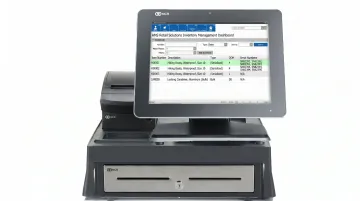
AMS Retail Solutions is a single-source POS provider for specialty outdoor retailers, built on NCR Voyix Counterpoint—retail POS software purpose-built to handle serialized inventory, compliance tracking, and multi-product-type management on one platform.
AMS acts as a partner and trusted advisor throughout implementation and beyond: 24/7 support, retail-hardened hardware, customizable tools, and the flexibility to scale from a single store to a multi-location network. The company serves marine supply stores, bait and tackle shops, fishing supply retailers, hunting outfitters, and outdoor sporting goods retailers.
For hunting and fishing stores specifically, several capabilities stand out:
Key differentiators for hunting and fishing retailers:
- Offline POS capability keeps transactions running even when internet connectivity drops
- Serialized inventory tracking that meets ATF bound book requirements out of the box
- Real-time inventory management across all product types (serialized, bulk, variable)
- Built-in cross-selling and promotions tools for bundling gear and running seasonal pricing
- Streamlined checkout that cuts wait times during weekend rushes and seasonal peaks
- Inventory shrink reduction through accountability and tracking
- Single platform management for all product types — no juggling separate systems
Conclusion
The right POS system for a hunting and fishing store isn't the most well-known or lowest-cost option—it's the one that matches the store's specific inventory structure, compliance obligations, and seasonal rhythms without requiring constant manual intervention.
POS systems require ongoing evaluation, not a set-it-and-forget-it mindset. Review platform performance against key metrics at least annually:
- Inventory accuracy rates
- Shrink rate trends
- Stockout frequency by season
- Checkout speed during peak periods
As compliance requirements tighten and outdoor recreation participation continues to climb, the right system grows with your store—without requiring you to work around its limitations.
Frequently Asked Questions
Is there a free POS software?
Free POS options typically lack the specialized features hunting and fishing stores require—serialized tracking, license management, and compliance reporting. Manual workarounds, compliance risk, and lost sales usually cost more than a proper system.
What is the best software for gun inventory?
The best gun inventory software combines serialized tracking, bound-book capabilities, and POS integration in one platform. NCR Voyix Counterpoint is designed specifically for this, meeting ATF requirements while keeping daily operations manageable.
Which is the best POS software for retail?
For outdoor specialty stores, the best POS handles complex inventory types (serialized, bulk, variable), compliance needs (age verification, audit trails), and seasonal demand. Generic retail platforms are built for simpler operations and routinely fall short on these criteria.
Is POS the same as ERP?
No. A POS manages sales transactions and inventory at the register, while an ERP covers broader business functions—finance, HR, and supply chain. Some advanced POS systems include built-in reporting and purchasing tools, which covers most of what smaller specialty retailers actually need.
What are the three types of POS?
The three main types are legacy/on-premise POS, cloud-based POS, and mobile POS. Legacy and hybrid systems (like NCR Voyix Counterpoint with offline capability) are often preferred by specialty retailers needing reliability, depth, and the ability to operate without constant internet connectivity.