: What to Look for as a Buyer](https://file-host.link/website/amsretail-s09mhm/assets/blog-images/9d7dc12b-2233-4e15-ba02-4b8100c4d55b/1776808887411980_879fc0c8f0a446b1836f69ac13233a6e/360.webp)
Introduction
Managing a beauty supply store means juggling thousands of SKUs across hair care, skincare, cosmetics, and styling tools, while handling fast-moving transactions, professional buyer pricing, and multi-channel sales.
The wrong POS system doesn't just slow things down — it costs money. Pricing errors, inventory loss, and missed sales add up fast when your software can't keep pace with the demands unique to beauty retail.
According to the National Retail Federation, U.S. retail shrink reached 1.6% of sales in FY2022, totaling $112.1 billion in losses. For beauty supply stores carrying 7,000+ SKUs per location, exposure to inventory distortion is significantly amplified without a purpose-built system.
This guide covers what a POS system should do for beauty supply retail specifically, the features that matter most, and how to evaluate vendors before you commit.
Key Takeaways
- Beauty supply POS must handle high-SKU inventory with variant tracking across shades, sizes, and formulations
- Dual pricing tiers for retail vs. licensed professional buyers are essential for serving both walk-in customers and licensed professionals without manual overrides at checkout
- Barcode scanning, real-time stock alerts, and automated purchase ordering reduce shrink and margin losses
- Prioritize scalability and offline capability so your system works through network outages and grows with added locations or SKUs
- Vet vendors on transparent pricing, integration options, and implementation support before signing
What Is a Beauty Supply Store POS System?
A beauty supply store POS system combines software and hardware to process transactions, manage product inventory, handle customer data, and generate sales reports—designed specifically for the high-SKU, multi-variant, dual-audience nature of beauty retail.
Unlike salon or spa POS systems that prioritize appointment scheduling, service-based workflows, and tip tracking, beauty supply store POS systems are built around retail workflows. They must handle physical product complexity, purchase orders, vendor management, and potentially wholesale pricing structures.
How a Beauty Supply Store POS Differs From a Generic Retail POS
General retail POS systems are built for simpler product catalogs. Beauty supply stores carry hundreds or thousands of SKUs. For example, a single professional hair color brand like Wella Koleston Perfect carries 140+ shades—each a unique SKU. Generic systems struggle with this level of variant complexity, leading to:
- Checkout errors at the register
- Inaccurate stock counts across product variants
- No native support for profession-based pricing rules
Beauty supply stores often serve two distinct buyer types: the general public and licensed professionals. This requires pricing tier functionality that most generic POS systems don't natively support. According to the U.S. Bureau of Labor Statistics, there are 651,200 barbers, hairstylists, and cosmetologists employed in the U.S.—a substantial professional buyer segment that demands dedicated pricing infrastructure.
Serving both audiences also compounds inventory complexity. IHL Group reports that 70% of retailers experience inventory accuracy problems on a weekly or monthly basis—a rate that climbs sharply when a store manages thousands of product variants across multiple buyer tiers. That's the operational reality a purpose-fit system is designed to address.
Key Features to Look for in a Beauty Supply Store POS System
The right features aren't just about convenience—each one directly ties to measurable business outcomes such as reduced shrinkage, higher margins, faster checkout, or improved customer retention.
Advanced Inventory Management with Variant and SKU Support
Beauty supply stores need real-time tracking across product variants—shade, size, formulation, volume—not just product names. Look for systems that support:
- Detailed product matrices for managing combinations of attributes
- Barcode scanning for fast and accurate item lookup
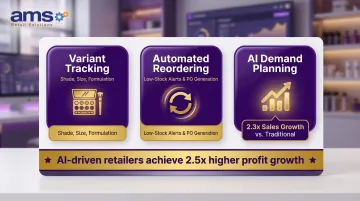
- Automated low-stock alerts that trigger reorder prompts before stockouts occur
Automated purchase order generation is a critical time-saver. The ability to send replenishment orders directly to suppliers from within the POS helps reduce both overstock and out-of-stock situations, both of which damage margins.
Retailers deploying AI/ML in demand planning achieve 2.3x higher sales growth and 2.5x higher profit growth versus those using traditional approaches. Real-time inventory analytics are what separate stores that react to stockouts from those that prevent them.
Dual Pricing Tiers for Retail and Professional Buyers
Many beauty supply stores serve both general consumers and licensed cosmetologists, stylists, or salon owners. A POS with tiered pricing functionality lets staff assign customers to pricing groups (such as "Licensed Professional") so the correct wholesale or discount rate applies automatically at checkout.
This eliminates manual overrides and pricing errors that erode margins and slow down the register.
Some systems extend this with license verification workflows or professional account management, which supports compliance and reduces the risk of unauthorized professional pricing. Licensify, for example, verifies beauty licenses across all 50 state boards in real time using patented technology.
Fast, Accurate Checkout with Barcode Scanning
At high product volumes, barcode scanning is essential. A POS that supports scanning across all product types speeds up transactions, reduces entry errors, and improves the customer experience at the register.
Look for systems where barcode lookup also surfaces variant details (such as developer volume or shade number) to avoid scanning the wrong product. This level of detail prevents costly mistakes at checkout.
Customer Loyalty Programs and CRM
Storing purchase history and preferences for repeat customers is essential. Loyalty programs that reward points per transaction or offer tier-based discounts encourage repeat visits.
A built-in CRM that tracks what each customer buys, particularly for professional buyers who reorder the same brands, enables staff to make relevant product recommendations. Over time, that visibility builds relationships that increase average basket size.
Sales Reporting and Inventory Analytics
Look for reports on:
- Top-selling SKUs and brands
- Slow-moving inventory
- Sales by product category
- Inventory turnover rates
These reports help store owners make better purchasing decisions, identify which product lines to expand or phase out, and spot seasonal trends.
According to Retalon, cosmetics have an inventory turnover rate of just 3.4x annually—well below the retail average of 9x. This means beauty supply retailers carry slower-moving inventory, making sophisticated analytics essential to avoid overstock and markdown losses.
What to Consider When Choosing the Best Beauty Supply Store POS
Feature lists alone don't determine the right fit. The best POS for a beauty supply store is the one that aligns with the store's size, customer base, growth plans, and operational reality—and is backed by a vendor who understands specialty retail.
Scalability for Single-Store and Multi-Location Growth
A POS that works well for one location may create problems when a second or third is added. Look for systems that offer:
- Centralized inventory management across locations
- Shared customer profiles
- Consistent pricing rules applied store-wide
Scalability also applies to transaction volume and SKU count. A system should handle a growing catalog without slowdowns or data errors.
Transparent Pricing and Total Cost of Ownership
POS pricing structures can be opaque. Subscription fees, per-terminal fees, payment processing rates, implementation costs, and annual maintenance fees all contribute to the real monthly cost. Ask vendors for a complete written quote including all fees before committing.
Look beyond the lowest subscription price and assess total cost over 2-3 years, factoring in hardware, support, and any add-on modules required for features like loyalty programs or e-commerce integration.
Ease of Use and Staff Training Requirements
A complicated interface adds to onboarding time and increases checkout errors, especially for stores with high staff turnover. The best systems minimize training time with intuitive navigation, role-based access, and available training resources from the vendor.
Ask vendors: How long does it typically take to train a new cashier? Is there onboarding support, documentation, or video tutorials included?
Offline Capability and Hardware Reliability
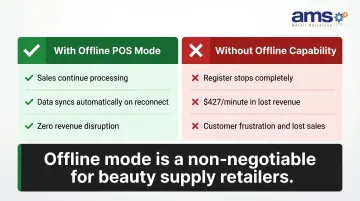
Internet outages are inevitable. A POS that goes fully offline stops the business cold—so look for systems that continue processing sales and capturing data locally when the connection drops, then sync automatically when restored.
According to 1Global, POS downtime costs small businesses as much as $427 per minute in lost revenue. That alone makes offline mode a non-negotiable requirement, not a nice-to-have.
Hardware matters too. Retail-hardened equipment designed to withstand the wear and tear of a busy store counter is a better investment than consumer-grade tablets or terminals not built for high-transaction environments.
Integration With E-Commerce and Business Software
Stores selling both in-store and online need POS systems that sync inventory and pricing across channels in real time. Without this, overselling and inventory discrepancies become constant problems.
E-commerce represented 26% of global beauty sales in 2024 and is projected to reach approximately 33% by 2030. Ask vendors about native integration with platforms like Shopify or WooCommerce, as well as accounting tools.
Integrations with accounting software reduce manual bookkeeping and give store owners a cleaner view of cash flow and profitability.
Quality of Vendor Support and Implementation Assistance
Implementation quality separates a smooth launch from a costly disruption. Before committing, get clear answers on:
- Whether a dedicated onboarding specialist is assigned
- How existing data is migrated from your current system
- Support hours, response time guarantees, and available channels (phone, chat, email)
24/7 support availability is worth evaluating closely, especially for stores with weekend or extended hours. A POS issue on a Saturday afternoon requires immediate resolution, not a Monday morning callback.
How AMS Retail Can Help
AMS Retail Solutions is a single-source POS solution for specialty retailers, built around NCR Voyix Counterpoint—retail point of sale software built to handle complex inventory, multi-tier pricing, and reporting demands of beauty supply stores with one location or many.
Key differentiators for beauty supply store buyers:
- Offline POS capability that keeps registers running even without a network connection
- Retail-hardened POS equipment built for the demands of a busy store floor
- Customizable tools that adapt to how each store operates rather than forcing owners into rigid workflows
- 24/7 support and service — phone or online, any time your store needs it
AMS takes a trusted advisor approach — not just selling software, but helping specialty retailers automate operations so they can reduce shrink, cut labor costs, and build lasting customer loyalty.
Conclusion
The right beauty supply store POS system fits how your store actually runs — from SKU complexity and professional pricing tiers to multi-location management and vendor support quality. Popularity doesn't determine fit; your workflow does.
Before committing to a platform, revisit these three priorities:
- Scalability: Can the system handle new locations, expanded SKU catalogs, and higher transaction volumes without a costly replacement?
- Vendor support: Does the provider offer responsive, ongoing support — not just during onboarding?
- Flexibility: Can you adjust pricing rules, loyalty programs, and reporting as your business model shifts?
A POS system requires periodic re-evaluation as your product lines and customer expectations change. The vendor relationship matters as much as the software itself.
Frequently Asked Questions
How should a beauty supply store manage inventory?
Beauty supply stores should use a POS with real-time SKU-level tracking, automated low-stock alerts, and purchase order management to handle high product variety, variant complexity, and multiple vendor relationships without manual tracking errors.
What is the best POS system for a small beauty supply store or salon?
The best fit depends on whether the business is primarily product retail or service-based. Beauty supply stores need retail-focused systems with strong inventory and tiered pricing capabilities, while salons prioritize appointment scheduling and CRM tools.
What key features should a beauty supply store look for in a POS system?
Top features include variant-level inventory tracking, dual pricing tiers for retail and professional buyers, barcode scanning, customer loyalty tools, and sales reporting for smarter purchasing decisions.
What are the main types of POS systems?
The primary types are cloud-based (subscription, accessible anywhere, lower upfront cost), on-premise (installed locally, higher upfront cost, more control), and hybrid systems that combine offline capability with cloud-based management. Hybrid systems are worth considering for retail environments where connectivity can be inconsistent.
What types of inventory make up a beauty salon's supplies?
Beauty supply store inventory typically spans hair care products (color, shampoos, conditioners, styling), skincare, cosmetics, nail care, tools and appliances, and professional-grade supplies. Each category often carries dozens of SKUs with variants in shade, size, or formulation — all of which your POS needs to track at the individual level.