Introduction
Home decor retailers struggle with an inventory challenge most general retailers never face: thousands of SKUs spanning colors, materials, sizes, and styles, plus custom and special orders that basic POS systems weren't built to handle. A single candle holder can multiply into dozens of trackable variants based on finish, size, and material alone.
Add seasonal buying cycles, multiple vendor relationships, and the need to track both showroom displays and back-room stock at the same time, and the operational strain compounds fast.
Solving this isn't purely a technology problem. It takes the right POS configuration, well-defined workflows, and features built specifically for high-SKU specialty retail. Without them, retailers fall back on manual counts, spreadsheet patches, and guesswork — resulting in inventory shrink, over-ordering, and frustrated customers when a popular variant is nowhere to be found.
This article covers how home decor retailers are using purpose-built POS tools to bring order to complex inventory and custom order management.
Key Takeaways
- High SKU counts, product variants, and custom orders require POS capabilities that most general-purpose systems can't handle
- The right POS centralizes SKU data, automates stock updates, and prevents overselling across all channels
- Custom orders require status tracking, customer communication workflows, and fulfillment coordination — not just a deposit field
- Key POS features include variant-level inventory tracking, custom order fields, reorder alerts, and integrated reporting
- A misconfigured or underpowered POS leads to inventory shrink, missed orders, and avoidable revenue loss
Why High-SKU Inventory Is a Unique Challenge for Home Decor Retailers
Specialty retailers typically manage 10,000 to 50,000+ SKUs per store, with home decor occupying one of the most complex positions in that range. Product variants proliferate rapidly: a decorative rug in blue, 5x7 ft, wool has a different SKU than the same rug in gray, or a different size, or a synthetic blend. A single product family can spawn dozens of trackable configurations.
Seasonal buying patterns add another layer of complexity. Furniture and home furnishing sales show consistent seasonal demand, with holiday items, spring collections, and outdoor living products creating distinct inventory cycles. Home improvement products demonstrate approximately 55% sell-through at 8 weeks and 90% annually—strong velocity when managed well, but a real markdown liability when not.
The financial stakes are concrete. The global retail industry loses $1.73 trillion annually to inventory distortion—out-of-stocks and overstocks combined—representing 6.5% of global retail sales. Average inventory accuracy across retail sits at just 63-66% with manual systems, versus 83% with barcode-based POS and 95-99% with RFID-enabled systems.
Without a POS designed for high-SKU environments, staff face daily operational friction:
- Manual counts consume hours and deliver unreliable results
- "Ghost inventory" shows stock that isn't physically available
- Popular variants sell out while overstocked items gather dust
- Buyers make purchasing decisions based on gut feel, not data
How POS Systems Manage High-SKU Inventory in Home Decor Stores
Modern POS systems use SKU-level inventory tracking with variant attributes—color, size, material, finish—so each product configuration is individually tracked and updated in real time at the point of sale.
This eliminates the "ghost inventory" problem, where sold items still appear in stock. It's a critical failure point: 70-80% of consumers leave and buy from a competitor when an item shows as available but isn't on the shelf.
Structuring Your Product Catalog in POS
Clean, consistent product hierarchy inside the POS is foundational. This means establishing categories, subcategories, product families, and variant attributes with disciplined naming conventions. Inconsistent data entry—where "ivory" appears in some records and "cream" in others for the same color—creates lookup errors and reporting blind spots that compound quickly.
POS systems with barcode and label printing capabilities allow staff to tag every variant accurately. This reduces checkout errors (staff selecting the wrong similar SKU) and enables fast cycle counts on the floor. RFID-enabled systems can count tens of thousands of items in a fraction of the time required for manual barcode scanning.
Getting the catalog right from the start prevents costly cleanup later. Prioritize these during setup:
- Assign unique SKUs to every color/size/material combination
- Use standardized naming conventions across all product entries
- Create logical category hierarchies that match how customers shop
- Tag products with searchable attributes (style, room, season, vendor)
Automated Reorder Alerts and Vendor Management
POS systems allow retailers to set minimum stock thresholds per SKU, triggering low-stock alerts or automated purchase order drafts when levels drop. This prevents stockouts on high-turnover décor items without requiring manual monitoring. Companies using automated inventory management report an 80% reduction in stockouts and a 30% improvement in order fulfillment rates.
AMS Retail Solutions' NCR Voyix Counterpoint platform includes built-in purchasing and receiving tools designed for specialty retailers with complex vendor relationships and high product counts. The system tracks detailed inventory and purchasing history, enabling buyers to identify patterns and optimize reorder timing.
Retailers deploying AI and machine learning for inventory management achieve 2.3x higher sales growth and 2.5x higher profit growth compared to competitors using traditional approaches — a gap that compounds as SKU counts grow.
Inventory Reporting for Smarter Buying Decisions
POS-generated sell-through reports, ABC analysis, and seasonal trend data allow buyers to make data-backed restocking decisions rather than relying on gut feel. This reduces overstock and improves cash flow.
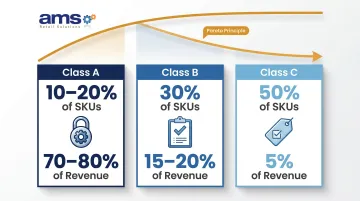
ABC inventory analysis classifies SKUs into three tiers based on the Pareto Principle:
- Class A (10-20% of SKUs): Drives 70-80% of revenue — requires tight controls, frequent counts, and demand forecasting
- Class B (~30% of SKUs): Generates 15-20% of revenue — needs moderate controls and periodic review
- Class C (~50% of SKUs): Accounts for ~5% of revenue — basic controls, minimal records
The cost of getting this wrong is steep. Low-performing companies carry inventory costs 3x higher than top performers, with overstocking making up 44% of total inventory among larger SMBs on average.
For specialty retailers on thin margins, even a 2% reduction in markdowns yields close to 1% profit improvement — the kind of gain that compounds across a full product season.
How POS Systems Streamline Custom Order Management
Custom orders define home decor retail. Customers frequently request specific finishes, non-standard dimensions, fabric selections, or monogramming. Without a structured process inside the POS, these orders are tracked in notebooks, sticky notes, or informal spreadsheets—leading to errors, missed deadlines, and unhappy customers.
The data confirms the importance of in-store consultation for these purchases. 48% of consumers prefer to purchase home furnishings in-store, with only 36% buying living room furniture online and 27% purchasing outdoor furniture online. Those in-store buyers often need to configure products on the spot—dimensions, finishes, fabrics—with average lead times running 8 to 14 weeks for custom or imported pieces.
Creating and Capturing Custom Orders at POS
POS systems with custom order or special order fields allow staff to record all order specifications—product details, customization notes, customer preferences, requested delivery date—at the time of sale, storing everything in one linked record rather than separately.
Customer deposits play a critical role in the workflow. Collecting a deposit at POS:
- Creates a financial record linked to the order
- Reduces no-show cancellations
- Establishes customer commitment
- Provides working capital for vendor payments
Tracking Order Status and Fulfillment Milestones
POS systems can assign order statuses (Order Placed → Sent to Vendor → In Production → Ready for Pickup → Delivered) so staff at any register can pull up a customer's order and give accurate updates without digging through paper records.
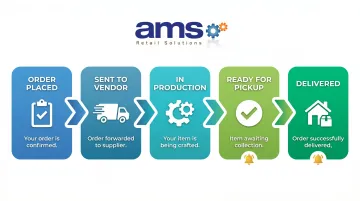
Automated or triggered customer notifications (via email or SMS) tied to status changes reduce inbound "Where's my order?" calls and improve the customer experience during long lead times. When a customer knows their custom sofa moved from production to shipping without having to call the store, that's a small interaction that builds lasting loyalty.
Preventing Custom Order Errors and Revenue Loss
Documented custom orders in POS create a paper trail that protects both the retailer and the customer, reducing disputes over specifications, pricing, or delivery timelines.
That same documentation doubles as operational data. Management can analyze:
- Custom order volume and trends
- Average lead times by vendor or product category
- Margin comparison: custom orders vs. stocked inventory
- On-time fulfillment rates by vendor
For retailers doing significant custom order volume, this visibility often reveals which vendors are quietly eroding margins through chronic delays—and which product categories are worth expanding.
Key POS Features That Drive Results for Home Decor Retailers
Not all POS systems are built for high-SKU specialty retail. The features below are what separate systems that genuinely support home decor operations from those that add friction.
Variant-Level Inventory Tracking
The POS must track inventory at the individual variant level—not just the parent product. This means a blue 5x7 wool rug and a gray 5x7 wool rug are distinct inventory items with separate stock counts, sales history, and reorder points.
Display product images at checkout to reduce staff errors when selecting between similar SKUs. Visual confirmation prevents the mistake of selling a customer the wrong variant.
Integrated Customer Profiles and Purchase History
CRM functionality built into the POS stores each customer's purchase history, preferences, and custom order details. This gives staff everything they need to make relevant recommendations, apply loyalty rewards, and follow up when complementary products arrive.
69% of home furnishings consumers used BOPIS in the past year, with 80% of those shoppers buying additional items during pickup. Integrated customer profiles allow staff to suggest add-ons based on previous purchases when customers arrive for order pickup.
Real-Time Reporting and Analytics
Built-in reporting dashboards showing sales by SKU, category, vendor, and time period give home decor retailers the visibility needed to:
- Identify dead stock requiring markdown
- Plan seasonal buys based on historical performance
- Evaluate which product categories drive margin versus volume
- Monitor sell-through rates and adjust purchasing accordingly
Omnichannel Inventory Sync
POS systems that sync inventory in real time across in-store and online channels prevent the overselling problem that damages customer trust. When a vase sells in-store, the online available quantity updates immediately.
73% of retail consumers prefer to use multiple channels while shopping. Without synchronized inventory, retailers risk selling the same item twice: once in-store and once online. That leaves one customer without their order and staff scrambling to make it right.
Common Mistakes Home Decor Retailers Make Without the Right POS
Relying on Manual Inventory Counts or Spreadsheets Alongside a POS
67% of retailers still use Excel for inventory management, with that figure reaching 95% among small retailers. Disconnected systems create reconciliation gaps that are unsustainable in high-SKU stores where daily movement across dozens of variants makes manual tracking error-prone.
The numbers tell the story:
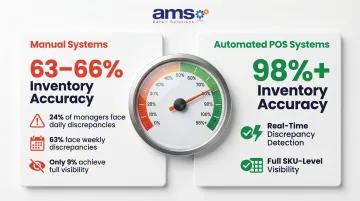
- 24% of retail managers encounter inventory discrepancies daily; 63% face them weekly
- Only 9% of businesses have full inventory visibility
- Manual systems average 63-66% inventory accuracy — versus 98%+ for optimized automated systems
Setting Up the Product Catalog Inconsistently at Implementation
Bad inventory data doesn't stay isolated. Rushing the initial POS setup — using inconsistent naming conventions, skipping variant attributes, or not assigning accurate cost data — creates downstream problems in reporting, purchasing, and shrink analysis that are expensive to unwind.
Once incorrect data propagates across thousands of SKUs, the cleanup effort is substantial. Getting the catalog right from day one is far cheaper than correcting it after the fact.
Treating Custom Orders as Informal Transactions
Processing custom orders without a formal POS workflow—no deposit captured, no status tracking, no customer record created—leads to:
- Lost orders when staff turnover occurs
- Unresolvable disputes over what was promised
- Inventory committed to a customer without visibility for the rest of the team
- Revenue leakage when orders are forgotten or miscommunicated
Frequently Asked Questions
What are the 4 types of inventory management systems?
The four main types are:
- Perpetual inventory — continuous, real-time tracking of every transaction
- Periodic inventory — physical counts at recurring intervals
- Just-in-time (JIT) — minimal stock levels to reduce waste
- MRP (Materials Requirements Planning) — material needs calculated from production schedules
Perpetual inventory, as used in modern POS systems, is the most practical approach for home decor retailers that need real-time accuracy.
What is SKU in inventory management?
SKU (Stock Keeping Unit) is a unique identifier assigned to each distinct product variant. For example, a rug in blue, 5x7 ft, wool would have a different SKU than the same rug in gray or a different size. SKU-level tracking is what makes real-time inventory accuracy possible in high-variant retail environments.
What are the 5 S's of retail operations?
The 5 S's—Sort, Set in order, Shine, Standardize, Sustain—originated in the Toyota Production System as a workplace organization framework. POS systems reinforce the final two: standardization locks in consistent processes, while sustain tools like cycle counts and audit logs keep those standards in practice day-to-day.
How does a POS system handle custom orders in a home decor store?
A POS captures order specifications, customer details, and deposit payment in a linked record, assigns a trackable status to the order, and can trigger customer notifications as the order progresses. This replaces informal tracking with a structured, auditable process that prevents errors and keeps customers informed.
What POS features matter most for high-SKU home decor retailers?
The most critical features are variant-level inventory tracking, automated reorder alerts, custom order fields, real-time reporting, and omnichannel inventory sync. Specialty retailers should prioritize systems built for complex catalogs, such as NCR Voyix Counterpoint offered by AMS Retail Solutions, rather than general retail platforms adapted after the fact.
How does POS inventory management help reduce shrink in a home decor store?
Real-time POS tracking makes inventory discrepancies immediately visible, and cycle count tools catch errors before they compound. With the average retail shrink rate at 1.6% of sales — $112.1 billion in industry losses — accurate SKU-level accountability is a direct profit recovery tool.