
Introduction
Running a marine supply store means managing thousands of boat part SKUs spanning multiple manufacturers, all while navigating one of retail's most extreme seasonal demand patterns. When the spring rush hits, boaters need parts immediately. Come fall, you're sitting on inventory that won't move until next season. Generic retail POS systems aren't built for this reality.
Without purpose-fit inventory tools, the mistakes are expensive: over-stocking heading into winter locks up capital for months, while stockouts during peak season cost sales when customers need critical parts right now.
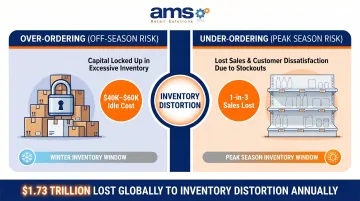
The scale of the problem is significant. According to IHL Group research, global retail loses $1.73 trillion annually to inventory distortion from overstocks and out-of-stocks combined, with 70% of retailers experiencing accuracy problems weekly or monthly.
That exposure hits marine retailers harder than most, given the compressed season and complex parts catalog. This article covers how the right POS handles seasonal inventory cycles, boat parts complexity, shrink reduction, and cash flow — and what features to prioritize when evaluating systems.
Key Takeaways
- Marine supply stores squeeze most of their annual revenue into roughly five months — while managing catalogs that run into the thousands of SKUs
- A specialty POS handles part cross-references, serialized inventory, and seasonal demand forecasting in ways generic retail software simply can't
- Historical sales data and automated reorder points keep you stocked for peak season without over-buying for winter
- Look for real-time inventory tracking, multi-supplier part management, offline capability, and customer purchase history as non-negotiable features
- Linking every part to a transaction eliminates unbilled parts and reduces shrink
Why Marine Supply Stores Face Unique Inventory Challenges
Marine retail combines two challenges that generic retail tools can't handle reliably: intense seasonal demand and massive product complexity. The U.S. recreational marine aftermarket reached $12.4 billion in 2024, serving an estimated 85 million Americans who go boating annually. Yet this substantial market concentrates most activity into roughly five months, with winter boat shows driving 30-60% of annual sales and the prime selling season ending after Labor Day.
Your inventory must span engine parts, safety equipment, electronics, consumables, and accessories — often sourced from dozens of suppliers, each using different part numbering systems. A single impeller, for example, might carry three different part numbers depending on the source:
- OEM manufacturer (original equipment number)
- Marine distributor (catalog-specific SKU)
- Aftermarket supplier (proprietary part code)
Without cross-referencing capability, staff waste time hunting for parts, make ordering errors, and create duplicate stock entries.
That operational friction carries a direct financial cost. Industry benchmarks show inventory carrying costs typically run 20-30% of total inventory value annually — for a marine retailer holding $200,000 in inventory through the off-season, that's $40,000-$60,000 sitting idle.
Over-ordering before winter locks up working capital for months while generating zero revenue. Under-ordering before peak season creates a different problem: IHL Group found that stockouts result in a lost sale approximately one-third of the time, meaning missed revenue precisely when boaters need parts most.
The Seasonal Inventory Challenge: Preparing for Peak and Off-Season
Pre-Season Stocking Strategy
Successful pre-season inventory build-up — typically late winter through early spring — relies on data, not guesswork. Your POS should reveal which SKUs sold fastest last season, which items caused stockouts, and which were over-ordered. This historical sales data drives more precise purchasing decisions.
Use POS sales reports to establish seasonal minimum/maximum stock levels for fast-moving parts and consumables. Then set automated reorder triggers to fire before peak demand hits, not during it. If impellers historically sell out by mid-May, your reorder point should trigger in March — early enough to secure vendor shipments without rush fees.
Managing Peak Season Demand
Real-time POS sales velocity data identifies your in-season fast movers — typically impellers, filters, zincs, safety gear, and marine electronics. During peak months, tighten reorder points on these items so you never run dry when weekend boaters arrive needing immediate solutions.
Marine supply stores serve three distinct buyer patterns, each requiring a different stocking approach:
- Impulse buyers — weekend boaters browsing the dock; keep high-turn consumables near checkout
- Urgent repair customers — boaters with mechanical failures needing parts immediately; maintain deep inventory on common repair items
- Planned maintenance shoppers — customers preparing ahead of the season; ensure broad selection across routine service parts
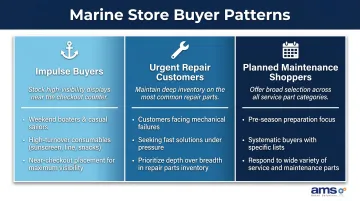
Understanding which buyers drive your sales mix helps you allocate shelf space and reorder budgets where they matter most.
Off-Season Drawdown and Stock Rebalancing
End-of-season is when your POS earns its keep. Run aging reports to identify slow-moving or dead stock before the loss compounds. Boating Industry magazine establishes these marine-industry aging thresholds:
- 180-270 days: Warning level
- 271-365 days: Critical level
- 365+ days: Dead stock requiring immediate action
Discount or return aging inventory before winter to protect cash flow during the off-season. Use that downtime to audit vendor relationships, reconcile purchase orders against received inventory in your POS, and prepare next season's purchasing plan based on full-year sell-through data.
Managing Boat Parts Inventory: SKUs, Suppliers, and Serialized Components
Handling Parts with Multiple Supplier Numbers
The same boat part often carries different numbers from the manufacturer, OEM supplier, or distributor. Your POS should let staff cross-reference all of these under one internal stock number. Two capabilities matter here:
- Cross-reference lookup: Staff find and reorder the right part every time, regardless of which vendor number appears on the invoice
- Per-vendor pricing tiers: Separate cost records for each supplier automatically apply the correct price at reorder, protecting margins when distributors adjust seasonal pricing without notice
Serialized Parts and Warranty Tracking
High-value marine components — outboard engines, electronics, navigation systems — require serialized inventory tracking. Capturing serial numbers at point of sale enables warranty lookups, recall identification, and accurate service history without paper records. When a customer returns six months later with a malfunctioning chartplotter, you can instantly verify purchase date, warranty status, and whether a recall applies.
Tying Parts to Transactions to Prevent Loss
One of the most common sources of shrink in marine supply stores is parts pulled for service jobs or counter sales but never billed. The National Retail Federation reports the average retail shrink rate reached 1.6% of sales in FY 2022, with hardware and home improvement categories — the closest proxy for parts retail — showing rates around 1.5%.
For a marine retailer with $1 million in annual sales, that's $15,000 walking out the door annually.
Linking every part movement to a specific transaction or work order eliminates this leak. When a technician pulls an impeller for a service job, it's immediately tied to that customer's work order and billed accordingly. No more parts disappearing into service jobs without generating revenue.
Key POS Features Every Marine Supply Store Needs
Real-Time Inventory Tracking and Automated Reorder Points
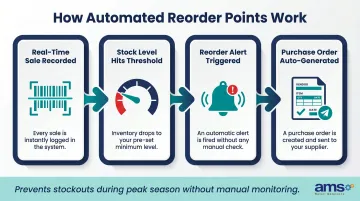
Real-time inventory visibility — where every sale, return, and receiving action immediately updates stock levels — is the baseline requirement. End-of-day batch updates create lag and errors that cost sales during peak season.
Configurable min/max reorder points combined with automated purchase order generation ensure critical parts are replenished before stockouts occur. During peak season, you can't manually monitor hundreds of SKUs. Your POS should do it for you, triggering reorders when stock hits predetermined thresholds.
Multi-Location and Service Bay Integration
Marine supply stores operating a service department need a POS that tracks inventory across both retail floor and service bay separately. Parts consumed in repairs must be deducted from inventory in real time and billed accurately to the customer, preventing the "invisible shrink" of service-consumed parts that never make it to an invoice.
Offline POS Capability
Many marine supply stores operate at marinas, docks, or waterfront properties with unreliable internet connectivity. IHL Group research shows that retailers prioritizing network reliability deploy mobile POS at 68% higher rates than those who don't — but what happens when the network fails entirely?
A POS with offline capability processes sales, updates inventory locally, and syncs when reconnected. Operations never stop, even when connectivity drops — a non-negotiable for any store selling dockside or at a remote marina.
Customer Purchase History and Loyalty Tracking
Tracking individual customer purchase history enables marine retailers to identify repeat buyers — marina members, regular boaters, charter operators — and personalize service accordingly. Loyalty programs pay off here because boating customers return for the same seasonal maintenance parts year after year — that's built-in recurring revenue if you stay top of mind.
When a customer returns looking for "that oil filter I bought last spring," your POS should instantly show their purchase history rather than forcing them to remember part numbers.
Reporting and Analytics for Smarter Buying
A good POS turns purchasing from gut-feel into data-driven decisions. Run these reports regularly:
- Seasonal turnover rates by product category — Identifies which categories sell through quickly versus which tie up capital
- Vendor fill-rate performance — Reveals which suppliers consistently deliver on time versus which cause stockouts
- Gross margin by SKU — Shows which parts generate the best returns
- Slow-mover aging reports — Surfaces dead stock before it becomes a write-off
Dead stock is especially punishing in marine retail, where off-season write-offs hit right when cash flow is already tight.
Strategies to Reduce Inventory Shrink and Improve Cash Flow
Cycle counting — using your POS to generate targeted count sheets for specific product categories on a rotating schedule — is more effective and less disruptive than annual full-inventory counts. NetSuite guidance notes that using the Pareto Principle (20% of SKUs typically account for 80% of sales), a facility with 1,500 SKUs can complete a full inventory rotation every six weeks by counting just 4-5 SKUs daily. This surfaces discrepancies before they compound into significant shrink losses.
Pair POS inventory data with vendor payment terms to strengthen your cash position. Use sell-through velocity data to negotiate just-in-time deliveries for fast movers and extended terms for slower seasonal categories.
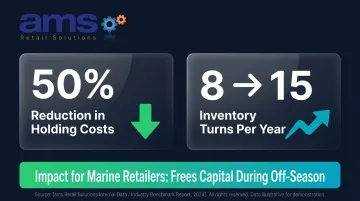
The results are measurable: a peer-reviewed retail study found high JIT adopters achieved a 50% reduction in holding costs and nearly doubled inventory turns — from 8 turns per year to 15. That freed-up capital matters most during the off-season when marine store revenue dips.
Beyond vendor terms, POS aging and margin reports guide end-of-season markdown decisions. Rather than carrying slow seasonal stock at full cost through winter, you can move it at a controlled discount — preserving working capital and shelf space for next season's incoming inventory.
Frequently Asked Questions
What are the 5 steps of inventory management?
The five core steps are: demand forecasting, procurement, receiving and storage, ongoing stock tracking, and regular audits. A quality POS automates the tracking and audit steps for marine retailers — eliminating the manual effort that eats up staff time during peak season.
How does a POS work step by step?
A POS scans the item, calculates totals with taxes and discounts, processes payment, and instantly updates inventory — all in one transaction. It also records customer purchase history and can trigger automatic reorders when stock drops below a set threshold.
What is the best software for parts inventory?
For marine retail, look for software that cross-references multiple supplier part numbers under a single SKU, tracks serialized components, and sets automated reorder points based on seasonal demand. Specialty retail POS solutions like NCR Voyix Counterpoint handle these requirements where generic inventory tools fall short.
Is there a free software for inventory management?
Free tools exist — basic spreadsheets and entry-level apps — but they fall short for marine supply stores managing thousands of part SKUs, extreme seasonal demand swings, and multi-supplier complexity. Research from DockMaster indicates spreadsheet-dependent marine operations lose an average of $47,000 annually from inefficiencies. The ROI of a proper POS typically outweighs the cost quickly through reduced shrink and better buying decisions.
What is the golden rule for inventory?
Never tie up more capital in inventory than your turnover rate supports — stock should be bought to sell, not to sit. For marine retailers, that means using POS data to buy aggressively before peak season and draw down inventory before winter, keeping aging stock visible so markdowns happen before it becomes dead capital.