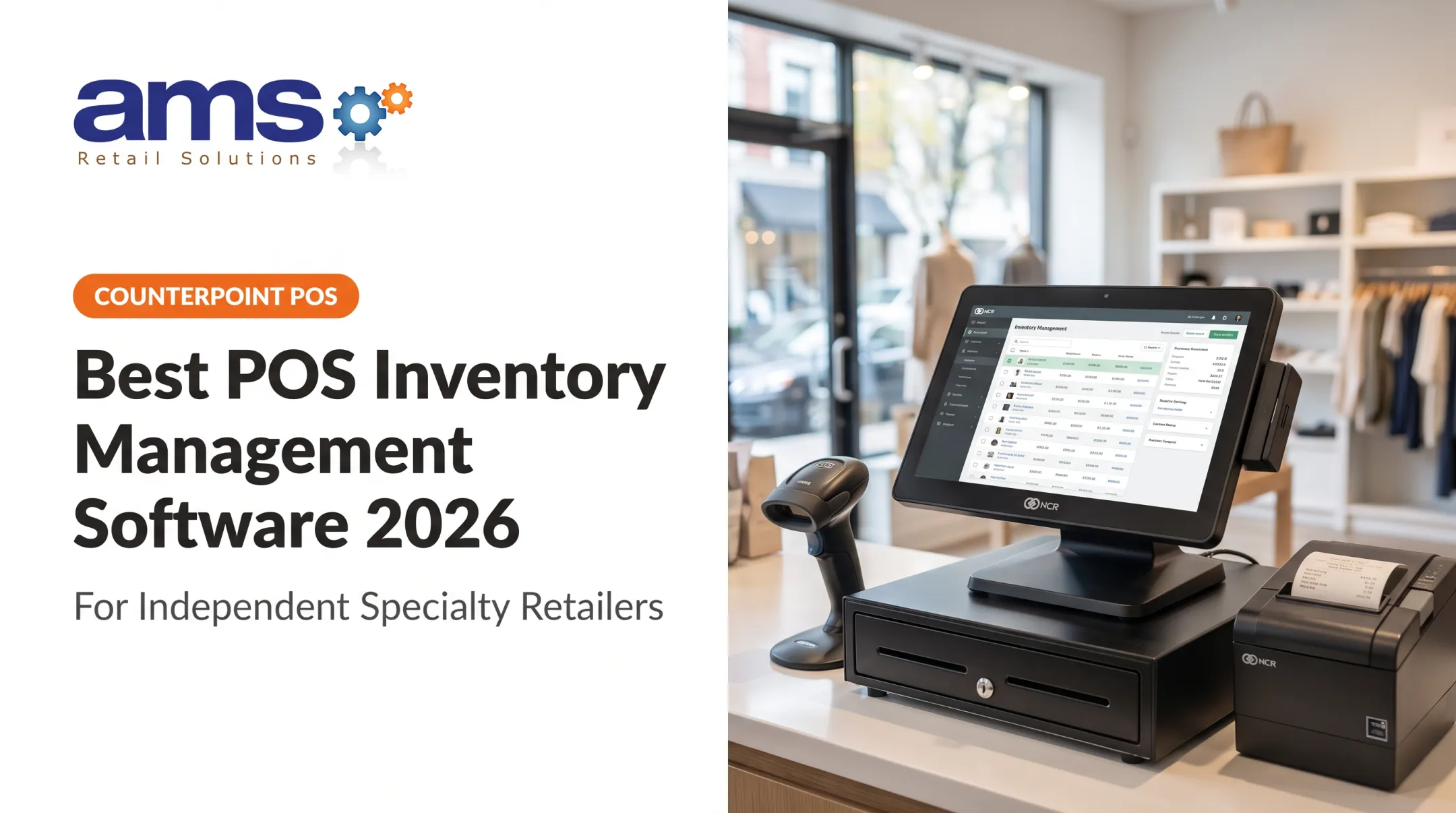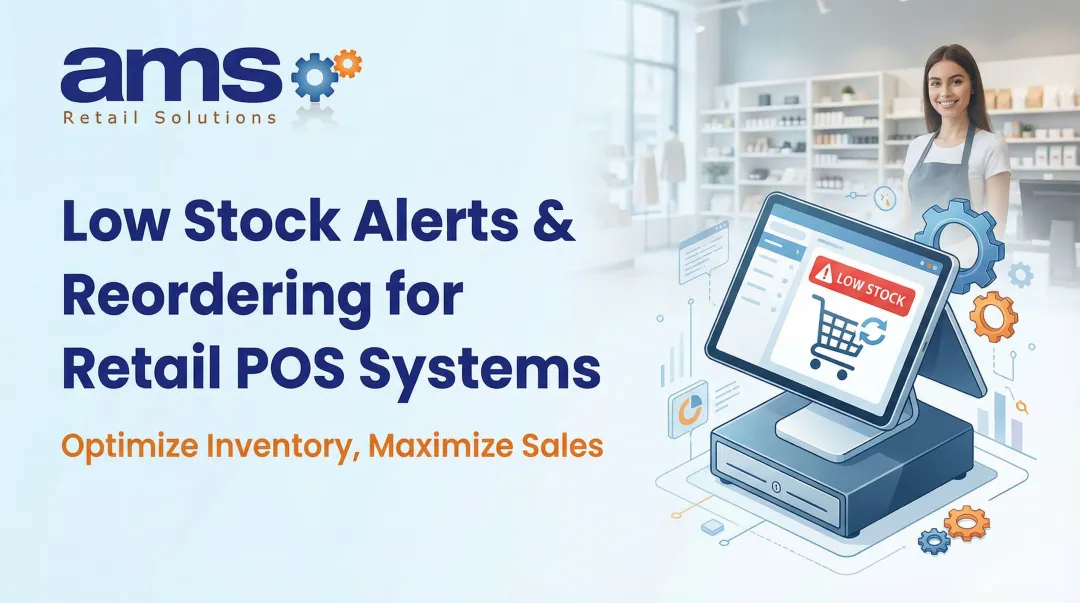

Effective retail inventory management isn't a single task. It's a workflow that connects product records, purchasing, receiving, selling, counting, and reporting into one system. Spreadsheets and periodic manual counts can't keep up once you're juggling seasonal products, multiple pack sizes, or size and color variants.
This guide compares five inventory-management solutions built for U.S. small businesses, including specialty retailers dealing with seasonal or complex merchandise like garden centers, farm stores, and sporting-goods shops.
Key Takeaways
- One system should connect sales, purchasing, counts, reorder alerts, and reporting—so you leave spreadsheet chaos behind.
- Real-time POS visibility cuts stockouts, trims excess inventory, and improves cash flow with sharper purchase data.
- Garden centers, farm markets, feed and seed, and sporting goods retailers gain most from forecasting, lead-time tracking, and cycle counts.
- Judge scalability, offline capability, hardware fit, and total cost—not brand name or the lowest sticker price.
Overview of Retail Inventory Management for Small Business
Retail inventory management covers the full cycle: purchasing, receiving, tracking, storing, selling, replenishing, and reconciling products so the right item is on the shelf at the right time. Done well, it directly affects cash flow, gross margins, labor efficiency, and shrink.
A survey of 500 U.S. retailers found the average small store held $48,000 in excess stock, representing 22% of total inventory, with 27% reporting they wrote off surplus goods in 2022. That's capital sitting on shelves instead of funding payroll or new orders.
The flip side is just as costly. According to an AlixPartners holiday-shopping survey, roughly two-thirds of shoppers said they'd leave and buy elsewhere if an item was out of stock—whether they were shopping online or in store.

Specialty retail complicates matters further:
- Garden centers deal with seasonal swings and plant material tracked by size and grade.
- Farm markets and feed stores manage variable pack sizes and weighed versus bagged goods.
- Landscape and hardscape suppliers track bulk materials, special orders, and mixed units of measure.
- Sporting-goods stores track deep SKU matrices across size, color, and model year.
There's no single "best" system here. The right fit depends on your product complexity, number of locations, sales channels, staff bandwidth, internet reliability, and where you plan to grow.
Top Retail Inventory Management Solutions for Small Business
Each option below is evaluated against the same criteria: inventory accuracy, POS integration, replenishment and reporting depth, specialty-retail fit, ease of implementation, scalability, support, and overall value. Pricing and features change often, so confirm current details directly with each vendor before deciding.
AMS Retail Solutions with NCR Voyix Counterpoint
AMS Retail Solutions is a single-source point-of-sale provider built around NCR Voyix Counterpoint, designed specifically for specialty retail operations rather than general merchandise chains. Instead of stitching together separate tools for selling, inventory, and reporting, Counterpoint handles all three from one platform.
What sets this approach apart for independent retailers:
- Customizable tools that adapt to how your specific operation runs, rather than forcing a generic retail workflow.
- Retail-hardened POS equipment, including touchscreen terminals, barcode scanners, and payment hardware built for daily store use.
- Offline POS capability so checkout keeps running even if your internet connection drops.
- One store or many, with the same platform scaling as you add locations.
- 24/7 support, including one-on-one training and ongoing maintenance.
The platform's inventory and reporting tools cover sales and return history, purchasing history, inventory cost and retail value, and slow-moving product identification, useful for spotting what's not selling before it becomes a write-off.
| Category | Details |
|---|---|
| Best fit | Independent specialty retailers (garden centers, farm stores, sporting goods, fashion, and similar) |
| Connectivity | Offline POS capability built in |
| Scalability | Single store or multi-store |
| Support | 24/7 support with training and maintenance |
| Pricing | Quote-based, configured around store size and hardware needs |
Because implementations are built around each retailer's SKU complexity and hardware requirements, pricing isn't published as a flat monthly rate. AMS Retail Solutions works directly with retailers to configure the right setup rather than selling a one-size-fits-all package.
Lightspeed Retail
Lightspeed Retail's inventory toolkit includes:
- Product variant management and location-level stock
- Transfers, reorder points, and low-stock alerts
- Purchase orders and NuORDER supplier catalog integration
Forecasting tools are built specifically for seasonal and multi-location retailers.
Lightspeed's own release on its seasonality forecasting feature claims merchants using Lightspeed Insights saw approximately 26% fewer out-of-stock days on top-selling items compared to those with access but not actively using it. That's a vendor-reported comparison, not an independent study, but it points to a real advantage for stores managing seasonal demand.
Pricing runs Basic at $89/month, Core at $149/month, and Plus at $289/month, with annual billing advertised at savings up to 18%. Confirm current tiers before signing, since software pricing shifts.
Trade-offs: Independent reviews are mixed. One Capterra reviewer praised inventory tracking and categorization; another flagged inconsistent customer service. Retailers with complex catalogs tend to get the most value here.
Square for Retail
Square for Retail is built for accessibility. Setup is fast, and its Free plan includes basic item creation by barcode or GTIN scan, low-stock alerts, and inventory counting.
Where the paid tiers matter:
- Vendor and purchase-order management require Plus ($49/location/month) or Premium ($149/location/month).
- Transfer orders between locations are Premium-only.
- Payment processing is charged separately on every plan, including Free.
Square Online syncs orders and stock between physical and online sales, which helps small retailers running both channels without a separate inventory tool.
Capterra shows Square for Retail at 4.7 out of 5 across nearly 500 reviews. Reviewers like the ease of setup and inventory tracking; common complaints center on transaction fees and support depth once operations get more complex.

It's a strong starting point for single-location retailers with straightforward catalogs, and a weaker fit for stores that need deep supplier management from day one.
Shopify POS
Shopify POS fits retailers who prioritize ecommerce alongside a physical storefront. Products live in Shopify admin, and both admin and POS can track, adjust, count, and receive stock. Note that creating transfers between locations still requires the admin dashboard, not the POS app itself.
Important update: Shopify's own inventory app, Stocky, is being discontinued (August 31, 2026). Purchase orders, supplier records, and transfers now live natively in Shopify admin. If you've seen older articles describing Stocky as a POS Pro perk, that information is outdated, and historical Stocky records won't migrate automatically.
Pricing:
- Basic / Grow / Advanced: $29 / $79 / $299 per month billed yearly (or $39 / $105 / $399 monthly)
- POS Pro: +$89 per location per month, billed yearly, for advanced in-person features
- Inventory sync add-ons: some setups need third-party apps (e.g., SyncX starts free and scales to paid tiers)
Reviewers on Software Advice like the in-store/online synchronization but note limited offline functionality and additional hardware costs, worth flagging if your location has spotty connectivity.
Clover Retail
Clover covers the inventory basics:
- Variant-aware SKU catalog and real-time stock levels
- Barcode-based updates
- Sales and cost reporting
Hardware options range from a compact countertop terminal to the Station Duo with a customer-facing display and the handheld Flex device.
What's less clear from Clover's own materials: native supplier purchase orders and low-stock alerts aren't confirmed features on the standard retail plan. Retailers needing those often turn to the third-party app SKU IQ for in-store and online syncing, an added cost layered onto the base system.
Pricing structure: The compact terminal runs $349 upfront or $16/month for 36 months. Card processing sits at 2.6% + 10 cents per transaction. Some online hardware offers require a three-year contract, so read the fine print before committing.
G2 reviewers report easy sales and inventory tracking, alongside concerns about reseller-imposed fees and contract terms that vary by where you buy. Ask specifically about app dependence and data portability before signing, since your experience can differ significantly by reseller.
How We Chose the Best Retail Inventory Management Solutions
Cheap, familiar, or heavily advertised isn't the same as what's right for your store. A system loaded with features you'll never touch just adds training time and confusion.
Inventory and operational capabilities we weighed:
- Real-time stock updates after every sale and receipt
- Barcode and SKU management, including product variants
- Purchase orders, reorder points, and supplier records
- Stock transfers between locations
- Returns processing and cycle counts
- Shrink tracking and slow-mover reporting
Business fit and ownership costs we weighed:
- POS and ecommerce integration depth
- Offline operation when connectivity drops
- Hardware requirements and staff training time
- Data migration and customer support quality
- Contract terms, subscription fees, and payment-processing requirements
- Room to scale as you add locations or SKUs
We prioritized current product documentation and independent reviews from Capterra, G2, and Software Advice over marketing claims. We also cross-checked pricing pages directly rather than relying on older articles. Software pricing and feature gates change often; what's accurate today may shift within months.

Conclusion
The best retail inventory management solution is the one that gives your team accurate, usable information without adding complexity you do not need. Feature count and sticker price matter less than fit.
Match each option to how you actually operate:
- SKU count and product attributes
- Seasonal patterns and supplier lead times
- Sales channels and staffing levels
- Day-to-day connectivity needs
A garden center managing plant material by grade has different requirements than a sporting-goods store tracking size and model-year matrices, even though both are specialty retail.
If you run a specialty retail business, AMS Retail Solutions can help you see whether NCR Voyix Counterpoint and its supporting POS tools fit your inventory, checkout, and growth plans. Call 757.495.4995 to talk it through.
Frequently Asked Questions
How do I get inventory for a retail store?
Source products through wholesalers, manufacturers, distributors, and trade marketplaces, or buy direct from suppliers. Compare unit costs, minimum order quantities, lead times, payment terms, and return policies before committing to a vendor.
How do I manage inventory in a retail store?
Build accurate SKU records, track every sale and receipt in real time, and set reorder points based on lead times. Count stock regularly, reconcile discrepancies, and use POS reports to flag slow movers and guide future purchasing.
What is the best inventory management system for a small retail business?
Match the system to your product complexity, sales channels, number of locations, budget, and growth plans. Compare real-time tracking, POS integration, replenishment tools, reporting depth, offline capability, and total cost, not just the sticker price.
Do small retailers need inventory management software?
Spreadsheets can work for a very small, single-location shop with simple products. Once you're managing multiple channels, seasonal inventory, or growing SKU counts, manual tracking becomes error-prone and eats up staff time better spent elsewhere.
How often should a small retail business count inventory?
Base your schedule on transaction volume, product value, and shrink risk. Many retailers run monthly counts on high-priority items, quarterly on mid-tier products, and a full physical count once or twice a year.
What should I look for in a retail POS with inventory management?
Look for real-time stock updates, product variant support, barcode scanning, purchase orders, and reorder alerts. Also check reporting depth, offline functionality, integration options, data security, and whether pricing scales as you grow.