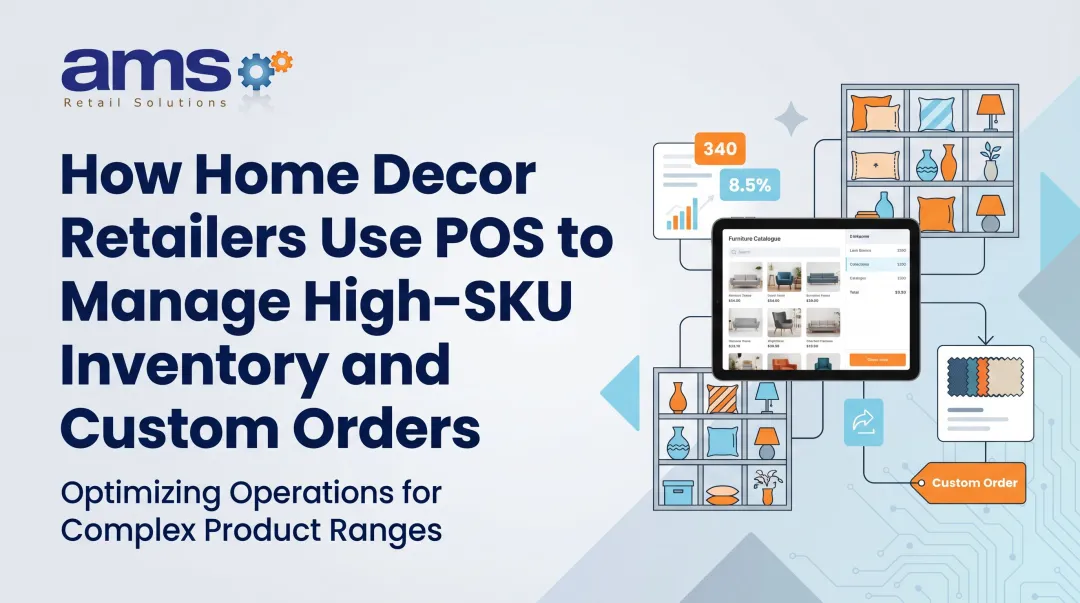

The usual pain points show up fast. Stock availability is unclear, order updates are manual, checkout is slow, follow-ups slip, and reporting is thin. The Home Furnishings Association lists serialized and multi-attribute products, web-to-store synchronization, and training and support among the things to look for.
This guide compares five options: STORIS, NCR Voyix Counterpoint, Lightspeed Retail, Shopify POS, and Square for Retail. It judges each on workflow fit, order depth, integrations, cost, and support.
Key Takeaways
- Furniture store software combines POS, inventory, customer, order, and reporting tools, not CAD or design software.
- The right fit depends on special-order volume, delivery process, store count, and ecommerce needs.
- Test quote-to-delivery workflows, not just checkout.
- Compare total cost, offline behavior, integrations, and support, not the monthly price alone.
Overview of Furniture Store Software in the US Market
Furniture store software is the connected retail technology behind showroom sales and everything after the customer commits: inventory, purchasing, customer records, fulfillment, delivery, and reporting.
In a typical US showroom, the flow looks like this:
- An associate consults on the floor and configures the product.
- The customer approves a quote and pays a deposit.
- The store orders from the vendor.
- The warehouse receives the goods.
- Delivery is scheduled, then service follows the sale.

Retail POS covers transactions, customer records, and inventory. Broader retail ERP, such as STORIS, adds purchasing, merchandising, logistics, accounting, and analytics. Furniture design and CAD tools sit outside this category entirely.
One current trend is cross-channel visibility. The HFA's 2026 omnichannel article, written by a vendor and best read as industry perspective, describes location-level availability and delivery timeframes for out-of-stock furniture.
Best Furniture Store Software for Showrooms
Judge each platform on workflow fit, inventory and order depth, customer experience, integrations, implementation, scalability, support, and current pricing. Brand recognition shouldn't drive the decision. Pricing below was checked in November 2026 and is in USD.
STORIS
STORIS is a furniture and home-furnishings retail platform. It offers cloud packages for independent retailers and tailored enterprise combinations, centralizing stores, websites, and distribution.
Its furniture-specific strengths:
- Mobile configuration using vendor, category, group, and SKU templates
- Quotes that preserve selected options, prices, and promotions
- Automatic vendor purchase orders at special-order checkout
- Delivery routes, capacity limits, split fulfillment, and white-glove delivery, with delivery and installation charges applied at POS
- Customer history and open carts to support follow-up
| Snapshot | Details |
|---|---|
| Best fit | Furniture retailers with heavy special-order and delivery complexity |
| Capabilities | Native configuration, quotes, vendor POs, routing, reporting. QuickBooks and partner-built Shopify/WooCommerce connections via integration |
| Commercial | Quote-based, pricing not published. Hosted cloud or on-premise. Implementation includes a project manager, data conversion, and training. Showroom deposit rules and offline POS behavior are not clearly documented |
NCR Voyix Counterpoint
NCR Voyix positions Counterpoint as a specialty-retail system for retailers with 1 to 500 locations. Furniture isn't among the named verticals on its current page.
Documented strengths include real-time inventory across locations, multi-vendor purchasing, reorder tools, loyalty, configurable touchscreens, profitability reporting, and layaway. Quotes, deposits, special orders, and item-variant grids are not clearly listed on current product pages, so plan on configuration or integrations to close gaps. Confirm upholstery configuration and delivery routing with NCR Voyix or a reseller.
| Snapshot | Details |
|---|---|
| Best fit | Specialty showrooms wanting a flexible, customizable POS, from one store to many |
| Capabilities | Native inventory, purchasing, customers, reporting, layaway. Ecommerce integration advertised |
| Commercial | Pricing not published. Licensing, hardware compatibility, and support terms should be confirmed with a reseller |
Lightspeed Retail
Lightspeed's X-Series covers checkout, refunds and exchanges, customer profiles, inventory variants, supplier POs, receiving, transfers, and reporting. It adds integrated ecommerce, multi-outlet management, click-and-collect, and local delivery.
Its feature page lists deposits, laybys, and special orders, but the detailed mechanics are documented for the older R-Series. Don't assume they carry over. X-Series custom items let staff enter a price at sale, which isn't an upholstery configurator. It suits simpler showrooms best.
| Snapshot | Details |
|---|---|
| Best fit | Small to mid-size showrooms with straightforward catalogs and ecommerce |
| Capabilities | Native inventory, POs, customers, reporting, ecommerce. Furniture routing and installation are not clearly documented |
| Commercial | Basic $89, Core $149, Plus $289 per month billed annually; card-present 2.6% + $0.10. Hardware pricing not published; 24/7 chat and phone support |
Shopify POS
Shopify POS shines when showroom and online sales overlap. Customers share profiles across channels, and staff can see stock, dimensions, finish options, and order status.
Native tools include draft orders for quotes and partial payments for deposits. Percentage-deposit requirements on draft orders need Shopify Plus. Local delivery needs POS Pro. Custom draft items aren't inventory-tracked.
Complex furniture work typically needs apps. Bevy OrderPilot adds quotes, deposits, and vendor POs, while Blueprint Product Configurator handles conditional options.
| Snapshot | Details |
|---|---|
| Best fit | Showrooms where online sales are as important as floor sales |
| Capabilities | Native POS, ecommerce, inventory, customers, drafts, partial payments, purchase orders. Configuration via apps. White-glove routing is not clearly documented |
| Commercial | Basic $29, Grow $79, Advanced $299 per month billed annually; in-person 2.6%/2.5%/2.4% + $0.10. POS Pro adds $89 per location monthly. Terminal $349 |
Square for Retail
Square offers fast setup and easy checkout: product variations, customer profiles, low-stock alerts, refunds, exchanges, reporting, and synchronized location and online stock. Vendor POs and receiving are available on eligible paid plans.
Deposits run through Square Invoices, where inventory isn't reduced until the invoice is fully paid, and deposits apply to the order total, not individual items. Manufacturer-linked special orders and white-glove delivery are not clearly documented.
| Snapshot | Details |
|---|---|
| Best fit | Small showrooms with simple catalogs and limited special orders |
| Capabilities | Native checkout, inventory, customers, reporting, returns, POs. Accounting and ecommerce via integrations |
| Commercial | Free, $49 Plus, or $149 Premium per location monthly; card-present 2.6%/2.5%/2.4% + $0.15. Hardware from $59. Phone support varies by plan |

How We Chose the Best Furniture Store Software
Don't pick software because it's cheap, popular, or demos well. Run realistic showroom scenarios through each shortlisted system.
Test the Full Workflow
Walk one sale end to end and note every point where staff leave the system:
- Browse and configure products
- Build the quote and take a deposit
- Place the special order and update the customer
- Receive stock and schedule delivery
- Collect the final payment
Check Inventory and Order Visibility
Confirm the system tracks each stock view below, and ask whether each is native or needs an integration:
- Floor and warehouse stock
- Incoming shipments and items in transit
- Vendor stock and reserved items
- Damaged goods and returns
Review Customer Tools
Look for tools that keep the sale moving on the floor:
- Customer history and saved quotes
- Follow-up reminders
- Financing or payment integrations
- Receipts and fast checkout
- Omnichannel selling
Compare Technical and Commercial Fit
- Accounting and ecommerce integrations
- Offline capability: Square allows offline payments on supported hardware if reconnected within 72 hours, while Lightspeed's offline payments are in beta
- Security: PCI guidance notes an approved terminal alone doesn't guarantee compliance
- Permissions, reporting, and scalability
- Hardware, implementation timeline, training, and support
- Contract terms and total cost of ownership

Conclusion
The best showroom software matches your product complexity, sales process, inventory structure, delivery model, and growth plans. The most recognizable brand isn't automatically the answer.
Before signing, test finalists with sample transactions. Measure:
- Checkout speed
- Inventory accuracy
- Quote-to-order handling
- Staff adoption
- Reporting quality
- Integration performance
If you want a single-source retail POS, AMS Retail Solutions, an authorized NCR Voyix Counterpoint reseller, can help you evaluate Counterpoint for your showroom. Its offering includes:
- Customization and offline POS capability
- Retail-hardened equipment
- Implementation and one-on-one training
- 24/7 support Confirm your furniture-specific requirements, such as special orders and deposits, during the evaluation.
Frequently Asked Questions
What is the best POS system for a furniture store?
There's no universal winner. Furniture-specific platforms like STORIS handle special orders and delivery natively, while broader POS options suit simpler needs. Match the platform to your special orders, deposits, inventory locations, delivery, ecommerce, and store count.
What features should furniture showroom software have?
Core needs include product variants, quotes and deposits, special orders, multi-location inventory, delivery coordination, customer records, reporting, and payment or accounting integrations.
Can furniture store software manage special orders, deposits, and delivery scheduling?
It varies. Some features are native, others need apps or integrations. Test the full quote-to-delivery workflow before buying.
Should a furniture showroom choose POS software or an ERP system?
POS handles checkout and customer-facing sales. ERP or broader retail management covers purchasing, fulfillment, finance, and multi-location operations. Choose by how much back-office complexity you carry.
How much does furniture store software cost?
Costs include subscriptions or licenses, payment processing, hardware, implementation, integrations, training, and add-ons. Compare total cost of ownership, not the advertised starting price.
Can furniture store software work offline and integrate with ecommerce or accounting systems?
Offline and integration support differ by vendor. Confirm offline transaction behavior, data synchronization, supported platforms, and recovery procedures before purchase.