
Introduction
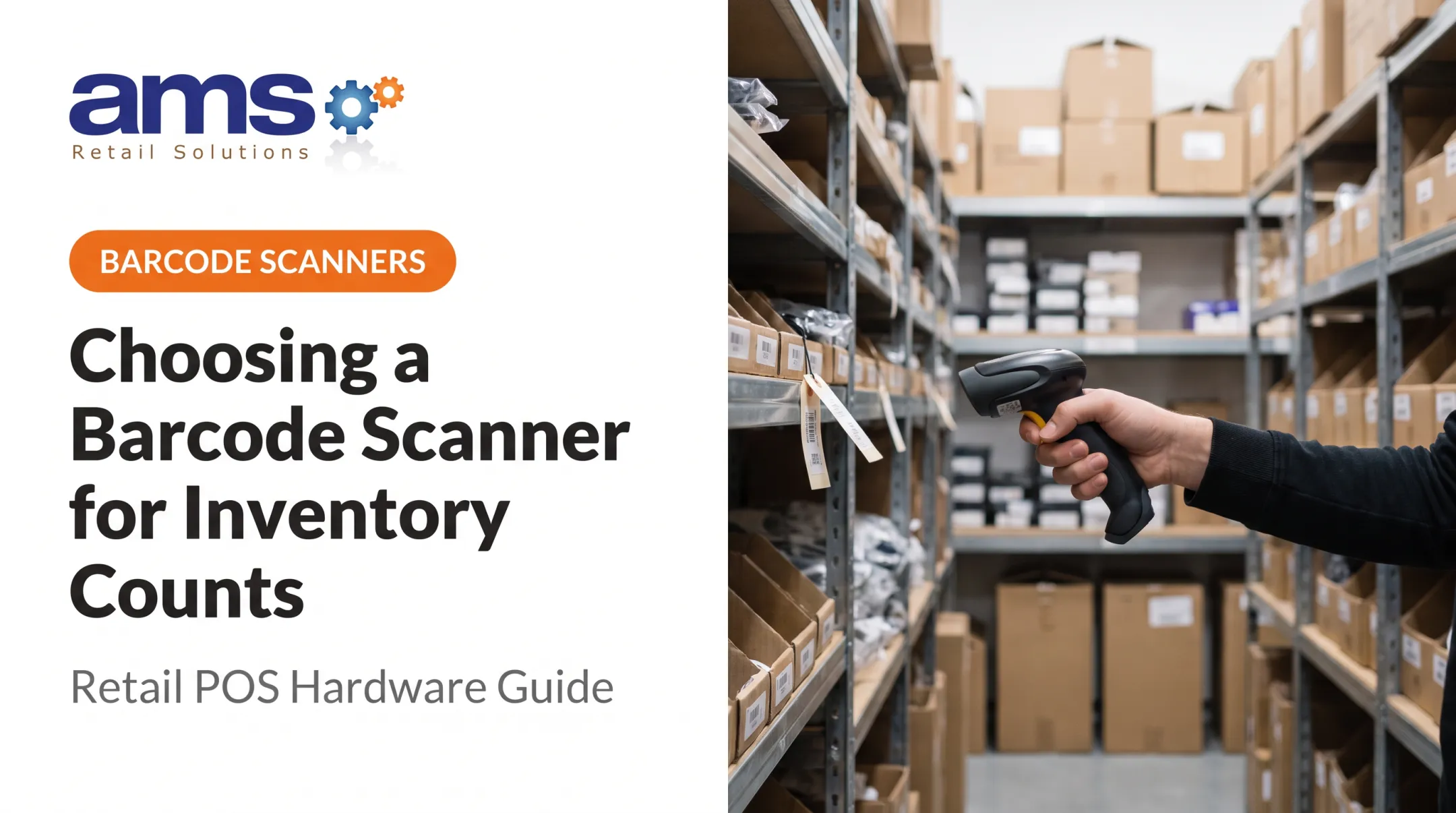
A handheld barcode scanner sits between almost every task in a US store: checkout, receiving, price checks, stockroom transfers, and inventory counts. When it works, nobody notices. When it doesn't, lines back up and counts drift.
The right scanner cuts manual entry, speeds up the register, and keeps stock records honest. The wrong one brings pairing failures, dead batteries, or a USB mode your POS can't read.
Timing matters too. GS1 US is pushing retail POS systems to scan and process 2D barcodes by end-2027, which makes imager choice a real decision now.
Below, we compare four current models: Zebra DS2278, Zebra DS2208, Honeywell Xenon XP 1950g, and Socket Mobile S740. We also explain why the Datalogic GD4500 is left out.
Key Takeaways
- Pick by workflow: fixed checkout, receiving, mobile counts, or tablet-based selling.
- A 2D imager covers QR codes, phone screens, and future labels.
- Corded scanners simplify charging; wireless adds mobility and battery management.
- POS compatibility matters as much as scan speed, so test before buying.
- Warranty and support shape value more than sticker price.
Overview of Handheld Barcode Scanners in the US Retail Market
A handheld barcode scanner reads a barcode and sends the decoded product or inventory identifier to a POS, tablet, computer, or inventory app.
1D vs. 2D: What Each Reads
According to Zebra's scanner guide, the technologies differ in practical ways:
| Type | Reads |
|---|---|
| 1D laser | Printed linear barcodes only; no 2D codes or phone screens |
| 1D linear imager | Linear codes, including on phone screens; no 2D codes |
| 2D area imager | 1D and 2D codes (including QR), on labels and screens |
For stores still printing UPC labels, a 1D scanner works today. For anything newer, 2D is the safer buy.
Where Scanners Earn Their Keep
Specialty retailers use handhelds in several places:
- Checkout and returns at the counter
- Receiving pallets of potting soil, feed, or seasonal stock
- Price verification on the sales floor
- Cycle counts in a stockroom or yard
- Product lookup for customers in a garden center or outdoor store
A Market Signal
Mobile POS is a top in-store mobile priority for 57% of respondents in RCP's 2025 report, which surveyed over 100 US retailers. That measures priority, not installed scanners. Still, it explains why wireless and tablet-friendly models keep gaining attention.

Best Handheld Barcode Scanners for US Retail
Each scanner was judged on 1D/2D capability, connection type, durability, warranty, POS fit, and the workflow it suits, not brand recognition. Confirm current US list pricing with a reseller.
Zebra DS2278: Best Overall Wireless Handheld Scanner
The DS2278 is a cordless 1D/2D array imager with Bluetooth 4.0 (BLE, Class 2). Zebra specifies at least 30 ft of radio range in open air, and up to 300 ft with the CR2278 cradle. That is radio range, not scanning distance.
Why it stands out:
- Moves between checkout, receiving, and stockroom without a cord
- Survives multiple 5 ft drops to concrete; rated IP52
- Charges in the cradle or directly over Micro USB
- Zebra says the 2,400-mAh battery will likely never need replacing, though that is a manufacturer claim
Tradeoffs: you manage charging and pairing, and warranty is shorter than the DS2208's.
| Details | |
|---|---|
| Best for | Mobile checkout, receiving, lookup, cycle counts |
| Technical | 1D/2D imager, Bluetooth with cradle, IP52 |
| Buying | Warranty: 36 months scanner and cradle, 12 months battery; cradle vs. cable package affects cost |
Zebra DS2208: Best Value Wired 2D Handheld Scanner
The DS2208 is a corded 2D imager reading UPC, QR Code, and DataMatrix. It supports USB, RS-232, and keyboard wedge, depending on the cable.
It fits fixed registers, receiving desks, and service counters. There are no batteries to charge, and one model can be deployed across every lane. The cable limits movement and can clutter a counter.
Its 60-month warranty is the longest of the Zebra pair. Zebra says it also works with existing LS2208 universal cables, which helps stores upgrading old scanners.
| Details | |
|---|---|
| Best for | Fixed POS stations, receiving, lookup, back-office work |
| Technical | 1D/2D, USB keyboard HID plus other modes, IP52, 5 ft drops |
| Buying | 60-month warranty; cables are interface-specific, so match yours to the host |
Honeywell Xenon XP 1950g: Best for Difficult or Damaged Barcodes
The 1950g is a corded general-duty area imager, available in standard-range (SR) and high-density (HD) configurations. Honeywell sells the 1952g separately as the cordless version, so don't mix their specs.
It reads 1D, PDF, and 2D codes, and is built for 50 drops from 6 ft to concrete. The datasheet lists SR reads of 13-mil UPC from 0 to 490 mm. Honeywell backs it with a 5-year warranty.
It makes sense for high-volume counters or stores handling glossy, curved, or worn labels. For a controlled indoor counter with clean UPCs, it may be more scanner than you need.
| Details | |
|---|---|
| Best for | High-volume checkout, receiving, returns, difficult labels |
| Technical | SR or HD configuration, corded, IP52, host interface selection |
| Buying | 5-year warranty; configuration choice drives cost |
Socket Mobile SocketScan S740: Best for Tablet and iPad Workflows
The S740 is a compact 1D/2D Bluetooth scanner (Class 2, Bluetooth 2.1 + EDR) that reads printed and on-screen codes. Socket lists support for iOS, Android, and Windows 11.
It suits pop-up sales, market-style checkout, garden-center floors, and mobile counts. It runs on two replaceable NiMH batteries (2,000 mAh), with roughly 6 hours of charging.
One detail trips buyers up. Basic Mode uses HID keyboard input. Application Mode uses SPP and requires apps built on Socket's CaptureSDK. Test it with your exact app.
| Details | |
|---|---|
| Best for | iPad, tablet, mobile POS, pop-ups, floor inventory |
| Technical | HID and SPP modes, replaceable batteries, multiple charging options |
| Buying | 1-year warranty included; extended options sold separately |
Why the Datalogic Gryphon GD4500 Is Missing
A major US reseller lists the GD4500 as end-of-life, with manufacturer orders closed and the Gryphon 4600 as successor. Stock may linger at distributors, but skip discontinued models for new deployments.

How We Chose the Best Handheld Barcode Scanners
Selections rest on manufacturer documentation, spec sheets, lifecycle notices, and warranty terms. Hands-on lab tests were not part of the evaluation, so test shortlisted units yourself before you buy.
What We Weighed
- First-pass scanning on UPCs, phone screens, and damaged labels
- Associate comfort during repeated scans
- Wireless uptime and charging effort
- Ease of deployment across lanes
- Software compatibility
- Cost over the expected service life
No independent, comparable service-life or total-cost benchmark exists for these exact models in specialty retail. Use warranty length and accessory costs as your guide.
Common Buying Mistakes
- Buying 1D-only without checking future needs
- Choosing wireless with no plan for charging and pairing
- Ignoring the POS input mode
- Paying for rugged hardware that sits at an indoor counter
Even image scanners can fail on 2D data. GS1 US testing found every participating retailer had problems processing additional Application Identifier data. Hardware readiness and software readiness are separate questions.
Pre-Purchase Checklist
- List every barcode format you use today and expect to use.
- Map fixed versus mobile workflows.
- Test each scanner with your exact POS or inventory software.
- Confirm accessories, cables, and warranty coverage.
- Count the units needed for peak season.

Conclusion
The best handheld scanner depends on your workflow, barcode types, mobility needs, and POS environment. Popularity and low price are poor tiebreakers.
Test your shortlist at checkout, receiving, and inventory stations. Then compare battery, cable, accessory, and replacement costs before standardizing on one model.
Specialty retailers can call AMS Retail Solutions at 757.495.4995 to talk through how scanning hardware fits an NCR Voyix Counterpoint POS deployment, for one store or many.
Frequently Asked Questions
What is the best handheld barcode scanner to buy?
It depends on wired or wireless use, 1D or 2D needs, and POS compatibility. For most mixed retail work, the Zebra DS2278 is our top overall pick.
What are some good wireless handheld barcode scanners?
The Zebra DS2278 suits roaming work across checkout, receiving, and counts. The Socket Mobile S740 fits tablet and mobile POS setups. Plan for charging and pairing with either.
What is the most popular handheld barcode scanner?
No reliable public data ranks models by US retail share. Popularity varies by store size and POS ecosystem, so ask resellers what they deploy most.
Do retail stores need a 1D or 2D handheld barcode scanner?
A 1D scanner reads standard UPCs. A 2D imager also reads QR codes, phone screens, and newer GS1 2D barcodes, making it the safer choice.
Should a retail store choose a wired or wireless handheld barcode scanner?
Wired models avoid charging and pairing at fixed counters. Wireless adds mobility. Many stores use both.
Will a handheld barcode scanner work with a retail POS system?
Many use USB keyboard emulation or Bluetooth HID, but confirm your POS software, operating system, and connection mode first. No public Counterpoint certification list covers these models, so test before buying.