When staff classify those events wrongly, the damage adds up. NRF's 2023 survey attributed 27% of shrink to process and control failures and errors.
This article separates the main POS transaction types, explains how they differ, and shows what to look for when choosing a system.
Key Takeaways
- A transaction type can describe the action, tender, channel, or status.
- Core types: sales, returns, refunds, exchanges, voids, gift cards, store credit, split tender, deposits.
- Each transaction should update inventory, payment, tax, and reporting records once, without duplicates.
- Choose a POS on controls, audit trails, and workflow fit, not feature count.
What Is a POS Transaction?
A POS transaction is a recorded event in which a retailer sells goods or services, accepts or reverses payment, or adjusts an earlier sale.
Most records connect:
- Items or services sold, with prices and discounts
- Tax and tender type
- Employee and, when applicable, customer account
- Receipt and transaction status
Transactions happen at fixed registers, mobile checkout stations, service counters, kiosks, and connected online channels. A landscape supply yard might sell from the lot on a mobile terminal, while a power equipment dealer runs the sales floor, parts counter, and service bay from one customer file.
Why POS Transaction Types Matter to Retailers
Correct classification keeps inventory quantities, cash drawer totals, payment settlements, sales tax records, and management reports aligned.

The wrong type causes real problems:
- Inaccurate stock counts when a return doesn't restock
- Duplicate revenue from re-rung sales
- Refunds sent to the wrong tender
- Unexplained drawer differences
- Weak audit trails when someone asks what happened
Specialty retailers feel this more:
- Garden centers ride seasonal inventory swings
- Farm and agriculture stores carry grower accounts on terms
- Outdoor retailers handle special orders
- Many stores split stock across yards, warehouses, and multiple locations
Each of those needs clean transaction visibility.
Types of POS Transactions Retailers Use
Four dimensions often get confused: the action (sale, return, void), the tender (cash, card, gift card), the channel (in person, online), and the status (approved, pending, failed).
One checkout carries all four. An in-store sale paid with a contactless debit card is a sale action, a card tender, an in-person channel, and an approved status. Square's API, for example, separates payment source and status as distinct fields. Payment source and status do not replace the merchandise action.
Sales and Purchase Transactions
A standard sale starts when items go into a basket. The POS calculates prices and tax, accepts payment, and completes the sale.
A good record should:
- Reduce inventory
- Record the tender
- Issue a receipt
- Preserve SKU, quantity, employee, location, discounts, and customer account
Feed and seed stores add weight-based sales, with scales, varied units of measure, and fractional quantities. Garden centers sell plant material tracked by size and grade. Wine shops mix case and bottle pricing with scale-weighed items.
Payment-Method and Channel Variations
Retailers commonly handle:
- Cash
- Debit and credit cards (EMV chip, contactless, or keyed)
- Mobile wallets
- Online orders and mobile POS sales
Card-present and keyed payments are not equal. The Kansas City Fed notes card-not-present transactions are more prone to fraud because the card and cardholder aren't physically present.
Visa's published schedule also shows keyed debit interchange of 1.65% + $0.15 versus 0.80% + $0.15 for retail debit. Confirm your own processor's rules, fees, and staff procedures.
Cash and electronic payments settle differently. Square's payout timing, for instance, applies to card payments, not cash taken at the counter. Still, every accepted tender belongs in the same sales and reconciliation records.
Returns, Refunds, and Exchanges
Return, refund, exchange, and store credit are related but distinct:
- Return: merchandise comes back
- Refund: money goes back to the customer
- Exchange: one item replaces another
- Store credit: creates a liability, unlike a cash or card refund
Link the adjustment to the original receipt when possible, restock correctly, apply your return policy, and record the reason. Watch the outcomes: refund to original tender, partial refund, exchange with a price difference, or store credit. In Lightspeed's R-Series, an exchange with equal totals produces a $0.00 balance.
Returns carry real exposure. NRF projects $849.9B in 2025 returns, though that figure measures merchandise value, not processing cost.
Voids, Cancellations, and Corrections
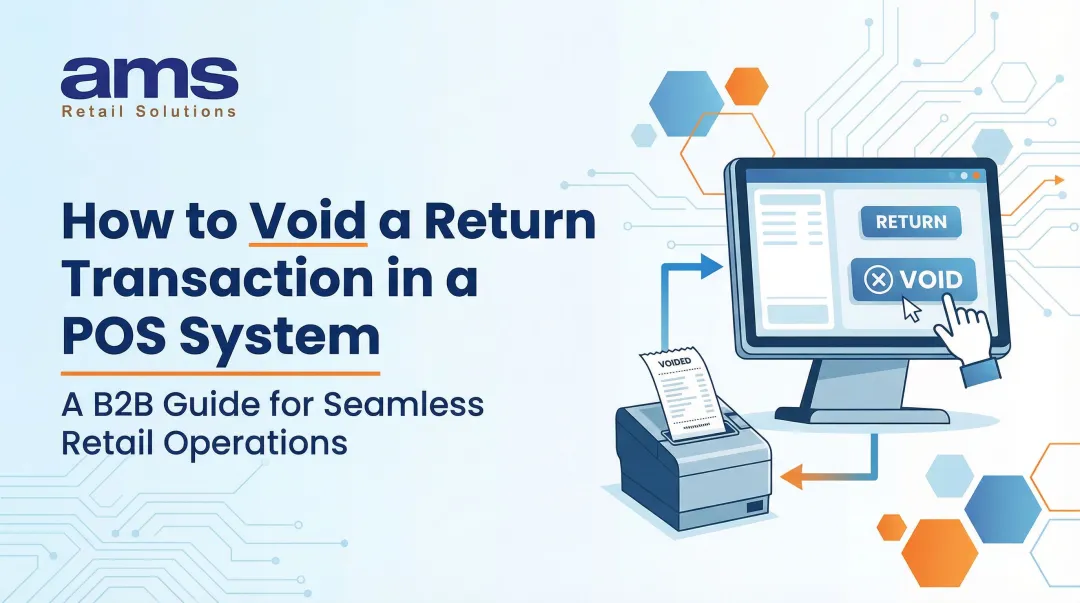
A void removes or reverses an uncompleted or eligible transaction. A refund happens after the sale is complete.
Common triggers include:
- Duplicate entries
- Mis-scanned items or wrong quantities
- Abandoned checkouts
- Failed authorizations
- Pricing mistakes
A void in the register doesn't automatically return card funds. Lightspeed's documentation says so explicitly, so check how your system handles both sides.
Because voids are easy to abuse, enforce role-based permissions, approval rules, timestamps, employee IDs, and audit logs. Those make misuse harder and investigation faster.

Gift Cards, Store Credit, Split Tender, and Deposits
These often post differently from a standard sale:
- Gift card redemptions draw down a stored balance
- Store credit and loyalty rewards offset a purchase
- Split tender divides one sale across several payments
- Deposits, layaways, and special orders collect partial payment now and fulfill later
The POS should track outstanding gift card and store-credit balances, partial payments, remaining balances, and eventual fulfillment. Accounting treats prepayments as liabilities until goods transfer, so cash collected isn't yet revenue.
This matters for outdoor living retailers taking progress payments, sporting goods stores running layaways, and home and flooring shops tying estimates, deposits, and final invoices to one job.
How to Choose the Right POS Transaction Capabilities
Pick capabilities based on your real workflows, inventory model, customers, and growth plans. The longest feature list is not the goal.
Factors to Consider
- Transaction mix: List current and planned payment methods, adjustments, customer accounts, gift cards, special orders, deposits, and channels.
- Inventory complexity: Variants, serialized or high-value units, seasonal items, weighed goods, bundles, transfers, and location-specific stock.
- Checkout environment: Fixed registers, mobile selling, events, multiple departments, spotty connectivity.
- Controls and reporting: Searchable history, permissions, approvals, refund controls, audit trails, end-of-day reports, reconciliation.
- Scale and integration: Multi-location support, accounting and payment integrations, loyalty, ecommerce, hardware, future growth.
Connectivity deserves a hard look. Square's offline mode, for example, requires upload within 72 hours and excludes gift cards and manually keyed cards. Ask any vendor what offline mode excludes.
Applying the Criteria to Specialty Retail
AMS Retail Solutions is an authorized NCR Voyix Counterpoint provider for independent specialty retailers in the U.S. and Canada. Counterpoint is a single-source POS that connects checkout, inventory, reporting, and operations for one store or many.
Features relevant to this decision include:
- Customizable tools tailored to each industry
- Sales and return history reporting
- Gift card sales and tracking
- User management and security
- Offline POS capability when the network is down
- Multi-store flexibility, with online selling available
- Retail-hardened equipment and 24/7 support
Confirm specifics, such as store credit, deposits, and special orders, against current product documentation during your demo.
What to Check Before Finalizing a POS Solution
Don't choose on payment acceptance alone. Returns, voids, inventory adjustments, reconciliation, permissions, and reporting matter just as much.
Ask how the system handles:
- Failed payments and duplicate transactions
- Partial refunds and split tender
- Gift cards, store credit, and deposits
- Transactions created during connectivity interruptions
Then test with your own staff before committing. Run a normal sale, a return, an exchange, a void, and a cash closeout. Include one transaction you must match to a processor or bank statement.

Conclusion
POS transaction types are more than payment methods. They describe the sales, adjustments, channels, and statuses that shape your operational records.
Accurate handling protects inventory, cash flow, reporting, customer service, and auditability. Choose a POS that fits your workflows today and has room for new products, locations, payment methods, and channels tomorrow.
Frequently Asked Questions
What is a POS transaction type?
It's the category assigned to a sale, payment, return, refund, void, exchange, or other POS event. Systems may classify it by action, tender, channel, or status.
What are examples of transaction types?
Examples include sales, cash and card payments, mobile wallet payments, returns, refunds, exchanges, voids, gift card redemptions, store credit, split tender, and online or mobile transactions.
What is POS purchase on a bank statement?
It generally marks a purchase made through a merchant's point-of-sale system. The exact descriptor, merchant name, date, and amount depend on your bank, the processor, and the retailer.
What is the POS transaction limit?
No single universal limit exists. Limits depend on the card issuer, available funds, processor risk controls, merchant settings, and tender type. One bank lists $6,000 daily for standard debit cards.
How do POS refunds and returns differ from a sale?
A return records merchandise coming back, a refund reverses all or part of the payment, and an exchange swaps products. Each should link to the original receipt and update inventory correctly.
What is the difference between an in-store and an online POS transaction?
In-store payments are card-present, with chip or contactless verification. Online payments are card-not-present, carry higher fraud exposure, and rely on checks like AVS, CVV, or 3-D Secure.