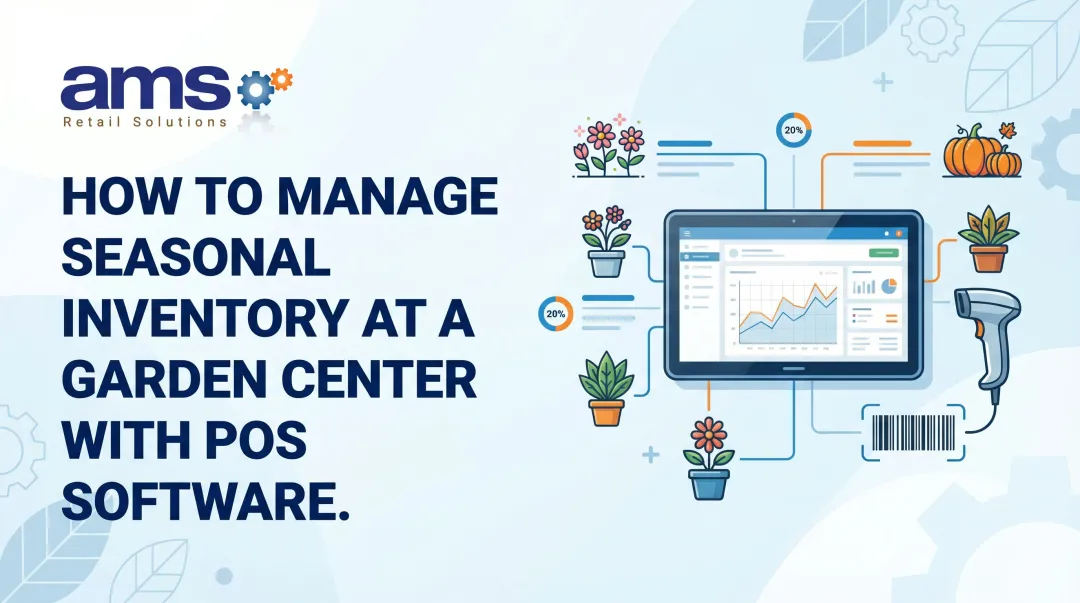

In one Garden Center survey, 74% of independent garden center respondents named May their strongest month. Farm markets, feed and seed stores, outdoor sporting goods retailers, and other weather-, holiday-, or harvest-driven merchants face the same compressed calendar.
This guide walks through a practical process: identify seasonal SKUs, forecast demand, plan purchasing and staffing, monitor sales in season, clear leftovers, and feed the results into next year's buy.
Key Takeaways
- Plan the full lifecycle: preparation, peak, taper, clearance, and review.
- Balance lead times, safety stock, storage, cash flow, and shelf life before ordering.
- Watch sell-through, stockouts, and days of inventory while the window is open.
- Reliable POS and inventory data makes every one of these steps easier.
What Seasonal Inventory Means for Specialty Retail
What qualifies as seasonal inventory?
Seasonal inventory is stock whose demand rises and falls predictably with weather, holidays, planting or harvest cycles, sporting events, or school calendars. A seasonal pattern has a fixed, known period. Forecasting: Principles and Practice distinguishes it from cyclical swings, which have no fixed frequency and usually track the economy.
Typical examples:
- Spring plants, fertilizer, and planting supplies
- Harvest products at farm markets
- Winter feed and weather equipment
- Lawn and garden tools
- Camping gear and sport-specific merchandise
Why does it matter?
Right-sized inventory protects availability, margin, cash flow, storage space, and labor. The trade-off is lopsided. A missed sale in a brief window may never come back. Excess stock may mean markdowns, disposal, vendor returns, or months of storage.
Not every seasonal item deserves equal attention. Focus on the ones that drive revenue or carry the most risk.
What makes specialty retail different?
Specialty assortments are smaller and serve niche needs. Several factors raise the stakes compared with high-volume general merchandise:
- Supplier minimums and limited replenishment windows
- Perishability and weather sensitivity
- Customers who won't accept substitutes
Build a Seasonal Inventory Plan Before Demand Peaks
Create a seasonal calendar and classify the assortment
Build a calendar for each season with these milestones:
- Ordering window
- Expected receiving period
- Peak demand
- Taper
- Clearance
- Post-season review
Add supplier lead times and planned promotions. Then classify seasonal SKUs by sales velocity, margin, shelf life, substitutability, and supplier risk. A high-margin, perishable, hard-to-substitute item needs far closer oversight than a durable accessory.
Forecast demand using clean data
Demand forecasting predicts sales so you can buy the right quantities in advance. Start with several seasons of POS history, then adjust for distortions:
- Stockouts that hid real demand
- Unusual weather or store closures
- Promotional spikes and price changes
- New or discontinued products
The simplest method is a seasonal-naive forecast: use last year's value for the same period, then adjust for known changes.
For new products, history won't help. Use judgmental methods such as analogy, Delphi, and scenario forecasting. Draw on comparable SKUs, supplier input, preorders, and customer feedback. Build base, upside, and downside scenarios rather than one number, and document your reasoning.
Set order quantities, safety stock, and reorder points
Expected demand, lead time, order frequency, minimum order quantities, and storage capacity should drive the initial buy and any planned replenishment.
Two formulas help:
- Reorder point = expected demand during lead time + safety stock
- Days of inventory = average inventory at cost / COGS x days in the period
For example, a fertilizer SKU sells 20 bags a week and the supplier takes 2 weeks to deliver. Expected lead-time demand is 40 bags. Add 15 bags of safety stock and the reorder point is 55 bags. When on-hand drops to 55, reorder.

Safety stock itself depends on a service-level factor and demand variability during lead time. Keep data periods and units consistent.
Coordinate suppliers, cash flow, and storage
Before peak, confirm vendor availability, delivery dates, substitution policies, return terms, freight, and backup sources. Buy early where supply risk is high. Order closer to demand for items with reliable suppliers and quick delivery.
Carrying cost covers capital, taxes, insurance, obsolescence, spoilage, and space. Weigh it against cash limits and likely markdowns. Judge each buy by seasonal profit, not sales volume.
Manage Inventory During the Peak Season
Monitor sales velocity and inventory health
Set a review cadence based on SKU velocity and season length. Fast movers may need daily checks; slower categories can wait for a weekly review. The Garden Center Group describes a weekly report covering sales and transactions across 25 categories.
Track:
- Sell-through
- On-hand quantity
- Stockout rate
- Days of inventory
- Gross margin
- Open purchase orders
- Forecast variance
Compare actuals to the plan. An item selling faster or slower than expected, or moving in a different channel, is an early signal to act.
Replenish, transfer, and reallocate with clear rules
Prioritize high-velocity, high-margin, essential, and hard-to-substitute items. If you run multiple stores, transfer stock from slow locations to fast ones.
Automated reorder suggestions work well for stable, durable items. Require staff approval for perishables, limited-life merchandise, unreliable suppliers, and items whose demand is shifting quickly.

Keep inventory records accurate
Decisions are only as good as on-hand counts. Use cycle counts instead of a single annual count, and count high-variance classes or locations more often. Support accuracy with:
- Barcode scanning
- Receiving reconciliation
- Adjustment controls
- Investigation of shrink and damage
Coordinate promotions, staff, and customer promises
Align ads, displays, discounts, reservations, online availability, and pickup or delivery promises with actual stock. A promotion that creates demand you can't fill hurts more than no promotion.
Schedule ahead and cross-train staff for receiving, replenishment, returns, and checkout so labor doesn't become the bottleneck.
Manage End-of-Season Inventory and Learn From Results
Move remaining inventory without destroying margin
Use a staged approach based on sell-through, remaining season length, shelf life, and margin:
- Start with small markdowns
- Add bundles and add-on offers
- Feature seasonal displays
- Open next-cycle preorders
- Shift remainder to other channels
Go carefully. The Outdoor Industry Association notes that repeated promotions have trained customers to wait for deals.
Then sort leftovers:
- Carry over: durable, non-dated, stable products
- Re-channel: outlet, wholesale, or another location
- Clear or write off: perishable, trend-sensitive, damaged, or dated items
Be careful with living goods. Woody nursery stock, for instance, must survive winter with little damage to be sellable next year.
Complete a post-season review
Compare planned and actual results by SKU, category, location, and season:
- Sales and sell-through
- Stockouts and days of inventory
- Turnover and markdowns
- Margin, shrink, and returns
- Supplier performance
Measure forecast accuracy alongside those results:
- Forecast error equals actual minus forecast
- MAPE averages absolute percentage error, but breaks down near zero demand
- Bias shows whether you consistently over- or under-forecast
Record the cause of each major variance: weather, promotion timing, supplier delays, pricing, assortment changes, or bad counts. Then update forecasts, order quantities, lead-time assumptions, and reorder settings for next season.
Use POS and Inventory Technology to Improve Seasonal Control
Evaluate the technology
A suitable platform should deliver dependable sales and stock data plus the controls you use every week. Look for:
- Item-level history with receiving and adjustment workflows
- Purchase-order visibility and configurable reorder controls
- Reporting, barcode support, and multi-location visibility when you need it
Verify each capability on any system you consider.
Evaluation checklist:
- Data accuracy
- Ease of use and staff training
- Integrations
- Role permissions and audit trails
- Customizable seasonal workflows
- Offline checkout capability
- Reporting flexibility
- Vendor support
Where AMS Retail Solutions fits
AMS Retail Solutions is an authorized NCR Voyix Counterpoint provider serving independent specialty retailers in the U.S. and Canada. Its single-source approach covers software, retail-hardened POS hardware, training, and 24/7 support.
Features that support seasonal work include:
- Detailed inventory and purchasing history
- Comprehensive sales and return history
- Slow-moving inventory identification
- Real-time management alerts
- Seasonal purchasing management
- Transfers between warehouses and stores
NCR Voyix's Counterpoint page confirms inventory tracking, automated purchasing, smart reorder recommendations, and reports on turn rate and profitability. Confirm exact workflows and offline behavior with AMS Retail before you buy.
Picture a garden center reviewing last spring's sales by category, spotting where it stocked out, and adjusting reorder settings before this year's delivery window. Central transaction history makes that review possible.
Put the process into action
- Start with your highest-risk seasonal categories.
- Clean item records and vendor lead times.
- Set initial reorder and safety-stock rules.
- Train staff and test workflows before the season.
- Review early demand signals often.
The cycle is simple: forecast, buy, receive, monitor, replenish, clear, learn. Each pass sharpens the next one, and better visibility helps specialty retailers run more easily, efficiently, and profitably.

Frequently Asked Questions
What is inventory demand forecasting?
It's predicting future sales so you can buy the right quantities ahead of time. Specialty retailers combine historical sales, seasonality, promotions, weather, lead times, and current demand signals.
How do I improve days of inventory?
Improve forecast quality, match purchases to sales velocity and lead times, set reorder points, and reduce slow movers. Track it by seasonal category rather than using one target for every SKU.
Can you give me an example of seasonal inventory?
Spring plants and fertilizer at a garden center. Demand builds into spring, peaks, then drops predictably, so the buy must land before the peak and clearance must follow it.
What is seasonal inventory management?
It covers planning, purchasing, monitoring, replenishment, markdowns, storage, and post-season review for products whose demand shifts during recurring seasons.
How can specialty retailers prevent seasonal stockouts?
Analyze past demand, plan around supplier lead times, hold safety stock, set reorder points, review sell-through often, keep counts accurate, and replenish or transfer quickly.
Which metrics should specialty retailers track during a seasonal sales period?
Sell-through, stockout rate, days of inventory, turnover, forecast variance, gross margin, markdown rate, shrink, and supplier performance. The most useful ones depend on the product and season.