
Returns alone are a big factor. The NRF projects consumers will return $849.9 billion in merchandise in 2025, or 15.8% of sales, though that survey covers large merchants.
The best POS hardware isn't the cheapest card reader. It has to work with your software, payment processing, inventory controls and peripherals. This guide compares five ecosystems on durability, compatibility, mobility, offline capability, scalability, security and total cost.
Key Takeaways
- Choose hardware by product complexity, selling environment, checkout volume and growth plans, not brand name.
- A full setup often includes a terminal, payment device, scanner, cash drawer, receipt printer and label printer.
- Offline acceptance differs sharply by provider, so confirm what still works without internet.
- Compare total cost, including subscriptions, processing and contracts, not just device prices.
Overview of POS Hardware in the Specialty Retail Industry
POS hardware is the physical equipment that runs checkout: terminals, card readers, barcode scanners, receipt printers, cash drawers and networking gear. It connects every sale to your POS software.
Specialty stores put different demands on it:
- Garden centers and nurseries: seasonal inventory swings, plant material tracked by size and grade, barcode tags, and dusty, damp greenhouse conditions
- Farm markets: mobile checkout and flexible payment options
- Feed and seed: boots and apparel by color and size, plus transfers between warehouses and stores
- Outdoor sporting goods: deep SKU matrices across size, color and model year, plus seasonal markdowns
- Pet supplies and other specialty stores: varied catalogs, loyalty programs and special orders
Seasonality is real. Garden Center's 2025 industry report described one of the least profitable springs in a decade, which makes checkout downtime even costlier when traffic does arrive.
Hardware performance also depends on the POS platform, payment processor, label systems, accounting or ecommerce tools and your network. So judge each option below as a complete workflow, not a spec sheet.

Best POS Hardware for Specialty Retail Stores in the US
Judge each option on reliability, specialty fit, peripheral compatibility, inventory support, scalability, support quality, offline capability and transparent costs. Prices below were advertised online and should be rechecked before you buy.
AMS Retail Solutions with NCR Voyix Counterpoint
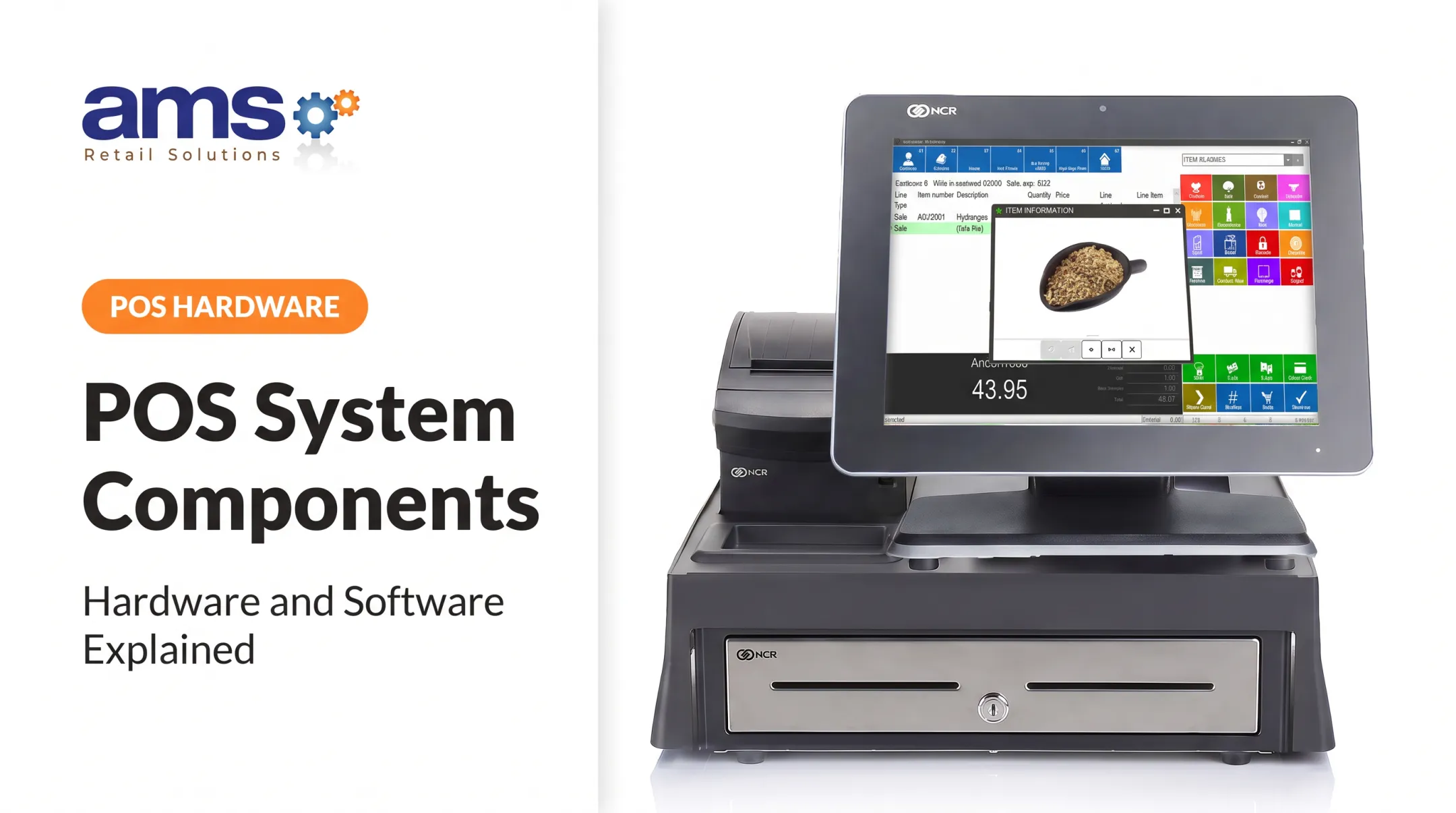
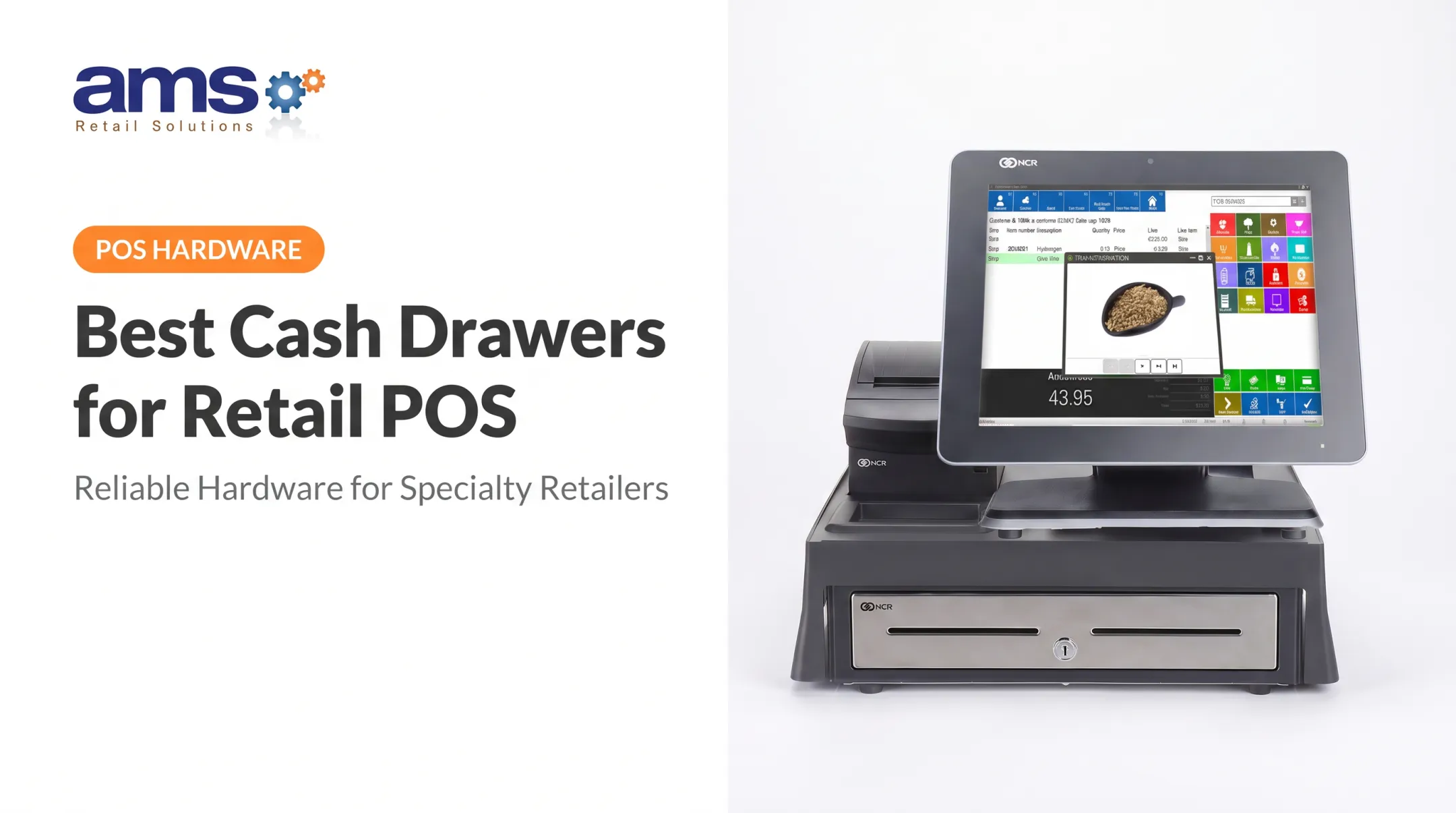
AMS Retail Solutions is a single-source POS provider for specialty retailers. It pairs Counterpoint software with retail-hardened POS equipment, such as touchscreen terminals, cash drawers and receipt printers, and it provides implementation, training and support.
It stands out for stores that want configurable tools and a partner-led rollout rather than a consumer checkout device. NCR Voyix's official material covers sporting goods and lawn and garden, real-time inventory across locations, label printing, physical counts and stores from 1 to 500 locations.
| Area | What to know |
|---|---|
| Specialty fit | Garden centers, farm markets, feed and seed, outdoor sporting goods and other specialty retailers; tools are customizable |
| Hardware and operations | Touchscreen terminal, receipt printer, cash drawer; AMS lists offline POS capability when the network is down. Ask for exact scanner, printer and display models |
| Cost and support | Pricing is quote-based. AMS advertises 24/7 support, one-on-one training, equipment repair and maintenance |
Ask AMS how offline card authorization works; the public product overview leaves those details unclear.
Clover POS Hardware
Clover is a modular ecosystem, from handhelds to countertop stations. Current advertised prices run from $349 (Compact) to $1,899 (Station Duo), with Mini at $849 and Flex at $749.
That range suits stores needing a fixed register plus mobile checkout. Watch the commercial terms: the direct retail offer cites a three-year contract, with monthly software at $84.95 on Standard.
| Area | What to know |
|---|---|
| Specialty fit | Fixed checkout, pop-ups and mobile sales |
| Hardware and operations | Zebra scanners work with Station and Mini; Flex receipt printing needs a Station or Mini. Offline acceptance lasts up to seven days, with authorization on reconnection and declined-payment risk on you |
| Cost and support | Card-present rates start at 2.3% + 10c; optional Clover Care adds three-year protection; live support is available, so confirm staffed hours with Clover |
Square for Retail Hardware
Square suits smaller stores that want quick setup. Hardware includes the Register ($899), Terminal ($299), Handheld ($399), Stand ($149) and Reader ($59). Plans run $0, $49 or $149 per location monthly, with no locked-in contracts.
| Area | What to know |
|---|---|
| Specialty fit | Supports variations, purchase orders, stock transfers and multi-location sync |
| Hardware and operations | Compatibility isn't universal; Star CD5 USB drawers don't work on Register. Offline sessions are limited to 24-72 hours depending on device |
| Cost and support | Card-present rates run 2.4% to 2.6% + 15c. Premium includes 24/7 priority support. Terms allow fund holds and reserves based on risk |
Advanced label workflows sit on Plus and Premium, and Terminal can't create labels.
Lightspeed Retail Hardware
Lightspeed X-Series fits complex catalogs and ecommerce. Each variant carries its own SKU, with up to three attributes and 200 combinations. Purchase orders, synchronized ecommerce stock and loyalty are included.
| Area | What to know |
|---|---|
| Specialty fit | Detailed catalogs, multi-outlet inventory, ecommerce sync |
| Hardware and operations | Windows, Mac and iPad setups with Socket or Zebra scanners, Epson printers and Star drawers. Offline payments on WisePOS E are in beta with eligibility limits |
| Cost and support | Plans run $89 to $289 monthly on annual billing; processing starts at 2.6% + 10c. Lightspeed Payments is generally required; renewal and termination terms apply. Lightspeed lists 24/7 phone and chat support |
Expect a steeper learning curve than simpler systems.
Shopify POS Hardware
Shopify POS makes sense if you sell online and in-store from shared inventory. Basic runs $39 monthly, and POS Pro adds $89 per location. Hardware includes the Tap & Chip reader ($49), POS Terminal ($349), Zebra DS2278 scanner ($299) and Epson printer ($289).
| Area | What to know |
|---|---|
| Specialty fit | Inventory sync across channels, pickup and exchanges (Pro features) |
| Hardware and operations | Offline card acceptance needs activation and compatible hardware; returns, exchanges and pickup fulfillment are unavailable offline |
| Cost and support | In-person rates start at 2.6% + 10c on Basic; confirm current support hours with Shopify before you buy |
Skip POS Go; it's discontinued.

How We Chose the Best POS Hardware
We compared whole ecosystems, not single terminals. Advertised price, screen size and brand familiarity are poor guides.
- Workflow coverage: scanning, variants, returns, purchase orders, stock counts, price changes, loyalty and multi-location management
- Durability: retail-hardened construction, warranty and replacement. Warranties vary: Square Register, two years; Zebra DS2208 scanner, 60 months
- Connectivity: wired and wireless options, offline transactions and what happens when a printer or payment device fails
- Security: PCI PTS approval alone doesn't establish PCI DSS compliance; ask whether a validated P2PE solution applies
- Total cost: hardware, subscriptions, processing, accessories, training, integrations, support and contract terms
No measured reliability ranking or universal lowest-cost winner exists. Verify current specs and pricing with each vendor.

Conclusion
The best POS hardware matches your products, selling environments, inventory processes, staffing and growth plans, not just the initial budget or a popular brand.
Before committing, test the whole workflow: scanning, payment, returns, stock updates, receipt and label printing, offline recovery and reporting.
If you run a US specialty retail store, AMS Retail Solutions can walk you through a configurable Counterpoint setup with retail-hardened equipment. Call 757.495.4995 to find the right fit.
Frequently Asked Questions
What hardware does a specialty retail store need for a POS system?
Most stores need a terminal, payment device, barcode scanner, cash drawer and receipt printer. Add a label printer, customer display, scale or mobile device based on your workflow.
Is retail-hardened POS hardware worth the investment?
Commercial-grade equipment supports continuous use and peripheral compatibility, which can mean less downtime. Compare warranty and replacement terms before buying.
Can a POS system work if the internet goes down?
It depends on the provider and payment setup. Confirm which transactions, inventory updates and syncing still work offline; accepting a card offline isn't the same as receiving approval.
Do specialty retail stores need barcode scanners and label printers?
Scanners speed checkout and improve stock accuracy, especially with many SKUs. Label printers help with product, shelf and price tags, but whether you need them depends on your merchandise.
What POS hardware is best for outdoor or seasonal retail operations?
Look for portable checkout, long battery life, reliable connectivity and payment flexibility. Verify documented dust or weather ratings, since few POS devices publish them, and plan offline procedures.
How should specialty retailers compare the total cost of POS hardware?
Add up equipment, software, processing, accessories, installation, training, support, warranties, replacements and contract terms. Device price alone is misleading.